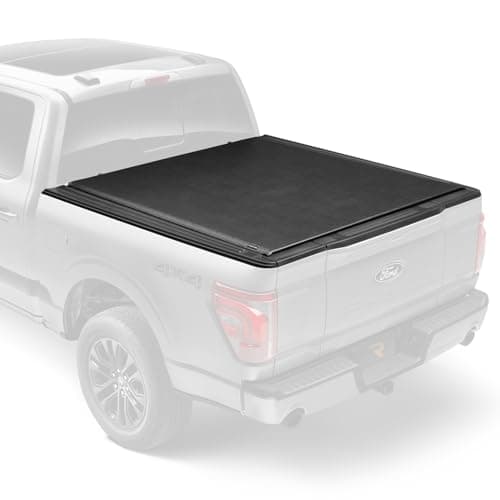
Featured here: the TruXedo TruXedo Lo Pro Soft Roll-Up — F-150 5'7" (2015-2026).
Heads up: we earn an Amazon commission when you buy through our links, at no extra cost to you. Prices are pulled live from Amazon and were last checked October 5, 2026; when we cannot verify a price we say so rather than print an old one. How this site is funded.
You will see “5-10% better fuel economy” attached to almost every tonneau cover sold. We are not going to repeat it as fact, because it is genuinely contested and the honest position is less convenient than either side of the argument.
Buy a cover for weather and privacy. If fuel economy is your only reason, the evidence does not support the purchase, and we would rather tell you that than sell you a figure we cannot stand behind.
Why the tests disagree
The underlying physics is not simple. An open pickup bed creates a recirculating vortex behind the cab, and whether covering it reduces drag depends on things that vary between trucks and between tests:
Tailgate position. Up, down, or replaced with a net — all three change the flow substantially, and tests have historically not been consistent about it.
Speed. Aerodynamic drag scales with the square of speed, so an effect measurable at 70 mph may be invisible in town.
Cover profile. A flush low-profile cover and a raised hard cover present different shapes to the air.
Truck shape. Cab height, bed length, bed depth and the gap between cab and bed all matter, and they differ by model.
Test methodology. Coast-down, dynamometer, track and on-road tests are not directly comparable, and the effect sizes being claimed are small enough that methodology dominates.
Results in the published and popular-press record have gone in both directions, which is the hallmark of an effect that is either small or strongly condition-dependent.
What is reasonably established
Aerodynamic drag matters a lot at highway speed and little in town. This is uncontroversial physics, and it means any cover effect is a highway-driving effect.
Weight matters more in stop-start driving than drag does. A hard cover adds meaningful weight, which works against it in exactly the conditions where drag does not help.
Load has a clearer effect than cover shape. Removing unnecessary weight from a truck has a better-established fuel economy effect than any cover does.
A ladder rack or a loaded bed has a larger aerodynamic effect than a cover. If you are optimizing for fuel economy and you run a rack, the rack is where to look.
Covers, bought for the right reasons
TruXedoSpec-verified
TruXedo Lo Pro Soft Roll-Up — F-150 5'7" (2015-2026)
A low-profile soft roll-up that sits almost flush with the rails. Roll-ups beat folders on one axis that matters daily: you get the entire bed clear in about ten seconds without wrestling panels.
Who should skip it. Vinyl is vinyl. It will not take a snow load, it will not take weight, and in ten years it will look its age in a way an aluminum panel will not.
Protection
7.4
Weather seal
8.0
Install
9.4
Durability
7.8
Value
8.4
What works
+Whole bed clear in seconds — no panels to stow
+Low profile looks tidier than a folding cover
+Cheaper than any hard cover
+No drilling
What does not
−No snow or weight capacity
−Vinyl ages, especially in strong sun
−Rolled bundle sits at the bulkhead and reduces bed length when open
$1,199.9913% off · Price as of October 5, 2026. #ad
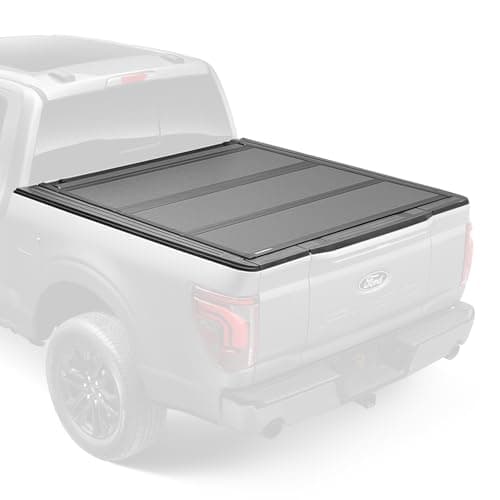
Aluminum panels, a matte finish that does not chalk, and it folds flat against the bulkhead so you can still carry tall cargo. For a truck that needs security most days and open-bed capacity some days, a hard tri-fold is the correct compromise and the MX4 is the one to buy.
Who should skip it. It is not a locking vault. The cover latches, but a determined thief gets through any folding panel cover. Valuable tools belong in a steel box under the cover, not loose beneath it.
Protection
9.2
Weather seal
8.8
Install
9.0
Durability
9.2
Value
7.4
What works
+Folds flat to the bulkhead — full bed height still available
+Aluminum panels shed snow load that a soft cover sags under
+Matte finish does not fade to gray the way gloss vinyl does
+Clamp-on install with no drilling
What does not
−Expensive relative to a soft tri-fold
−Latches deter, they do not secure
−Folded panels sit at the bulkhead and block the front third of the bed
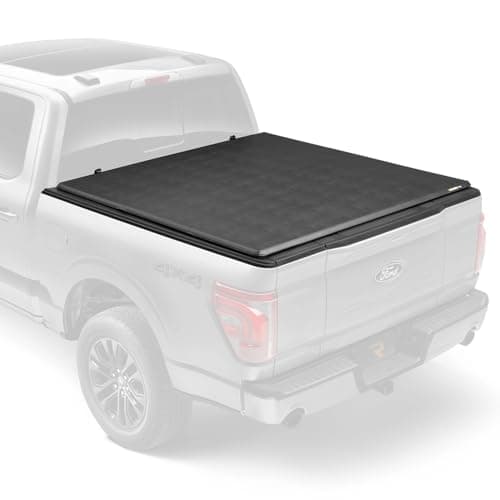
A soft tri-fold: it folds like a hard cover and costs like a soft one. It is the sensible middle of this category, and for most trucks it is the right amount of money to spend on a cover.
Who should skip it. It has the weaknesses of both formats — the panels are fabric over frame, so no load capacity, and the hinges are the first thing to wear.
Protection
7.8
Weather seal
8.0
Install
9.4
Durability
7.6
Value
8.6
What works
+Folds in sections rather than rolling into a bundle
Weather. Rain in an open bed ruins more on most trucks than theft does. This is the reason most people actually want one.
Privacy. An uncovered bed advertises its contents at every red light.
Appearance. A covered bed looks finished. It is a legitimate reason.
Keeping the bed clean. Leaves, snow, dust and rain all stop arriving.
None of those require a contested efficiency claim to justify, which is rather the point.
If you genuinely want to improve a truck's fuel economy
Take unnecessary weight out. The most reliable lever available, and free. A bed carrying three hundred pounds of things you do not need today is the cheapest fix on this list.
Check the tire pressures. Routinely, and against the door-jamb figure rather than the sidewall.
Remove a rack you are not using. If the rack comes off in twenty minutes and sits on for months unused, that is a real cost.
Drive it more gently at highway speed. Drag scales with the square of speed, which is the one place small behavior changes show up clearly.
Those four are better established than any cover claim and three of them are free. The Department of Energy's driving-habits guidance is linked below.
What we would say to a salesman
That the cover is worth buying for the weather, and that if the fuel economy figure were as reliable as the marketing suggests, the manufacturers would publish a test method alongside it. They generally do not, and in this category an unpublished method is the same kind of signal as an unpublished load rating.
Questions people actually ask
Does a tonneau cover improve gas mileage?
It is contested and we will not print the standard 5-10% figure as fact. Results in the record have gone in both directions, because the effect depends on speed, tailgate position, cover profile and truck shape. If fuel economy is your only reason to buy, the evidence does not support it.
Why do tonneau cover fuel economy tests disagree?
Because the effect being measured is small enough that methodology dominates. Tailgate position, speed, cover profile, truck shape and test type all change the result, and tests have not been consistent about them.
Does a tailgate net help fuel economy?
It is another version of the same contested question, and the same caveats apply. Tailgate position is one of the variables that makes cover tests disagree, which tells you the effect is condition-dependent rather than settled.
What actually improves a truck's fuel economy?
Taking unnecessary weight out of the bed, correct tire pressures, removing a rack you are not using, and easing off at highway speed where drag scales with the square of speed. All four are better established than any cover claim and three are free.
So should I buy a tonneau cover?
Yes, if you want weather protection, privacy or a tidier truck — all good reasons that need no contested figure to justify them. Not on the strength of the fuel economy claim alone.
Last reviewed October 5, 2026. Think a figure here is wrong? Tell us at contact@toolboxandtruck.com and we will check it, fix it and date the correction — see our editorial policy.