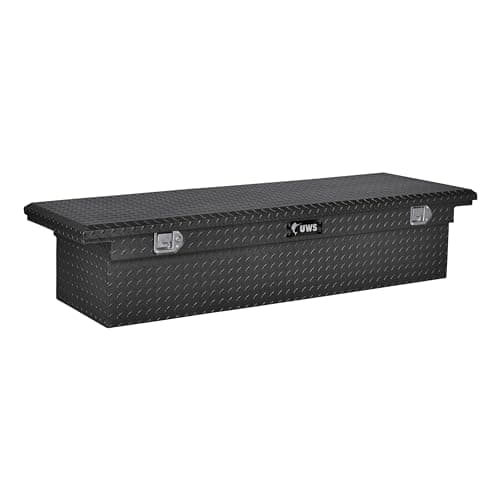
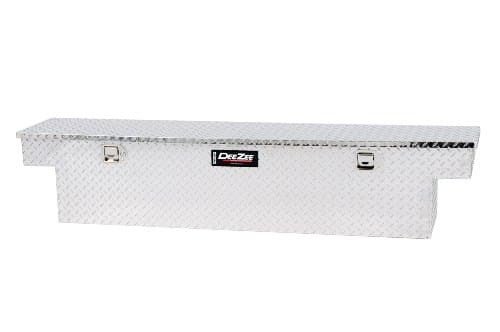
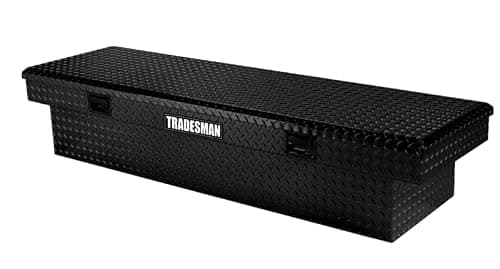
Our top pick: the UWS UWS EC10473 69-inch Heavy-Wall Aluminum Crossover.
Heads up: we earn an Amazon commission when you buy through our links, at no extra cost to you. Prices are pulled live from Amazon and were last checked October 5, 2026; when we cannot verify a price we say so rather than print an old one. How this site is funded.
How we know:Spec-verifiedOwner-report-verifiedWhat these mean
Tap any row for the full write-up. Prices come straight from Amazon and are never typed in by hand.
A crossover box sits across both bed rails behind the cab, the lid opens upward, and it is the format that roughly three quarters of work trucks end up running. It is the default for a reason: it locks properly, it does not need the bed floor, and it is the one shape every manufacturer builds in volume, so the product range is deep at every price.
What it costs you is bed length — typically 18 to 21 inches of floor in front of where your cargo now starts. On an 8-foot bed that is nothing. On a 5'5" bed it is a third of your usable length, and that is the single fact that should decide whether you are reading this page or the side-mount page.
Buy the UWS EC10473 if you intend to keep the truck. Buy the Better Built Crown if the budget is the constraint. Buy the JOBOX if the truck parks on the street with tools in it overnight.
How we ranked these
Five criteria, scored 0-10 and published per product so you can disagree with the weighting rather than with a black box. Every figure in the spec tables comes from the manufacturer's own listing, cited on each card; where the manufacturer does not publish a figure, the row says so instead of carrying an estimate.
Build. Wall thickness, lid construction and whether the extrusion holds its shape under load. This is the criterion that correlates with the box still being square in a decade.
Weather seal. Seal design and lid rigidity together, because a flexing lid is how a dry box starts leaking.
Security. Latch mechanism and lock points. A single center latch and a multi-point gear lock are not in the same category.
Bed usability. How much bed you lose and what else can still go in it. A narrow-body box scores high here even when it scores lower elsewhere.
Value. What you get for the live price, not against an abstract ideal.
The picks, ranked
Prices come straight from Amazon when you load the page. Where no live price is available the button says “check price” rather than showing you a number we cannot stand behind.
Heavy-wall aluminum, a foam-filled RigidCore lid that does not flex when you sit on it, and a low profile that still clears most rear glass. This is the crossover to buy if you intend to keep the truck.
Who should skip it. Skip it on a 5'5" short bed. At 69 inches it will sit on the rails, but you lose a disproportionate share of a short bed and the money is better spent on a side-mount pair.
Build
9.4
Weather seal
8.8
Security
8.6
Bed usability
8.0
Value
7.4
What works
+Foam-filled lid does not oil-can under body weight
+Low profile clears rear glass on most full-size crew cabs
+Heavy-wall extrusion survives being used as a step
+Gas struts are serviceable rather than sealed units
What does not
−Among the most expensive aluminum crossovers on the shelf
−69 in is a full-size length — not a mid-size answer
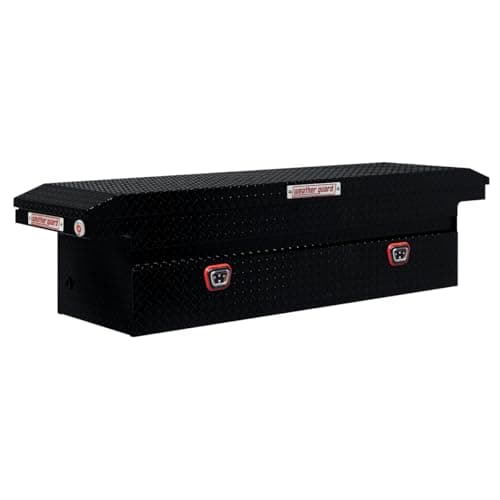
11.0 cu ft of aluminum in the low-profile saddle format that fleets have standardized on for decades. It is the box every other box gets compared with, and the reason is parts availability and a lid that stays sealed.
Who should skip it. It is the most expensive way to store tools in a pickup bed short of a drawer system. If this is a personal truck that sees a job every other weekend, the money is better spent elsewhere.
Build
9.6
Weather seal
9.4
Security
8.8
Bed usability
8.2
Value
6.8
What works
+11.0 cu ft published — not an estimate
+Weather Guard latch and seal hardware is available decades out
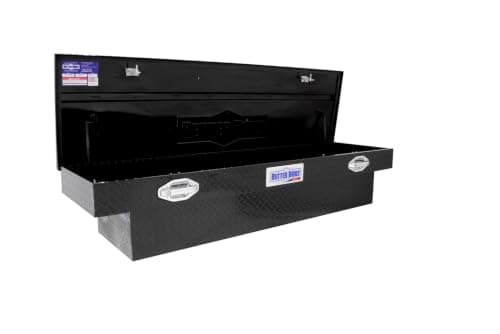
A 70 x 19 x 14 in gloss black aluminum single-lid box at a price the premium brands do not touch. You give up some lid rigidity; you keep most of the useful volume.
Who should skip it. Not the one if you plan to stand on the lid daily — the panel is thinner than UWS's foam-filled RigidCore and will flex. Buy the UWS or a saddle box instead.
Build
8.0
Weather seal
7.8
Security
7.6
Bed usability
8.2
Value
9.2
What works
+Full 19 in of depth — a framing square lies flat
+Gloss finish wipes clean; dust does not show the way matte does
+Priced well below the premium aluminum boxes
What does not
−Lid flexes under weight compared with foam-filled designs
−14 in height can crowd rear glass on lowered or small-cab trucks
−Latch hardware is the first thing owners report replacing
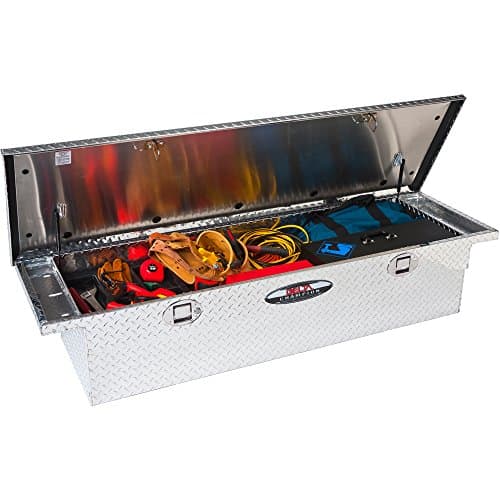
JOBOX's Gear-Lock drives multiple lock points from one key turn, which is the single biggest difference between a box a thief opens with a screwdriver and one he walks away from. The rest of the box is honest fleet-grade aluminum.
Who should skip it. It costs premium money and spends it on the latch rather than the lid. If your box lives behind a locked gate every night, you are paying for security you do not need.
Build
9.0
Weather seal
8.6
Security
9.6
Bed usability
8.0
Value
7.0
What works
+Multi-point locking is genuinely harder to defeat than a single center latch
+Fleet-grade build with parts availability years out
+Low profile preserves rear visibility
What does not
−Expensive
−Heavier than a comparable thin-wall box — two people to lift it on
−Gear-Lock hardware is the part to keep lubricated through winter
The narrow-body crossover. It eats noticeably less fore-aft bed length than a standard 19-20 in box, which is the whole point on a 5'5" or 5'7" bed where every inch in front of the wheel wells matters.
Who should skip it. If you carry long power tools in cases, the narrow body will fight you. A 19 in box swallows a circular saw case flat; this one does not.
Build
7.6
Weather seal
7.4
Security
7.2
Bed usability
9.2
Value
8.8
What works
+Gives back several inches of bed floor versus a standard-width box
+Light enough for a one-person install
+Cheapest route into a real aluminum crossover
What does not
−Narrow interior will not take large tool cases flat
−Thinner material than the heavy-wall boxes
−Published dimensions vary by listing — measure before you order
A 70 in slimline cross-bed box with a low enough crown that a folding tonneau will usually close over it. If you want both a cover and a box and refuse to cut either, start here.
Who should skip it. Slim means slim. If a cover is not in the plan, you are paying for a constraint you do not have — buy a deeper box.
Build
7.8
Weather seal
7.6
Security
7.4
Bed usability
9.0
Value
8.4
What works
+Low crown clears most tri-fold and hard folding covers
+Full 70 in of box length across the rails
+Black finish matches factory bed rail caps
What does not
−Shallow interior — not for bulky cases
−Cover clearance still has to be verified against your specific cover
−The lid is unremarkable; it is a storage box, not a step
Retractable covers with a canister at the bulkhead
The lid is the product
If you only evaluate one thing about a crossover box, evaluate the lid. A single-skin aluminum lid is a large flat panel with a latch in the middle of it, and large flat panels flex. You will sit on it to lace a boot, you will stand on it to reach a rack, and eventually you will drop something on it. Each of those events is fine. The cumulative effect of them is that the lid no longer sits flat against its own seal.
That is the mechanism behind the single most common complaint about tool boxes: the box was dry for two years and then it was not. Nothing broke. The lid simply stopped meeting the seal along its length.
A cored lid — UWS calls it RigidCore, other manufacturers use their own construction and their own name — is stiff across its span and does not develop that problem. You can feel the difference by pressing down on the center of a lid in a store: one deflects visibly and the other does not. If you are buying unseen, the proxy is whether the manufacturer talks about lid construction at all. Silence on the subject is informative.
Security: what actually fails
The failure owners describe is almost never a cut lid. It is a pry bar in the gap at the center of the lid, levering until the latch rod bends or the striker tears out of the thin skin. A box with lock points at both ends of the lid does not open that way, because there is nothing to lever against at the point of maximum leverage.
Latch type
How it is defeated
Where it is appropriate
Single center latch
Pry bar at the center of the lid
Behind a locked gate, or a box holding nothing valuable
Dual latch
Both latches, independently
Most work trucks, most of the time
Multi-point gear lock
Not easily — several points from one turn
Street-parked trucks carrying tools overnight
Padlock hasp
Usually by tearing the hasp out of the lid skin
Supplementary only, never the primary lock
The practical measures that do more than hardware — where you park, what comes out of the box at night, marking tools so they are worth less to resell — are in truck tool box security.
Fitment: the measurement to take before you order
Measure the exterior bed rail width: outside edge to outside edge, across the top of the rails, at the point nearest the cab. That is the widest exterior point of the bed and it is where the box's ends will land. Keep the tape taut — a sagging tape over six feet is easily an inch out.
Do not try to match that number to the box's advertised length. A crossover box's ends overhang the rails, so a “69-inch” box is sold for trucks whose exterior rail width is in the mid sixties. UWS publishes roughly 65 in for an F-150, 64 in for a Silverado 1500, 66 in for a Ram 1500 and 57 in for a Tacoma. Take your measurement, then check the manufacturer's fitment chart.
Measure the exterior rail width. Outside to outside, across the top, nearest the cab.
Confirm at least 1.5 in of box will rest on each rail. That is the mounting requirement, and it is what the fitment charts are built around.
Account for liners and rail caps. A bonded rail cap changes the surface the box lands on and the lip a clamp has to grip.
Check the rear glass. Close an imaginary lid at the box's stated height and look at the clearance. A 14 in box on a lowered truck can touch.
Decide about the cover now. If a tonneau cover is in the plan, you need a slimline box or a notched cover. Working that out afterwards is how people end up with two covers.
Every box on this page is a full-size box. A mid-size truck's exterior rail width is around 57 inches against the mid sixties on a half-ton, and that seven-to-nine-inch gap means a full-size box has nowhere to land. If you drive a Tacoma, Colorado, Canyon, Ranger or Frontier, go to the Tacoma tool box page for the correct size class.
Installation, and why you should not drill
A crossover box does not need holes in your truck. J-hook and clamp kits grip the underside of the bed rail lip and hold the box firmly, and the entire assembly comes off in under half an hour when you sell the truck. Drilling a bed rail introduces a sealed hole that will eventually not be sealed, which on a steel bed is where rust starts.
On a full-size work truck we expect to keep for a decade: the UWS. The lid construction is the part that matters and it is the part UWS spends its money on. On a truck where the budget has to cover a box, a cover and a rack: the Better Built Crown, accepting that the lid flexes and the latch may need replacing. On a fleet truck where the box has to be opened ten thousand times and parts have to exist in 2036: the Weather Guard saddle box, and nothing else comes close on parts availability.
And if you are running a short bed and the twenty inches matter: do not buy a crossover at all. Buy a side-mount pair and keep the floor.
Questions people actually ask
What size crossover tool box fits a full-size truck?
69 in and 72 in are the two standard sizes and both suit most full-size half-ton beds, but confirm it by measuring your exterior bed rail width — outside to outside across the top of the rails, nearest the cab — and checking that figure against the manufacturer's fitment chart. Do not match the measurement to the box length; the box ends overhang the rails. The measuring procedure.
How much bed space does a crossover box take?
Typically 18 to 21 inches of bed floor length, measured from the bulkhead back. On an 8 ft bed that is a minor cost; on a 5'5" bed it is roughly a third of your usable floor, which is the point at which a side-mount box becomes the better answer.
Is a single lid or a gull wing better?
A single lid is simpler, cheaper and seals along one perimeter. Gull wing lids give you access from whichever side you are standing on, which matters if the truck is often parked against a wall or a curb, and they are the better answer on a wide bed where reaching across a single lid is awkward. Single lid is the sensible default.
Can I stand on a crossover tool box lid?
On a cored or foam-filled lid, yes, routinely — that is part of why the construction exists. On a single-skin lid you can, but each time contributes to the panel losing its flatness, which is the mechanism behind a box that was dry and then was not. Where a manufacturer publishes a lid load rating we print it; most do not.
Do I need to drill my truck to fit a crossover box?
Usually not. J-hook and clamp kits grip the bed rail lip and hold the box without any holes, and the box comes off cleanly at resale. The exception is a truck with bonded rail caps that leave nothing to clamp onto. Step-by-step.
Will a crossover box fit under a tonneau cover?
Only a slimline or low-profile one, and only with the right cover. A standard 14 in box needs a cover specifically notched for a tool box. Retractable covers with a bulkhead canister are the hardest combination. Clearances and combinations.
Last reviewed October 5, 2026. Think a figure here is wrong? Tell us at contact@toolboxandtruck.com and we will check it, fix it and date the correction — see our editorial policy.