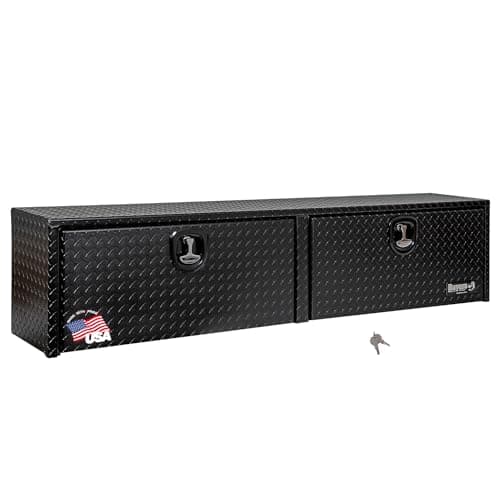
Our top pick: the Buyers Products Buyers Products 1721551 Aluminum Topsider, 72 x 13 x 16 in.
Heads up: we earn an Amazon commission when you buy through our links, at no extra cost to you. Prices are pulled live from Amazon and were last checked October 5, 2026; when we cannot verify a price we say so rather than print an old one. How this site is funded.
How we know:Spec-verifiedOwner-report-verifiedWhat these mean
Quick picks — Side mount tool boxes
#
Product
Best for
Material
Price
1
Buyers Products 1721551 Aluminum Topsider, 72 x 13 x 16 in
Tap any row for the full write-up. Prices come straight from Amazon and are never typed in by hand.
A side-mount box — sometimes called a topsider — runs lengthwise along one bed rail instead of across both. The entire bed floor stays clear. For anyone who regularly carries sheet goods, a pallet, bagged material or anything that has to sit flat, that is not a minor advantage; it is the difference between the truck working and the truck not working.
What you pay for it is specific and worth stating plainly before the picks: you lose the rail, which means you lose any realistic chance of a tonneau cover on that side, and usually a bed rack as well. If a cover is non-negotiable, close this page and go to the crossover roundup.
The Buyers Products 72-inch topsider is the right answer for a full-size work truck that never runs a cover. If the bed is short, the Northern Tool 48-inch is the length that actually fits.
How we ranked these
Same five criteria as the rest of the tool box section, with one weighting change: bed usability counts for more here, because preserving the floor is the entire reason this format exists.
Build. Wall thickness and whether the long span of a side box sags under a loaded lid.
Weather seal. A long lid has a long seal, and that is harder to keep flat than a short one.
Security. Latch quality and lock points.
Bed usability. Scored high across this whole category by definition, and used to separate the boxes that also preserve rail access from those that do not.
Value. Against the live Amazon price, including whether a pair is cheaper than two singles.
The picks, ranked
No. 1Buyers ProductsSpec-verified
Buyers Products 1721551 Aluminum Topsider, 72 x 13 x 16 in
A 72 x 13 x 16 in aluminum topsider that bolts along the bed rail and leaves the floor completely clear. For anyone who hauls sheet goods or a pallet, this is the right shape of tool box and a crossover is the wrong one.
Who should skip it. It consumes rail space, so a tonneau cover and a bed rack both get complicated. If a cover is non-negotiable, go crossover and give up the floor instead.
Build
9.0
Weather seal
8.4
Security
8.2
Bed usability
9.6
Value
7.6
What works
+Bed floor stays completely usable
+Long and shallow suits hand tools and cordless kits better than a deep well
+Buyers parts and latches are stocked everywhere
What does not
−Requires drilling the bed rail on most trucks
−Blocks a tonneau cover and most bed racks
−One box covers one side only — pairs get expensive
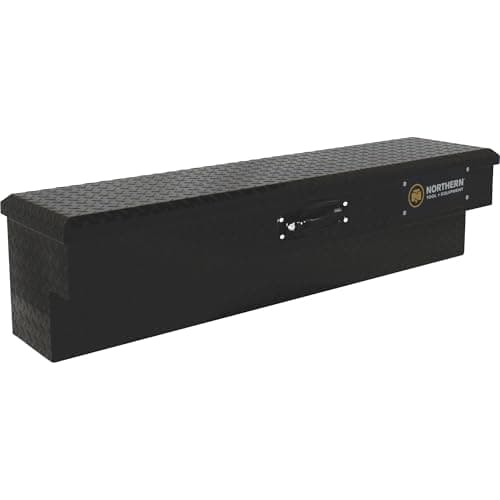
48 x 11.5 x 11 in is the size that actually fits a 5'5" or 5'7" bed rail without crowding the wheel well. Small, honest, and the right answer where a 72 in topsider will not go.
Who should skip it. 11 in of depth is a hand-tool box, not a power-tool box. If cordless kits in cases are the cargo, you want a crossover.
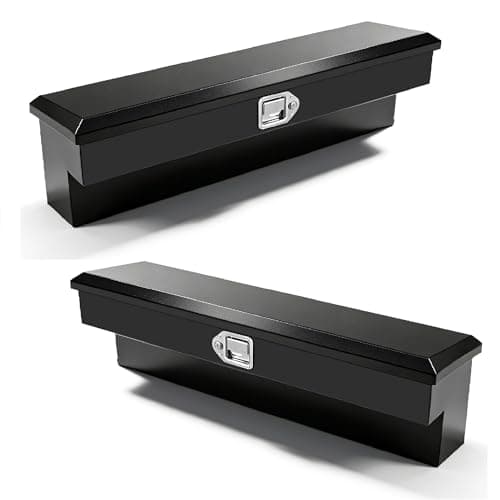
Two 48.8 x 13.4 x 12.7 in steel side boxes in one order. Running both rails is how a working bed gets organized — hand tools on the driver side, consumables on the passenger side — and buying the pair is cheaper than two singles.
Who should skip it. Steel means weight and it means rust at every drilled hole. If the truck lives in road salt, pay up for aluminum.
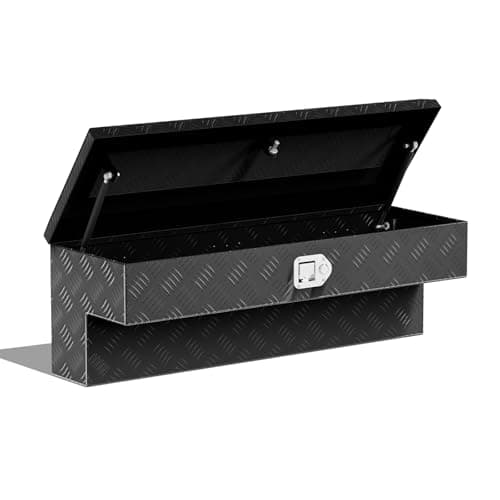
36 x 12 x 12 in of lockable aluminum for the price of a decent cordless battery. It is not a fleet box and does not pretend to be, but on a second truck or a trailer it does the job.
Who should skip it. Thin-wall aluminum and a budget latch. If the box holds anything you cannot replace in an afternoon, buy up.
Build
6.4
Weather seal
6.2
Security
6.0
Bed usability
9.0
Value
9.0
What works
+Cheap enough to buy two
+Aluminum does not rust at the mount holes
+Short enough for a mid-size rail
What does not
−Thin wall dents easily
−Budget latch is the weak point for security
−The seal is adequate, not good — expect damp in a downpour
Unlike a crossover, a side box is measured along the rail. That changes the measurement you need: you want the length of straight, uninterrupted rail between the bulkhead and the point where the bed narrows or the tailgate hinge hardware begins.
Measure the straight rail run. From the bulkhead rearward, stop where the rail curves or where hardware intrudes.
Check the wheel-well intrusion. A tall side box can foul the wheel-well arch on some beds. Look at the inner profile, not just the rail top.
Confirm the lid swing. A side box lid opens outward and upward. On a tight driveway or a narrow site road, check it clears the fence.
Decide about both sides. Two boxes is the setup most trades end up with — hand tools one side, consumables the other — and buying a pair is usually cheaper than two singles.
Shallow is a feature, not a compromise
Side boxes are shallow — 11 to 16 inches of depth is typical. People read that as a limitation and it is, for cased power tools. For everything else it is better than a deep box. A deep well means the thing you want is always at the bottom; a long shallow box means everything is visible and reachable in one layer.
The practical split that works: side boxes for hand tools, fasteners, consumables, straps and anything you reach for ten times a day. A separate chest or drawer unit for cased power tools. One box does not do both jobs well, and trying to make it do so is how people end up digging.
Steel or aluminum on a side box
This matters more here than on a crossover, for a reason specific to the format: side boxes have more mounting holes, in a part of the truck that gets hit by spray from the rear wheel. Every one of those holes is a place where a steel box starts rusting from the inside.
On a full-size truck that genuinely never gets a cover: one Buyers 72-inch topsider on the driver's side, and leave the passenger rail free for a bed rack. That combination keeps the floor, keeps the ability to carry long material, and gives you a fleet-grade box with parts you can still buy in ten years.
On a short bed: the 48-inch Northern Tool box, which is the length that actually fits a 5'5" rail without crowding the wheel well. On a second truck, a trailer or a tractor: the cheapest lockable aluminum box you can find, because the contents are straps and chain rather than anything you would mind losing.
Questions people actually ask
Can you run a tonneau cover with a side mount tool box?
Realistically no. A side box occupies the rail the cover's clamp rail needs, and the box's lid swings up through the space the cover occupies. If a cover matters, a crossover box is the format that coexists with one — and even then only a slimline box under a tri-fold. Cover and box combinations.
Do side mount boxes require drilling?
Almost always, yes. There is no clamp system that will hold a 72 in box full of hand tools on a bed rail. On a steel bed, seal every hole properly — an unsealed drilled hole rusts from the inside, where you will not see it until the rail is soft.
What length side mount box fits a short bed?
Measure the straight uninterrupted rail run from the bulkhead rearward, and buy shorter than that. On a 5'5" or 5'7" bed a 48 in box is usually the longest that fits without crowding the wheel well, which is why that size exists.
Are two side boxes better than one crossover?
For anyone hauling flat loads, yes — you keep the entire bed floor and you get hand tools on one side and consumables on the other, which is a genuinely better organization than one deep well. You give up the cover and most bed racks to get it.
How deep are side mount tool boxes?
Typically 11 to 16 inches, and that shallowness is the format's real strength: everything sits in one visible layer instead of in a pit. Cased power tools are the thing that will not fit, which is why side boxes pair well with a separate chest or drawer unit.
Last reviewed October 5, 2026. Think a figure here is wrong? Tell us at contact@toolboxandtruck.com and we will check it, fix it and date the correction — see our editorial policy.