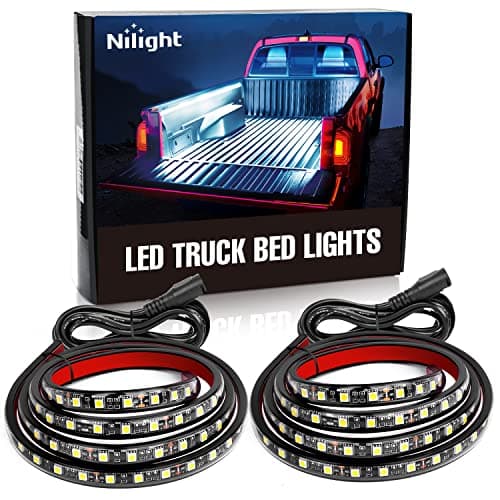
Our top pick: the Nilight Nilight TR-05 60-inch Bed Strip Kit, 2 x 180 LED.
Heads up: we earn an Amazon commission when you buy through our links, at no extra cost to you. Prices are pulled live from Amazon and were last checked October 5, 2026; when we cannot verify a price we say so rather than print an old one. How this site is funded.
Tap any row for the full write-up. Prices come straight from Amazon and are never typed in by hand.
Anyone who has gone looking for a specific wrench in a dark bed at five in the morning already knows why this page exists. A truck bed is a black hole after sunset, the factory cargo lamp is a token gesture on most trucks, and the fix costs less than a tank of fuel.
The trade is honest and worth stating: a wired kit is a wiring job. A fused feed, a switch you can reach, a route that does not chafe, and a couple of hours. If you will not do that, a rechargeable magnetic light is a legitimate second-best, and it will be flat on the morning you need it most.
Buy a complete wired strip kit — one that includes the fuse and the switch rather than selling them separately. Two 60-inch strips is right for a short bed; add a third across the bulkhead on a long one.
How we ranked these
Build. Sealing of the strip or pod, and the quality of the supplied wiring rather than the LED count.
Capacity. Coverage — whether the kit actually lights the whole bed, including the bulkhead corner where the shadow sits.
Install. What is in the box. A kit with the fuse, switch and splitter included is a different purchase from a bare strip.
Day-to-day access. Switch placement, and whether you can turn it on without opening the driver's door.
Value. Against the live price. Everything here is cheap; the question is what you get for it.
Two 60 in strips, 180 LEDs, with a waterproof switch, blade fuse and a two-way splitter in the box. It is a complete hard-wired kit rather than a strip and a prayer, which is why this is the one to buy.
Who should skip it. It is a wiring job. If you are not comfortable running a fused feed and finding a switch location, buy a rechargeable magnetic light instead.
Build
8.0
Capacity
8.4
Install
7.0
Day-to-day access
9.4
Value
9.4
What works
+Complete kit — fuse and switch included, not sold separately
+Two strips light both sides properly
+Stated warranty, which most strip kits do not carry
What does not
−Requires wiring into the truck
−Adhesive mounting needs a clean, dry surface to last
−Strip LEDs are directional — aim matters more than brightness
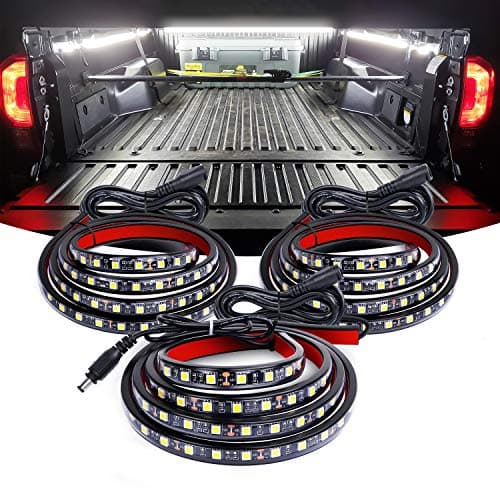
Three 60 in strips and 270 LEDs — the third strip goes across the bulkhead, which is exactly where the shadow sits when you only run two side strips. On an 8 ft bed it is the right kit.
Who should skip it. Overkill on a 5'5" bed. Two strips will light it and you will have one spare you never fit.
Build
7.6
Capacity
9.0
Install
6.6
Day-to-day access
9.2
Value
9.2
What works
+Third strip kills the bulkhead shadow
+More total output than the two-strip kit
+Still inexpensive
What does not
−More wiring runs
−Switch and fuse specification not stated in the listing
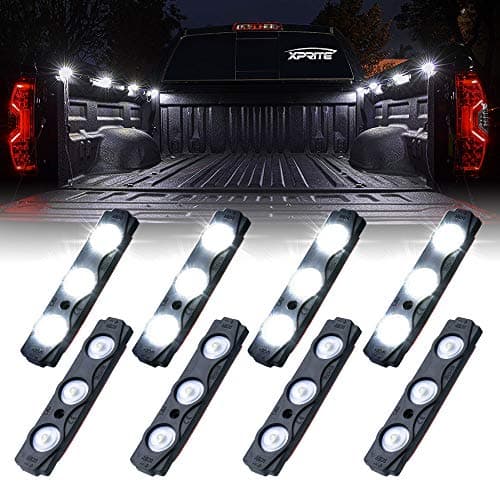
Eight small 24-LED pods instead of continuous strips. Pods throw light where you point them, which beats a strip for lighting into a tool box or down behind a wheel well.
Who should skip it. Eight pods is eight mounting points and eight wiring runs. If you want lighting fitted in an hour, buy strips.
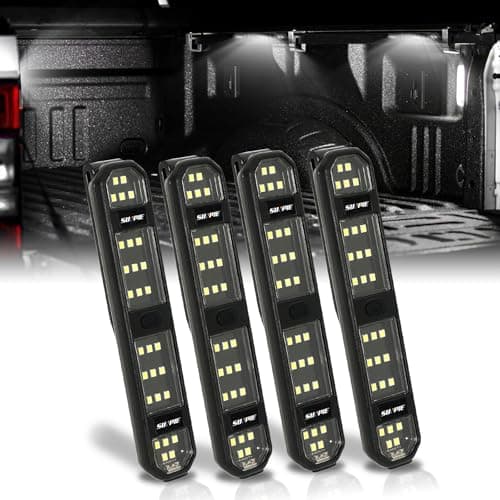
Rechargeable magnetic lights that stick where you need them and come off when you do not. Zero wiring, which makes this the right answer for a leased truck or anyone who refuses to cut into a harness.
Who should skip it. Batteries run down, usually on the night you need them. If the truck works after dark every day, wire a proper kit.
For general bed lighting, strips win. For lighting into a deep box or down behind a wheel well, pods win because you can aim them. The setup that actually works on a busy work truck is strips along the rails plus one pod aimed into wherever the tool box lives.
What “complete kit” means, and why it matters
The cheapest listings in this category are a strip and two wires. The ones worth buying include the parts that make it a circuit you can trust:
An inline fuse. Non-negotiable. An unfused accessory feed in a truck is a fire waiting for a chafed wire.
A waterproof switch. It will live somewhere that gets wet. A dry-rated switch in a wet location fails in a season.
A splitter and extension. Two strips need a splitter, and the supplied leads are never quite long enough on a long bed.
A stated warranty. Rare in this category, and a reasonable proxy for whether the seller expects the product to last.
Mounting a strip so it lasts
The adhesive on an LED strip is the part that fails, and it fails for predictable reasons. Three things make the difference between a strip that lasts five years and one that is hanging off by spring:
Clean properly. Isopropyl alcohol on the mounting surface, dry completely. A bed rail underside has road film on it even when it looks clean.
Mount warm. Adhesive cures badly below about 50F. Do this in a garage or on a warm afternoon.
Add mechanical retention. A few small clips or a bead of sealant at each end. The adhesive holds the middle; the ends are where peel starts.
Aim matters more than brightness. A strip pointed straight down lights the bed floor and dazzles you; angled slightly inward and downward it lights the cargo. Dry-fit and look before you commit the adhesive.
What we would actually buy
On a short bed: the two-strip complete kit with the fuse and waterproof switch in the box. On a 6'6" or 8 ft bed: the three-strip version, with the third across the bulkhead where the shadow otherwise sits.
On a leased truck, or if you genuinely will not wire anything: rechargeable magnetic lights, accepting the flat-battery failure mode and the fact that they only grip steel. Keep one in the cab and one in the bed.
Questions people actually ask
Should truck bed lights run off the ignition or the battery?
A battery feed with a fuse and a positive switch is what suits a work truck, because you want the lights with the engine off — which is most of when you need them. The risk is forgetting to switch them off; a switch with a pilot light solves that. An ignition-switched feed cannot drain the battery and also cannot light the bed while you load it.
How many LED strips do I need for a truck bed?
Two 60 in strips, one along each bed side, light a 5.5 ft or 6.5 ft bed properly. On an 8 ft bed add a third across the bulkhead, because that is where the shadow sits when you only run side strips.
Why does my LED strip keep coming unstuck?
Three usual causes: the surface was not cleaned with isopropyl alcohol before mounting, it was fitted below about 50F so the adhesive never cured properly, or there is no mechanical retention at the ends where peel starts. All three are preventable at install.
Are magnetic rechargeable bed lights any good?
As a no-wiring option, yes — and they also work under a hood or in a trailer. Two real limitations: they need bare steel to grip, so an aluminum-bodied bed gives them nothing, and they will be flat on the morning you most need them. For a truck that works after dark every day, wire a proper kit.
Do I need a fuse for truck bed lights?
Yes, always, and this is the one item in this category that is not a matter of preference. An unfused accessory feed in a vehicle is a fire risk the moment a wire chafes. Buy a kit that includes an inline fuse rather than adding the lights to a circuit that is already loaded.
Last reviewed October 5, 2026. Think a figure here is wrong? Tell us at contact@toolboxandtruck.com and we will check it, fix it and date the correction — see our editorial policy.