Work truck gear, ranked for the people who load it every morning.
Guides
How to measure a truck bed for a tool box
Four measurements, four minutes, and it is the difference between a box that mounts and a freight return. The first one is the one everybody gets wrong.
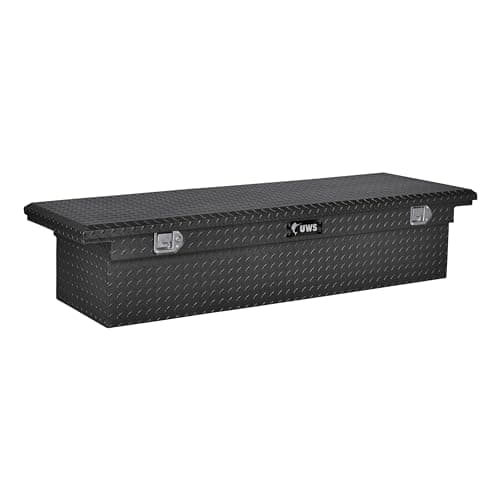
Featured here: the UWS UWS EC10473 69-inch Heavy-Wall Aluminum Crossover.
Heads up: we earn an Amazon commission when you buy through our links, at no extra cost to you. Prices are pulled live from Amazon and were last checked October 5, 2026; when we cannot verify a price we say so rather than print an old one. How this site is funded.
How we know:Spec-verifiedOwner-report-verifiedWhat these mean
Returning a tool box is miserable. It is bulky, the freight is not cheap, and the usual reason is a measurement that was either not taken or taken in the wrong place. Four minutes with a tape measure prevents nearly all of it.
The measurement that matters is the EXTERIOR bed rail width — outside edge to outside edge across the top of the rails, at the point nearest the cab. Not the bed length, not the interior width.
The four measurements, in order
Exterior bed rail width. Outside edge of one rail to outside edge of the other, across the top, at the point nearest the cab. This is the widest exterior point of the bed and it is where a crossover box's ends land.
Interior wheel well width. The narrowest interior point, between the wheel wells. This decides chests, drawer modules and bed slides.
Vertical bed depth. From the top lip of the rail down to the bed floor.
Rear glass clearance. From the rail top up to the bottom of the rear window, allowing for the box height and the lid opening.
Why the box is longer than your bed is wide
This is the single most common confusion in the category. A crossover box's advertised length includes its end caps, which overhang the bed rails rather than sitting between them. The mounting requirement is that at least 1.5 inches of box rests on each rail.
So a “69-inch” box goes on a truck whose exterior rail width is in the mid sixties. UWS publishes those widths as roughly 65 in for an F-150, 64 in for a Silverado 1500, 66 in for a Ram 1500 and 57 in for a Tacoma — which is exactly why a 69-inch box does not fit a Tacoma.
Published figures for the four trucks this site covers. Full chart with sources: /trucks/bed-dimensions-chart
Truck
Exterior rail width
Wheel well width
Box size class
Ford F-150
about 65 in
50.6 in
Full size (69/72 in)
Chevy Silverado 1500
about 64 in
50.63 in
Full size (69/72 in)
Ram 1500
about 66 in
51.0 in
Full size (69/72 in)
Toyota Tacoma
about 57 in
44.7 in
Mid size (60 in)
Do not match your measurement to the box length. Take the measurement, then check the manufacturer's fitment chart.
The five mistakes that cause returns
Measuring the interior instead of the exterior. The most common error by a wide margin, and it leads you to a box that is far too small.
Measuring at the tailgate instead of at the cab. The bed is widest at the bulkhead. Measure there.
Measuring a bare bed and ordering for a lined one. A bonded rail cap changes what the box lands on and what a clamp can grip.
Forgetting the rear glass. A 14 inch box plus a lid opening on a lowered truck can touch, and you only find out once it is mounted.
Not deciding about a cover. If a tonneau cover is in the plan, the box has to be a slimline one or the cover a notched one. Combinations.
Heavy-wall aluminum, a foam-filled RigidCore lid that does not flex when you sit on it, and a low profile that still clears most rear glass. This is the crossover to buy if you intend to keep the truck.
Who should skip it. Skip it on a 5'5" short bed. At 69 inches it will sit on the rails, but you lose a disproportionate share of a short bed and the money is better spent on a side-mount pair.
Build
9.4
Weather seal
8.8
Security
8.6
Bed usability
8.0
Value
7.4
What works
+Foam-filled lid does not oil-can under body weight
+Low profile clears rear glass on most full-size crew cabs
+Heavy-wall extrusion survives being used as a step
+Gas struts are serviceable rather than sealed units
What does not
−Among the most expensive aluminum crossovers on the shelf
−69 in is a full-size length — not a mid-size answer
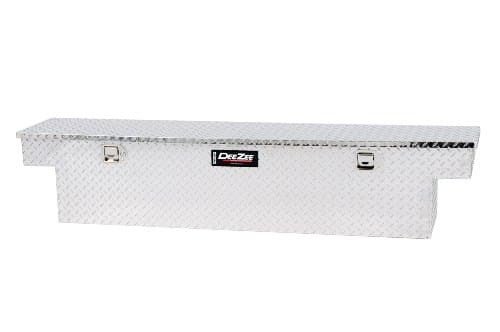
The narrow-body crossover. It eats noticeably less fore-aft bed length than a standard 19-20 in box, which is the whole point on a 5'5" or 5'7" bed where every inch in front of the wheel wells matters.
Who should skip it. If you carry long power tools in cases, the narrow body will fight you. A 19 in box swallows a circular saw case flat; this one does not.
Build
7.6
Weather seal
7.4
Security
7.2
Bed usability
9.2
Value
8.8
What works
+Gives back several inches of bed floor versus a standard-width box
+Light enough for a one-person install
+Cheapest route into a real aluminum crossover
What does not
−Narrow interior will not take large tool cases flat
−Thinner material than the heavy-wall boxes
−Published dimensions vary by listing — measure before you order
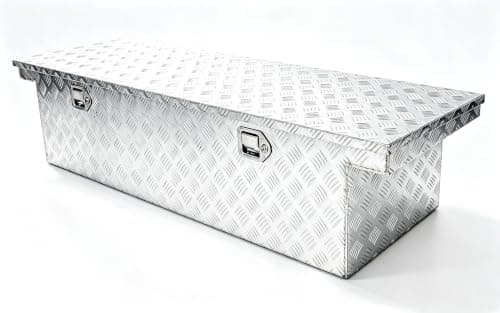
60 inches, which is the size class that matters: a mid-size truck's exterior rail width is around 57 in, and the 69 and 72 in boxes everyone else sells are built for the mid sixties. This one is not.
Who should skip it. Budget aluminum with a budget latch. It solves the fitment problem, not the security problem.
Tacoma, Colorado, Canyon, Ranger and Frontier — verify your exterior rail width first (a Tacoma is about 57 in)
✗ Does not fit
Full-size trucks (you are leaving volume on the table)
Secure storage of high-value tools
Measuring for a side-mount box instead
Different measurement. A side box runs along the rail, so you need the length of straight, uninterrupted rail between the bulkhead and the point where the rail curves or hardware intrudes. Also check the lid swings clear of a fence or a wall where you park.
Measuring for a chest or a drawer unit
The wheel well width is the governing figure, and measure it with whatever liner is actually in the bed. A drop-in liner costs you most of an inch on each side, which is enough to stop a 48-inch slide going in — and on a Tacoma at 44.7 inches, a 48-inch slide was never going in anyway.
Write it down
All four numbers, on your phone, now. You will need them again for a cover, a bed rack, a liner and a mat, and taking them once is the difference between buying confidently and guessing four more times.
Questions people actually ask
How do I measure my truck bed for a tool box?
Measure the exterior bed rail width: outside edge to outside edge, across the top of the rails, at the point nearest the cab, with the tape taut. That is the figure crossover tool box fitment is built around. Then check it against the manufacturer's fitment chart.
Why is the tool box longer than my bed is wide?
Because the box's end caps overhang the rails rather than sitting between them, and the mounting requirement is at least 1.5 inches of box resting on each rail. A 69 in box on a 65 in rail width is correct, not a mistake.
Do I measure the inside or the outside of the bed rails?
The outside, across the top of the rails, nearest the cab. Measuring the interior is the single most common error in this whole category and it leads you to a box that is far too small.
What measurement do I need for a bed slide or a drawer unit?
The interior width between the wheel wells, at the narrowest point, with whatever liner is actually in the bed. A standard 48 in slide needs this comfortably above 48 — which is why a Tacoma at 44.7 in will not take one.
Should I measure with the bed liner in?
Yes, because that is the bed the box has to fit. A drop-in liner costs you most of an inch each side on the interior measurement, and a bonded rail cap changes what a clamp has to grip on the exterior one.
Last reviewed October 5, 2026. Think a figure here is wrong? Tell us at contact@toolboxandtruck.com and we will check it, fix it and date the correction — see our editorial policy.