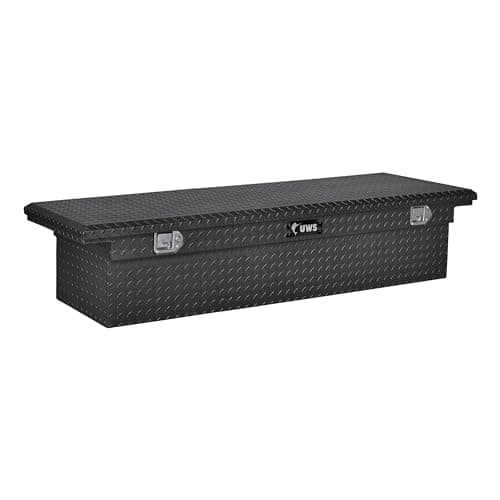
Featured here: the UWS EC10473 69-inch Heavy-Wall Aluminum Crossover.
Heads up: we earn a commission when you buy through our links, at no extra cost to you — from Amazon Associates, and from brand partner programs we have joined directly through the Impact network. Amazon prices are pulled live and were last checked November 28, 2026; a brand list price carries the date we read it off the maker’s own page. When we cannot verify a price we say so rather than print an old one. How this site is funded.
How we know:Spec-verifiedOwner-report-verifiedWhat these mean
Top pick9.5/10★★★★★
UWS
UWS EC10473 69-inch Heavy-Wall Aluminum Crossover
Heavy-wall aluminum, a foam-filled RigidCore lid that does not flex when you sit on it, and a low profile that still clears most rear glass.
A crossover tool box does not need holes in your truck. J-hook and clamp kits grip the underside of the bed rail lip and hold the box firmly, and the entire assembly comes off in under half an hour when the truck is sold.
That is worth more than convenience. A drilled hole in a bed rail is a sealed hole until it is not, and on a steel bed an unsealed hole rusts from the inside where you cannot see it. Not drilling removes the problem entirely.
Clamp it. The only reason to drill a crossover box on is a bed with bonded rail caps that leave no lip to grip, and that is a specific and uncommon case.
What you need
A J-hook or clamp kit. Four hooks minimum, and many boxes ship with them. Check before you buy a kit separately.
A socket or wrench for the lock nuts. Usually 1/2 in or 13 mm; check the kit.
A second person. The box has to be held in position while the first two hooks go on. A full-size box is a genuine two-person lift.
A tape measure. To center it, and to confirm the overhang is even.
Something to protect the rails. A blanket or a strip of carpet under the box while you position it.
The eight steps
Confirm the fitment first. Exterior bed rail width measured, checked against the manufacturer's chart. How to measure.
Clean the rails. Road film, grit and leaves under a box end become a grinding paste.
Lift the box onto the rails with the blanket in place. Do not slide it — lift and set down.
Center it. Measure the overhang on each side and make them equal. Confirm at least 1.5 in of box rests on each rail.
Position it fore-aft. As far forward as it will sit without touching the bulkhead, so you keep maximum floor behind it.
Fit the first two hooks diagonally. One front-left, one rear-right. Snug, not tight. This holds the position while you do the rest.
Fit the remaining hooks and tighten evenly. Work diagonally, like wheel nuts. Snug all four, then tighten all four.
Open and close the lid. Check it clears the rear glass and that the seal meets all round. Then check the overhang again — tightening can shift a box.
Heavy-wall aluminum, a foam-filled RigidCore lid that does not flex when you sit on it, and a low profile that still clears most rear glass. This is the crossover to buy if you intend to keep the truck.
Build
9.7
Weather seal
9.5
Security
9.4
Bed usability
9.2
Value
9.0
Why we picked it
+Foam-filled lid does not oil-can under body weight
+Low profile clears rear glass on most full-size crew cabs
+Heavy-wall extrusion survives being used as a step
+Gas struts are serviceable rather than sealed units
Good to know. Skip it on a 5'5" short bed. At 69 inches it will sit on the rails, but you lose a disproportionate share of a short bed and the money is better spent on a side-mount pair.
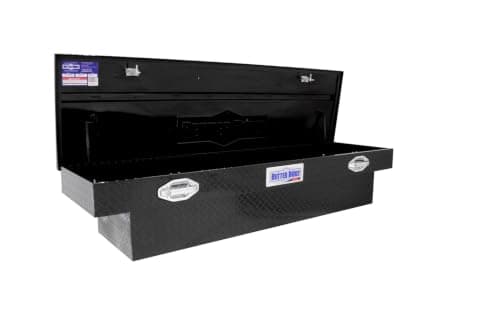
A 70 x 19 x 14 in gloss black aluminum single-lid box at a price the premium brands do not touch. You give up some lid rigidity; you keep most of the useful volume.
Build
9.2
Weather seal
9.2
Security
9.1
Bed usability
9.3
Value
9.6
Why we picked it
+Full 19 in of depth — a framing square lies flat
+Gloss finish wipes clean; dust does not show the way matte does
+Priced well below the premium aluminum boxes
Good to know. Not the one if you plan to stand on the lid daily — the panel is thinner than UWS's foam-filled RigidCore and will flex. Buy the UWS or a saddle box instead.
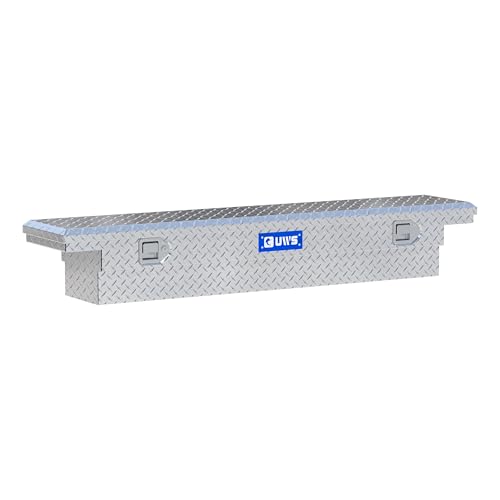
The slimmest box on this page by a clear margin: UWS publishes 12.62 in of width and 12.25 in of height, and those are the two figures that decide whether a box clears a tonneau cover and how much bed floor you keep. The lid is UWS's patented foam-filled rigid core rather than a flat skin, and the box is built deliberately low on the rail so the rear window stays usable.
Build
9.2
Weather seal
8.9
Security
9.2
Bed usability
9.7
Value
9.0
Why we picked it
+Publishes length, width, height and volume, which most of this category does not
+12.62 in wide leaves more usable bed floor than a standard crossover
+Patented foam-filled rigid core lid rather than a single flat skin
+Stainless steel lock handles rather than one stamped center catch
+Built low on the rail, so the view out of the rear window survives
Good to know. Twelve and a half inches of width is a genuinely shallow box — cased power tools do not go in it flat. The listing is also unusually bare for the money: UWS states the dimensions and the volume here but not the material or the wall thickness.
Beds where the space in front of the wheel wells is tight
Beds where height above the rails is constrained — 12.25 in published
✗ Does not fit
Anyone needing depth for cased tools
Beds the UWS fitment chart does not list — check it before you order
When you do have to drill
Two cases, and only two for a crossover box.
Bonded or capped bed rails with no lip. Some newer trucks have rail caps bonded in place that leave nothing for a hook to grip under. If there is no lip, there is no clamp.
A box that explicitly requires it. Rare on crossovers, normal on side-mount and underbody boxes — there is no clamp system that will hold a 72 inch loaded side box.
If you are drilling, three things matter and all three are about the hole rather than the box:
Use the manufacturer's recommended fastener. On an aluminum-bodied truck, dissimilar-metal contact with an electrolyte is a galvanic problem; use what the maker specifies.
Deburr and seal the hole. Bare metal in a drilled hole is where corrosion starts, and on a steel rail it starts inside where you will not see it.
Use a backing plate or a wide load-spreading washer. A fastener pulling against thin sheet will dish it.
A note on security
A clamped box can be unclamped. In practice the thief's problem is that unclamping takes time, tools and visible effort, where levering a latch takes seconds — which is why the latch is the thing to worry about rather than the mounting.
If the truck parks on the street loaded overnight, the upgrade to buy is a multi-point lock, not a drilled installation. Truck tool box security.
Questions people actually ask
Can you install a truck tool box without drilling?
Yes, on almost every full-size truck. J-hook and clamp kits grip the underside of the bed rail lip and hold the box firmly, and the whole assembly comes off cleanly at resale. Many boxes ship with the hooks included.
Is a clamped tool box secure?
Secure enough that the mounting is not the weak point. Unclamping a box takes time, tools and visible effort; levering a center latch takes seconds. If overnight street parking is your situation, buy a multi-point lock rather than drilling.
How many clamps does a tool box need?
Four as a minimum on a full-size crossover box, two per side. Tighten them diagonally like wheel nuts — snug all four first, then tighten — and re-check after a week of driving with the box loaded.
When do I have to drill for a tool box?
Two cases for a crossover box: a bed with bonded rail caps that leave no lip for a hook to grip, or a box that explicitly requires it. Side-mount and underbody boxes almost always need holes, because no clamp will hold a loaded 72 inch side box.
Does a tool box damage the bed rails?
Not if the rails are clean when it goes on and the clamps stay tight. Grit trapped under a box end becomes a grinding paste, and a box that has worked loose will mark the rails. Clean before fitting and re-torque after the first week.
Last reviewed October 5, 2026. Think a figure here is wrong? Tell us at contact@toolboxandtruck.com and we will check it, fix it and date the correction — see our editorial policy.