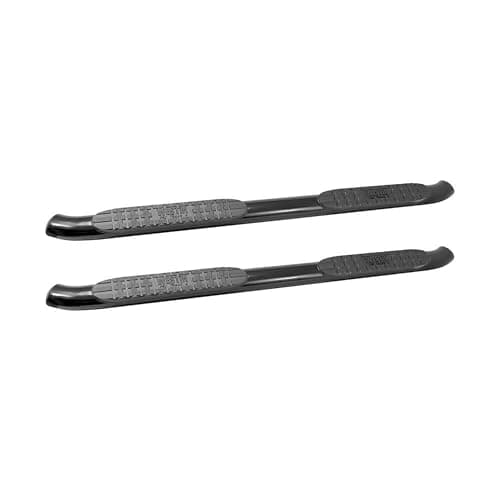
Our top pick: the Westin Westin PRO TRAXX 4 Oval Nerf Bars, Black, Pair.
Heads up: we earn an Amazon commission when you buy through our links, at no extra cost to you. Prices are pulled live from Amazon and were last checked October 5, 2026; when we cannot verify a price we say so rather than print an old one. How this site is funded.
How we know:Spec-verifiedOwner-report-verifiedWhat these mean
Tap any row for the full write-up. Prices come straight from Amazon and are never typed in by hand.
On a stock half-ton, running boards are a convenience. On a lifted truck, a heavy-duty truck, or any truck that a shorter person or an older knee has to get into forty times a day, they are the difference between climbing and stepping. That is worth more than it sounds.
The decision is not really about style. It is about ground clearance, and every option trades one problem for another.
Buy a flat board rather than a round bar if you actually step on it in work boots. Buy retractable only if the truck regularly goes somewhere a fixed board would ground out.
Three formats, and what each costs you
Step surface
Clearance
Fails by
Flat running board
Wide and flat — best underfoot
Permanently reduced
Coating, then the hardware
Oval nerf bar
Round — a boot rolls on it
Permanently reduced, slightly less
Almost nothing — that is the point
Retractable electric step
Wide, and out of the way when shut
Preserved
Motors, linkage and wiring in salt
A nerf bar is a round tube with a small step pad on it. It looks like a step and in work boots it is a worse one than a flat board, because a round surface is not somewhere a lugged sole sits confidently. If the board is decorative, a nerf bar is fine. If you step on it with a tool bag in each hand, buy the flat board.
How we ranked these
Protection. Secondary here — a board does deflect some stone spray onto itself rather than the rocker.
Weather seal. Scored as corrosion resistance, because that is what actually determines service life.
Install. Bracket count, factory mounting locations and whether it is a one-person job.
Durability. Coating and hardware quality. In the salt belt this is the only criterion that matters in year five.
Value. Against the live price, which in this category spans more than tenfold.
Four-inch oval tube nerf bars from a brand that has been making them for decades. Nothing to fail, a step pad you can hit with a boot, and hardware that does not seize into the mount after three winters.
Who should skip it. A fixed bar costs you clearance permanently and it is the first thing to catch on a rock or a curb. Know your access roads.
Protection
7.6
Weather seal
8.4
Install
8.6
Durability
9.0
Value
8.6
What works
+Nothing electrical to fail
+Step pads are replaceable wear items
+Westin mounting hardware resists seizing
What does not
−Permanent clearance loss
−Round tube is less secure underfoot than a flat board
−Fitment is bracket-specific — confirm against your truck
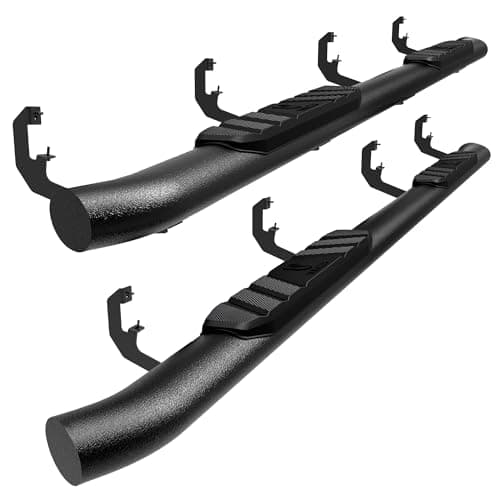
A 3.5 in flat-top board rather than a round bar, which is the right shape if you actually step on it with a work boot. Budget pricing, and the flat profile is the functional upgrade over a nerf bar.
Who should skip it. Budget coating. In a salt climate expect the hardware to show rust before the board does.
Protection
7.4
Weather seal
7.0
Install
8.6
Durability
7.4
Value
9.2
What works
+Flat step surface, not a round tube
+Covers 1500 and HD trucks
+Half the price of brand-name boards
What does not
−Coating and hardware are the weak points
−Permanent clearance loss
−Heavier than a nerf bar
Published specifications
Width
3.5 in
Fitment
Chevy Silverado / GMC Sierra 1500 2019-2026; 2500/3500 2020-2026
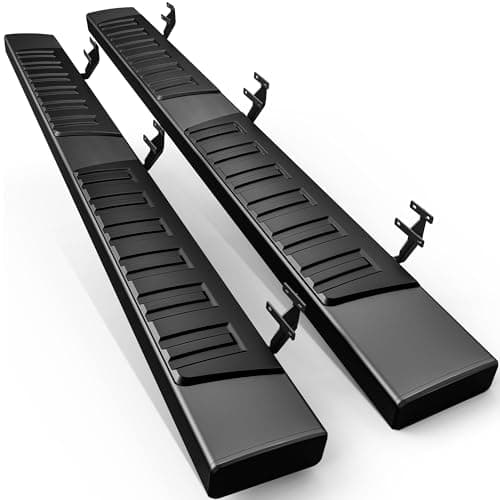
Six inches of step width on the F-150 SuperCrew. Width is what makes a board usable with a tool bag in each hand, and six inches is genuinely wide rather than nominally wide.
Who should skip it. SuperCrew only. On a SuperCab the rear door geometry is different and these will look and work wrong.
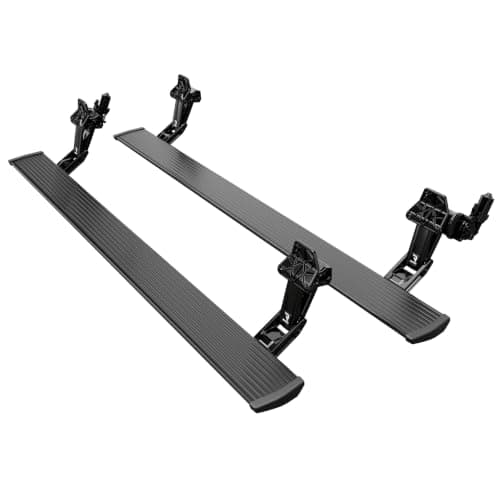
Electric retractable steps that deploy when a door opens and tuck away when it shuts. On a working truck the ground clearance matters — a fixed board is the thing that grounds out on a rutted site entrance.
Who should skip it. It is a motor, a harness and a controller on the underside of a truck that lives in salt and mud. Fixed boards cannot fail; these can.
Protection
7.0
Weather seal
7.4
Install
8.0
Durability
7.6
Value
6.4
What works
+No permanent clearance loss
+Plug-N-Play harness means no splicing
+LED lighting on the step itself
+Far easier entry than a fixed board at full extension
What does not
−Most expensive option in the category by a wide margin
Step width is the number that decides whether the board is usable. Three and a half inches is a usable step. Six inches is a confident one, which matters when both hands are full and you are stepping up in the dark.
Wider boards cost more clearance and catch more. That is the trade, and it is a real one on a truck that uses unmade roads. The practical compromise most work trucks land on is a 3.5 to 4 inch flat board: usable underfoot, and not so wide that it is the first thing to touch a rut.
Retractable steps: an honest account
Electric retractable steps solve the clearance problem completely. They deploy when a door opens and tuck away when it shuts, so there is nothing hanging below the truck while you drive.
They also put a motor, a linkage and a wiring harness on the underside of a truck that lives in salt, mud and road spray, and they cost several times what a fixed board costs. Repair is a specialist job rather than a bracket swap.
Buy them if the truck regularly goes where a fixed board grounds out, and the extra cost is justified by that.
Do not buy them for a truck that lives on pavement. You are paying for a problem you do not have.
Either way, a Plug-N-Play harness is worth insisting on. Splicing into a modern truck's wiring to power a step is how intermittent faults start.
Fitment and install
Boards mount to factory locations on the frame or rocker on almost every truck, which means no drilling. The fitment variable is cab configuration — crew, double, extended and regular cabs all take different lengths — and bracket applications that cover specific model-year ranges.
Confirm your cab. This is the most common ordering error in the category.
Check the bracket application list, not just the truck name. Brands publish these per part number.
Use anti-seize on the bracket bolts. In the salt belt these are the fasteners you will curse in five years.
Torque to spec and re-check. A board carries your whole weight repeatedly; a loose bracket is how a board ends up bent.
What we would actually buy
On a work truck on pavement and site roads: a 3.5 to 4 inch flat board from a brand whose coating holds up. Nothing to fail, a proper step surface, and the clearance cost is acceptable.
On a truck that regularly uses unmade roads where a board would ground: retractable electric steps with a Plug-N-Play harness, accepting the cost and the electronics.
On a truck where the boards are mostly cosmetic: an oval nerf bar is the cheapest honest answer, and it will outlast everything else here.
Questions people actually ask
Are flat running boards better than nerf bars?
If you actually step on them in work boots, yes — a round tube is not somewhere a lugged sole sits confidently, and a flat board is. Nerf bars are cheaper, lighter and essentially indestructible, which makes them the right answer if the boards are mostly cosmetic.
How much ground clearance do running boards cost?
Enough to matter off pavement. A wide board hangs lower and catches more; a 3.5 to 4 inch board is the compromise most work trucks land on. If the truck regularly uses rutted entrances, retractable steps are the only option that keeps the clearance.
Are electric retractable steps reliable?
They are a motor, a linkage and a harness living in salt and road spray, so they are inherently less reliable than a fixed bracket and repair is a specialist job. They are worth it specifically when ground clearance is a real constraint; on a pavement truck you are paying for a problem you do not have.
Do running boards need drilling?
Almost never — they mount to factory frame or rocker locations on nearly every truck. The variable is cab configuration, and ordering for the wrong cab is the most common mistake in this category. Use anti-seize on the bracket bolts if you live where it salts.
What step width should I look for?
Three and a half inches is usable; six inches is confident, which matters when both hands are full in the dark. Wider boards cost more clearance and catch more, so the right answer depends on where the truck goes rather than on which number is bigger.
Last reviewed October 5, 2026. Think a figure here is wrong? Tell us at contact@toolboxandtruck.com and we will check it, fix it and date the correction — see our editorial policy.