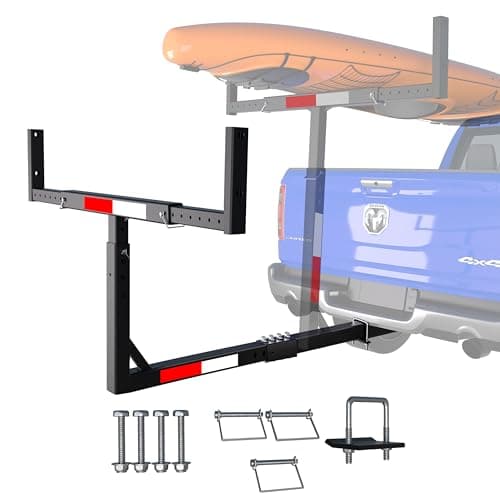
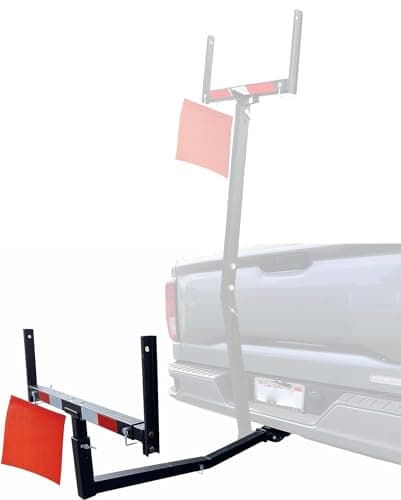
Our top pick: the TRUSOON TRUSOON 2-in-1 Hitch Bed Extender, 1000 lb.
Heads up: we earn an Amazon commission when you buy through our links, at no extra cost to you. Prices are pulled live from Amazon and were last checked October 5, 2026; when we cannot verify a price we say so rather than print an old one. How this site is funded.
How we know:Spec-verifiedOwner-report-verifiedWhat these mean
Tap any row for the full write-up. Prices come straight from Amazon and are never typed in by hand.
A 5'5" bed and a sixteen-foot length of lumber is a routine problem on a modern crew-cab truck, and letting the material hang unsupported off an open tailgate is both a handling problem and a legal one. An extender supports the tail so the load sits on something rather than pivoting on the tailgate edge.
It is also the cheapest item in this section and the one with the most specific limitations. Two of them are worth knowing before you shop: it occupies your hitch receiver, and the overhang still has to be flagged.
If the extender will carry real weight rather than just support a tail, buy the one with a published rating that covers it. Most extenders publish nothing, and that matters here more than in most categories.
Two formats, and they are not interchangeable
Hitch-mount extender
Retractable tailgate extender
Mounts to
The 2 in receiver
The bed walls, drilled
Blocks towing
Yes, completely
No
Lives on the truck
No — comes out in seconds
Yes — folds away
Support position
Behind the tailgate, lower
At tailgate height
Typical published rating
350-1,000 lb where stated
Rarely published
Right for
Occasional long loads
Regular long loads
The hitch-mount version is the one most people buy, because it is cheap and reversible. The retractable tailgate version is the one you want if you carry long material weekly, because it is always there and does not cost you the hitch.
How we ranked these
Build. Tube wall and weld quality. An extender carries a cantilevered load and flexes every mile.
Capacity. The published figure. We print it where it exists and say so where it does not — which is most of the category.
Install. Seconds for a hitch mount; drilling for a tailgate extender.
Versatility. Whether it also works as a kayak or canoe carrier, and whether the width adjusts.
Adjustable, 2-in-1 (extender or kayak carrier), and rated at 1000 lb. If the extender is going to carry real weight rather than just support the tail of a board, this is the one with the number to back it.
Who should skip it. A 1000 lb rating on a hitch extender is a rating for the steel, not permission to put 1000 lb of concrete behind the axle. Mind your tongue weight and your rear axle rating.
Build
8.2
Capacity
9.2
Install
9.2
Versatility
8.8
Value
8.6
What works
+Highest published rating in the category
+Doubles as a kayak carrier
+Adjustable
What does not
−Rating does not override the truck's rear axle rating
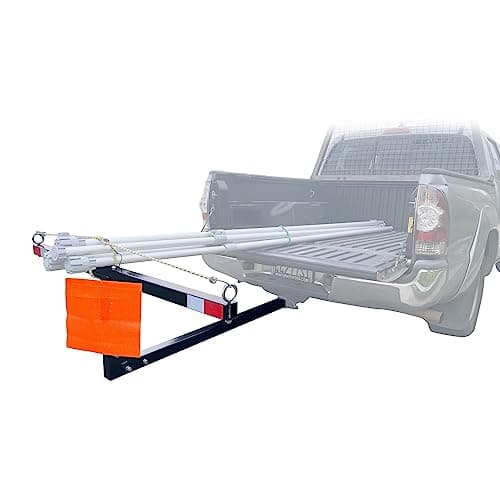
A hitch-mount extender that supports long material off the back of the truck. On a 5'5" bed carrying sixteen-foot lumber, this is the cheapest legal way to do it with the load properly supported.
Who should skip it. It uses the receiver, so you cannot tow at the same time, and the load still has to be flagged. It is not a substitute for a longer bed.
Build
7.6
Capacity
7.4
Install
9.8
Versatility
8.2
Value
9.4
What works
+Supports long material instead of letting it hang
Same idea as the 70231 with a published 350 lb capacity. The number matters: an unrated extender carrying 400 lb of lumber on a rough road is a guess you do not want to be making.
Who should skip it. 350 lb is a modest figure. For bundled lumber or steel, you need a rated rack rather than an extender.
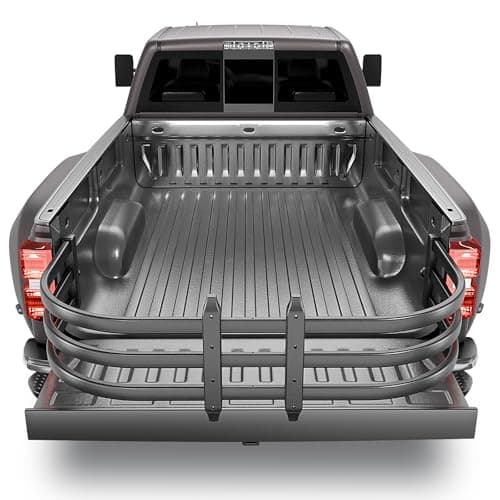
A retractable tailgate extender, 49-61 in adjustable, in aluminum. It stays fitted and folds away, which is the difference between an extender you use and one that lives in the garage.
Who should skip it. It requires drilling and it needs the tailgate down to work. If a sealed, cover-compatible bed matters, this complicates it.
Full-size beds 49 to 61 in wide at the tailgate — F-150, Ram, Silverado and similar
✗ Does not fit
Anyone unwilling to drill
Trucks with a retractable cover canister in the way
Why the rating matters more here
An extender is a cantilever. Load sitting on it is behind the rear axle, which means it is both lifting the front of the truck and amplifying every bump through the frame. A rating published for the steel does not mean your truck can carry that load in that position.
Check your rear axle rating and your payload. Weight behind the axle counts for more than weight between the axles.
Treat the extender's rating as a ceiling, not a target. A 1,000 lb rating is not permission to put 1,000 lb of concrete behind the axle.
Support the load, do not suspend it. The extender's job is to stop long material pivoting on the tailgate. It is not a second bed.
Strap at both ends. Material supported at two points and strapped at one will rotate.
The hitch problem
A hitch-mount extender occupies the receiver. That means no towing, no hitch-mount bike rack, no cargo carrier, and no hitch step while the extender is in. On a truck that tows regularly, swapping between the two becomes an irritation that eventually means the extender stays in the garage.
If that describes your truck, the retractable tailgate extender is worth the drilling and the extra money. It stays on the truck, folds out of the way, and leaves the receiver free.
The other way to solve this
For long material carried regularly, a ladder rack is a better answer than an extender. It supports the material along its length rather than at one point behind the axle, it does not need the tailgate down, and the load sits over the truck rather than behind it. An extender is the cheap and occasional solution; a rack is the proper one.
Fitment and install
Hitch-mount extenders fit any truck with a 2 inch receiver, which is almost all of them. The variable worth checking is the drop — some extenders sit low enough to ground out on a steep driveway when unloaded.
Tailgate extenders are sold by bed width and need drilling into the bed walls. Measure the width at the tailgate, and check that the mounting points do not foul a cover's clamp rail or a bed-rail-mounted box.
What we would actually buy
For occasional long loads on a truck that does not tow much: a hitch-mount extender with a published rating, flagged properly. Cheap, out in seconds, and it does the job.
For regular long loads: the retractable tailgate extender, or better still a ladder rack. The extender is the right answer when the material is heavy and low; the rack is the right answer when it is long and light.
The bed dimensions for all four trucks this site covers — so you can work out whether you need either — are in the bed dimensions chart.
Questions people actually ask
Do I need a bed extender for long lumber?
If the material overhangs the open tailgate unsupported, yes — an extender stops it pivoting on the tailgate edge. For material carried regularly, a ladder rack is the better answer because it supports the load along its length and does not need the tailgate down.
Can I tow with a hitch bed extender fitted?
No. A hitch-mount extender occupies the receiver completely. On a truck that tows regularly, that swapping becomes enough of an irritation that the extender ends up in the garage — which is the argument for a retractable tailgate extender instead.
How much weight can a bed extender hold?
Published figures run from 350 lb to 1,000 lb and plenty of extenders publish nothing. Treat any rating as a ceiling for the steel rather than a target: weight behind the rear axle counts for more than weight between the axles, and your axle rating is the real limit.
Do I have to flag an overhanging load?
Yes, and the specific requirement — how far before marking is needed, what color, whether lights are required after dark — is set by state law for non-commercial loads. Look up your state's rule. Fitting an extender does not exempt you from it.
Does a tailgate extender need drilling?
The retractable type does, into the bed walls. Measure the bed width at the tailgate and check the mounting points do not foul a tonneau cover's clamp rail or a rail-mounted tool box before you commit.
Last reviewed October 5, 2026. Think a figure here is wrong? Tell us at contact@toolboxandtruck.com and we will check it, fix it and date the correction — see our editorial policy.