Work truck gear, ranked for the people who load it every morning.
Guides
How to secure tools in a truck bed
Two different jobs get confused here: stopping things moving, and stopping things being taken. This page is the first one, and it is the one with rules attached.
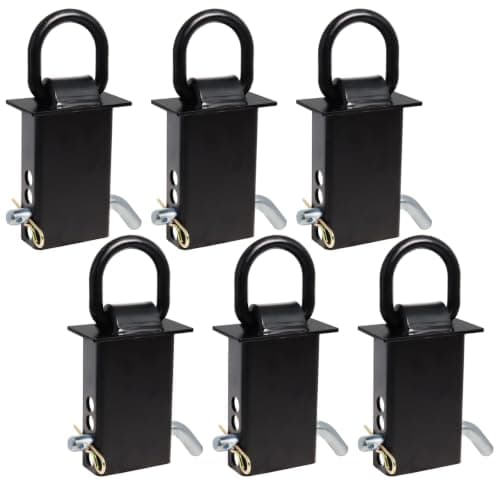
Featured here: the Generic (stake pocket pattern) Removable Stake Pocket D-Ring, 16,200 lb.
Heads up: we earn an Amazon commission when you buy through our links, at no extra cost to you. Prices are pulled live from Amazon and were last checked October 5, 2026; when we cannot verify a price we say so rather than print an old one. How this site is funded.
How we know:Spec-verifiedOwner-report-verifiedWhat these mean
Two things get called securing tools and they are different problems. Stopping the load moving is load securement, it has rules attached, and getting it wrong puts things on the highway. Stopping the load being taken is theft prevention, which is a different page.
Work to working load limit, not break strength. Anchor to rated points, not to whatever hook is nearest. And put the anchors where you actually strap, which is mid-bed — where the factory gave you nothing.
Break strength is not working load limit
This distinction is the single most important thing on this page and the marketing on every strap obscures it.
Break strength. The force at which the webbing fails in a test. This is the big number on the packaging. It is useful only for comparing straps with each other.
Working load limit. The figure you should actually work to, conventionally a fraction of break strength. This is the figure federal cargo securement rules are written in terms of.
The anchor's rating. Separate again, and usually the limiting factor. A 3,000 lb strap on a bolt through thin sheet metal is not a 3,000 lb assembly.
A strap advertised at 3,033 lb break strength is not a strap rated to restrain 3,000 lb of cargo. If you haul commercially, the federal rules govern and this page is not a substitute for them.
The order to secure a bed in
Put the load against a fixed face. Tailgate for most things; bulkhead if the load is heavy and you want the weight forward of the axle.
Brace it with a cargo bar, tight. No gap between the bar and the load — a gap is travel, and travel becomes an impact.
Strap anything heavy to rated anchors. Two points minimum, pulling in opposing directions so the load cannot walk.
Contain the small stuff. Loose small items roll under and around a bar. They need a box, a bag or a tote.
Check at the first stop. Everything settles in the first few miles. Thirty seconds of re-tensioning is the whole discipline.
Drops into the factory stake pocket, published at 16,200 lb, and lifts straight out when you are done. No drilling, no sealed holes, and a rating that is in a completely different league from a bolt-on ring.
Who should skip it. Your truck has to have usable stake pockets. Many newer trucks have them covered by bed rail caps, and some have none at all.
Build
8.4
Capacity
9.6
Install
9.6
Day-to-day access
9.0
Value
9.0
What works
+No drilling at all
+Very high published rating
+Removable, so the pocket is free again when you need it
What does not
−Needs accessible stake pockets
−Bed rail caps often have to come off
−Rating assumes a sound stake pocket, which on an older truck is an assumption
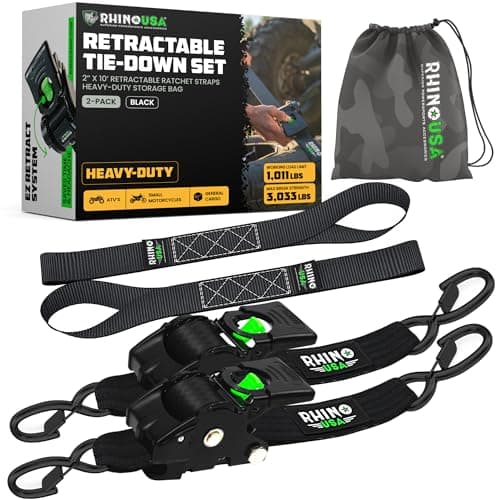
2 in webbing, 10 ft, published 3,033 lb break strength, and the strap retracts into the housing when you release it. The retraction is the feature: loose webbing in a bed is how straps get lost, frayed and run over.
Who should skip it. Retractable housings are bulkier than a plain strap and the mechanism is another thing to fail. For strapping down a load once a year, plain ratchet straps are fine.
Build
8.8
Capacity
8.8
Install
9.8
Day-to-day access
9.4
Value
7.8
What works
+Published break strength rather than a vague claim
+Retraction keeps the tail out of the dirt
+2 in webbing is the right width for real loads
What does not
−Bulkier housing than a plain strap
−The retraction mechanism is a wear item
−Break strength is not working load limit — do not confuse the two
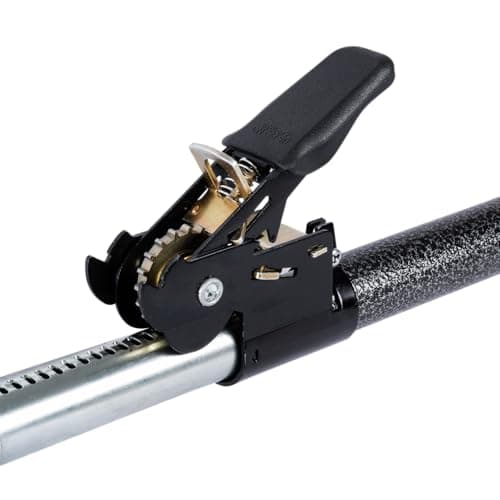
A 40-70 in ratcheting bar that braces across the bed and holds a load against the tailgate. It is the cheapest piece of kit on this site and it stops more rattling, sliding and scratched paint than anything else you can buy for the money.
Who should skip it. It is a brace, not a wall. It does not partition the bed into compartments and it will not hold a heavy load on its own.
Build
7.8
Capacity
6.8
Install
9.8
Day-to-day access
9.4
Value
9.6
What works
+Costs less than a tank of fuel
+Ratchet tension holds without tools
+Stores flat behind the seat when not in use
What does not
−Keeps a load in place; does not compartmentalize the bed
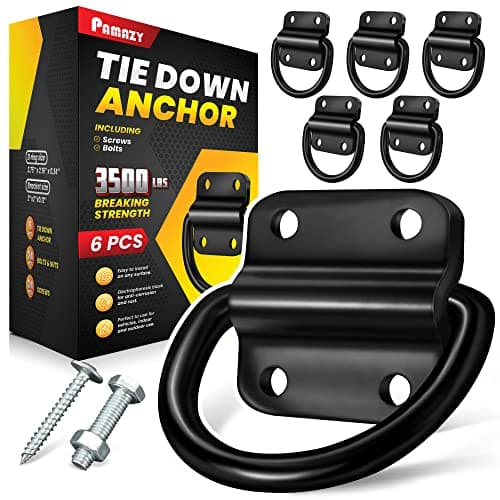
Six 3,500 lb steel D-rings. Most beds give you four factory points in the corners and nothing useful in the middle; these bolt in where you actually need them, which is usually mid-bed.
Who should skip it. They are only as strong as what they bolt to. A D-ring rated to 3,500 lb through thin sheet metal is not a 3,500 lb anchor — back it up with a plate.
Build
8.0
Capacity
8.2
Install
7.0
Day-to-day access
8.8
Value
9.6
What works
+Six points for less than the cost of one strap
+Lets you anchor mid-bed where factory points do not exist
Mounting into unsupported thin sheet without a backing plate
Where to put anchor points
Most beds give you four corner anchors and almost nothing you want to secure is in a corner. Fitting your own is the highest-value hour of work in this whole category.
Mid-bed, both sides. The most useful pair on any truck and the pair the factory never provides.
Low rather than high. A low anchor pulls downward, which is what stops a load lifting. A high anchor pulls sideways.
Immediately behind the bulkhead. For holding a heavy item forward where the weight belongs.
Not in the wheel well. Convenient, and it loads the thinnest panel in the bed.
The best anchor to fit is a removable stake-pocket D-ring: very high published rating, no drilling, and it lifts out when you need the pocket. The requirement is accessible, sound stake pockets — many newer trucks have them under bonded rail caps. Tie-downs and anchors.
If you are bolting anchors in
Use a steel backing plate. A ring rated to 3,500 lb bolted through unsupported sheet is not a 3,500 lb anchor.
Seal the hole. On a steel bed an unsealed hole rusts from the inside where you cannot see it.
Avoid double shear on a single bolt. Two bolts spread the load; one bolt is a pivot.
Straps: which type for what
Type
Tension
Use it for
Ratchet strap, 2 in
High
Heavy loads, equipment, anything that must not move
Ratchet strap, 1 in
Moderate
Lighter loads, totes, boxes
Cam buckle
Lower by design
Anything crushable — a ratchet will damage it
Retractable ratchet
High, self-stowing
Straps that live in the truck and get used daily
Bungee cord
None useful
A tarp. Not cargo. Ever.
The cam buckle entry is worth noticing: a ratchet will crush a load a cam buckle holds safely, and plenty of damage gets done by over-tensioning rather than under-tensioning.
The two things people always get wrong
Strapping to a cargo bar. The bar is a brace, not an anchor. Strap to rated anchor points.
One strap in the middle of a long item. It pivots. Two straps, one near each end, or the item rotates and the strap goes slack.
Questions people actually ask
What is the difference between break strength and working load limit?
Break strength is the force at which webbing fails in a test and is the number on the packaging; working load limit is the figure you should actually work to and is conventionally a fraction of it. Federal cargo securement rules are written in terms of working load limit.
Where should I put tie-down anchors in a truck bed?
Mid-bed on both sides first, because that is where you actually strap and the factory gives you nothing there. Then low on the bed sides, because a low anchor pulls downward and that is what stops a load lifting. Avoid the wheel wells.
Can I strap a load to a cargo bar?
No. A cargo bar is a brace that stops a load sliding; it is not an anchor and it is not rated as one. Strap to rated anchor points and use the bar to stop movement.
Are bungee cords good enough for a light load?
No. Bungees hold a tarp. They are not load securement, they fail suddenly and unpredictably under tension, and a failed bungee releases its stored energy at whatever is nearest. Use rated straps.
How many straps does a load need?
At least two on anything long, one near each end — a single mid-span strap lets the load pivot and then go slack. For commercial hauling the number and the working load limit required are set by federal rules rather than by judgment.
Last reviewed October 5, 2026. Think a figure here is wrong? Tell us at contact@toolboxandtruck.com and we will check it, fix it and date the correction — see our editorial policy.