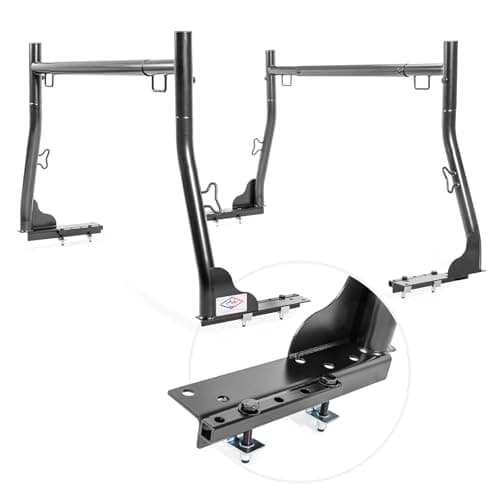
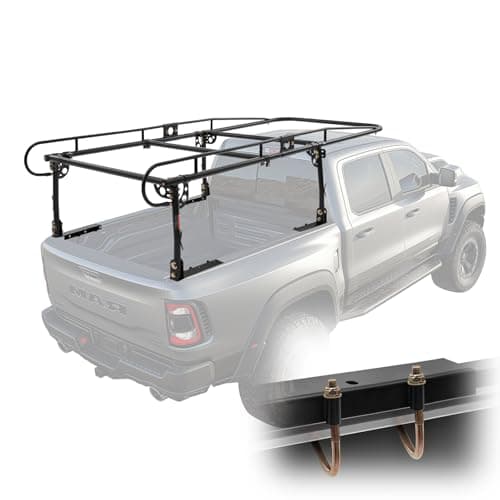
Our top pick: the AA-Racks AA-Racks X31-J Ladder Rack, 800 lb, with 8 Non-Drilling Z-Clamps.
Heads up: we earn an Amazon commission when you buy through our links, at no extra cost to you. Prices are pulled live from Amazon and were last checked October 5, 2026; when we cannot verify a price we say so rather than print an old one. How this site is funded.
How we know:Owner-report-verifiedSpec-verifiedWhat these mean
Quick picks — Ladder racks
#
Product
Best for
Capacity
Price
1
AA-Racks X31-J Ladder Rack, 800 lb, with 8 Non-Drilling Z-Clamps
Tap any row for the full write-up. Prices come straight from Amazon and are never typed in by hand.
A ladder rack carries material above the bed: ladders, conduit, pipe, lumber, anything longer than the bed can take lying down. On a trade truck it is often the single item that decides whether the truck can do the job at all.
It is also the category where the published numbers are most likely to be misread. Every rack here states a capacity and every one of those figures describes the rack rather than your truck. We will deal with that before the picks, because getting it wrong is a safety matter rather than a value one.
The AA-Racks X31-J is the value pick: 800 lb published, eight no-drill clamps, and it comes off in twenty minutes. Pay up for the TracRac only if you load it hard enough to care about long-term alignment.
What the capacity figure actually tells you
The ratings cluster at 800 lb and 1,000 lb. Three things sit between that number and what you can safely carry:
Your mounting points. A rack clamped to a bed rail lip transfers load into sheet metal. The rack is rarely the limit; the attachment usually is.
Your payload. The door-jamb sticker is the ceiling. The rack itself is dead weight before you load anything.
Where the weight sits. Load high and forward changes the truck's handling far more than the same weight on the bed floor. A rack full of conduit raises the center of gravity substantially.
Where a manufacturer does not publish a figure, our spec row says so rather than carrying an estimate. Ladder rack weight limits sets out what the published figures mean and what they do not.
How we ranked these
Build. Tube wall, joint design, and whether the crossbars stay square after repeated loading. This is the criterion the premium brands actually win on.
Capacity. The published figure, printed and cited.
Install. Clamp-on versus bolted, number of clamps, and whether one person can do it.
Versatility. Height adjustment, width adjustment, and whether accessories exist.
Value. Against the live Amazon price.
The picks, ranked
No. 1AA-RacksOwner-report-verified
AA-Racks X31-J Ladder Rack, 800 lb, with 8 Non-Drilling Z-Clamps
The same 800 lb X31 with eight Z-clamps instead of drilled mounts. The clamps are why you buy this version: no holes in the bed rail, nothing to seal, and the whole rack comes off in twenty minutes.
Who should skip it. Clamps need sound rails with accessible lips. Some newer trucks have bonded rail caps that leave nothing to clamp to.
Build
8.0
Capacity
8.4
Install
9.4
Versatility
8.6
Value
9.2
What works
+Zero holes in the truck
+Comes off completely for a clear bed
+Same 800 lb rating as the drilled version
What does not
−Clamps need accessible rail lips
−Clamped racks need re-torquing after the first loaded trips
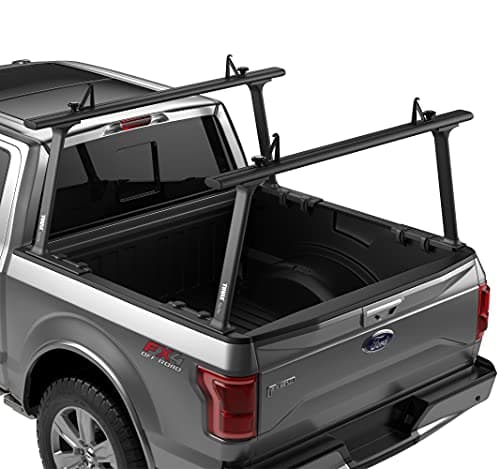
TracRac's entry rack, built on the clamp system the trade standardized on. The reason to pay for it is that the crossbars stay square to each other after a year of loading — budget racks walk out of alignment and then you are fighting the straps.
Who should skip it. It is a lot of money for a two-bar rack. If the rack carries a ladder twice a month, a clamp-on steel rack does the job for a quarter of the price.
Build
9.2
Capacity
8.4
Install
8.8
Versatility
8.6
Value
7.0
What works
+Crossbars stay square under repeated loading
+No-drill clamp system comes off cleanly when the truck is sold
Adjustable 58-69 in, rated to 1000 lb, and tall enough to carry over the cab line. The height is what makes it usable for lumber as well as ladders — a low rack forces long material to sit on the tailgate.
Who should skip it. Height costs you in wind noise and in low clearances. If the truck lives in a parking garage, measure the entrance first.
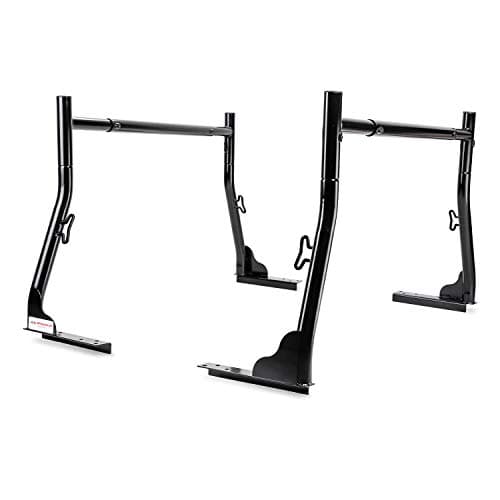
800 lb published capacity, extendable width, two bars, and it costs less than a decent tonneau cover. For a trade truck that carries ladders and conduit, this is the honest value pick in the category.
Who should skip it. Steel means rust at every scratch, and extendable joints mean more fasteners to check. If the rack never comes off, a welded rack would be stiffer.
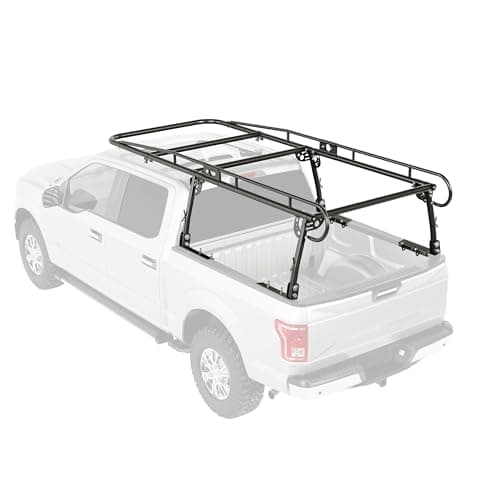
1000 lb published capacity with both drilling and non-drilling install options in the box. If what you actually need is a number on paper for heavier loads, this is the cheapest way to get it.
Who should skip it. A high rating on a budget rack is a rating for the tube, not the whole installation. Check your clamp or bolt points against the load before trusting it.
Trucks needing more than 800 lb of published capacity
✗ Does not fit
Mid-size beds without verifying the width
Trucks with rail-mount boxes
Clamp or bolt
A clamped rack grips the underside of the bed rail lip with Z-clamps or J-hooks. A bolted rack goes through the rail. Clamped should be your default for three reasons: no holes to seal, no rust starting at a drilled edge, and the rack comes off cleanly when the truck is sold.
The caveat is physical. Some newer trucks have bonded or capped bed rails with no accessible lip, and on those a clamp has nothing to grip. Look at your rail before you order, and if there is nothing to clamp, accept that you are drilling and seal the holes properly.
Height: more than you think, or less
Rack height determines what you can carry and what you can drive under. A rack that clears the cab line lets long material sit flat above the roof. A low rack forces the front of the load down onto the cab or the tailgate.
Over-cab height. Best for long material. Adds wind noise, and makes drive-throughs and parking garages a calculation rather than an assumption.
Bed-rail height. Lower noise, lower profile, but long material then overhangs the tailgate and usually needs a bed extender.
Adjustable height. The pragmatic answer, at the cost of more joints to maintain.
Measure your garage, your yard gate and the drive-through you actually use. This is the constraint owners discover after fitting rather than before, and a rack is not a thing you want to reconsider once it is drilled or clamped on.
Securing a ladder, which is not optional
Load securement on public roads is a legal obligation, and ladder handling on a jobsite falls under occupational safety requirements. Neither of those is our opinion and neither is satisfied by one strap in the middle.
Two straps minimum, one at each end of the ladder. A single mid-span strap lets the ladder pivot.
Load stops at the front. Without them, hard braking slides the ladder forward over the cab.
Check after the first stop. Webbing bedded onto an aluminum ladder rail loses tension in the first few miles.
Flag an overhang. If material projects past the tailgate, flagging requirements apply and vary by state.
What we would actually buy
On a trade truck that carries ladders daily and will be sold in five years: the clamp-on 800 lb two-bar rack, with load stops fitted. No holes, enough rating for anything a half-ton should carry, and a price that leaves budget for the straps.
On a truck where the rack gets loaded hard and often enough that alignment matters: the branded aluminum system. The premium is real and it buys stability rather than capacity.
On a truck that needs the rack height to change — under a cab line some days, over it on others: the adjustable rack, and accept the fastener checks.
Questions people actually ask
How much weight can a truck ladder rack hold?
The common published figures are 800 lb and 1,000 lb, and both describe the rack rather than your installation. Your mounting points, your payload and the raised center of gravity all sit between that figure and what you can safely carry. Full discussion.
Do you have to drill for a ladder rack?
Usually not — clamp-on racks grip the bed rail lip with Z-clamps or J-hooks and need no holes, which is the better default. Some newer trucks have bonded rail caps with no clampable lip, and those require a bolted install. Look at your rail before ordering.
What height ladder rack should I get?
Over-cab height carries long material flat and best; bed-rail height is quieter and lower but forces an overhang. Measure your garage, your yard gate and the drive-through you actually use before deciding — this is the constraint people discover after fitting.
How do I stop a ladder sliding forward?
Load stops at the front of the rack, plus two straps — one at each end of the ladder rather than one in the middle. A single mid-span strap lets the ladder pivot, and hard braking without load stops slides it forward over the cab.
Will a ladder rack fit with a tonneau cover?
Not mounted to the cover — no cover is structural. Some bed-rail rack systems are designed to coexist with a roll-up cover underneath, which is the only arrangement that actually works. Full answer.
Does a ladder rack hurt fuel economy?
It adds frontal area and turbulence, so some effect is expected, but we are not going to put a percentage on it — we have not tested it and the published figures in this area are not reliable. Treat the rack as a capability purchase, not an efficiency-neutral one.
Last reviewed October 5, 2026. Think a figure here is wrong? Tell us at contact@toolboxandtruck.com and we will check it, fix it and date the correction — see our editorial policy.