Work truck gear, ranked for the people who load it every morning.
Protection
The best mud flaps for a work truck
The highest return per dollar on this entire site. They cost less than a tank of fuel and they prevent the one damage pattern that is guaranteed on gravel.
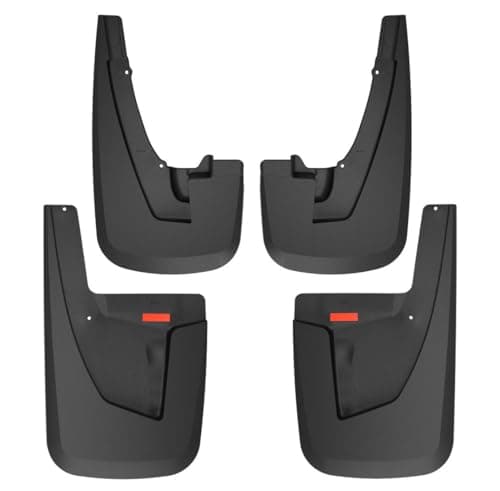
Our top pick: the Husky Liners Husky Liners Front & Rear Mud Guards — F-150 (2021-2024).
Heads up: we earn an Amazon commission when you buy through our links, at no extra cost to you. Prices are pulled live from Amazon and were last checked October 5, 2026; when we cannot verify a price we say so rather than print an old one. How this site is funded.
How we know:Spec-verifiedOwner-report-verifiedWhat these mean
Quick picks — Mud flaps
#
Product
Best for
Type
Price
1
Husky Liners Front & Rear Mud Guards — F-150 (2021-2024)
Tap any row for the full write-up. Prices come straight from Amazon and are never typed in by hand.
If you drive on gravel, your truck is being sandblasted every day. The damage shows up in two places: the rocker panel behind the front wheel, and the lower door and bed side behind the rear. It is slow, it is cumulative, and it is completely preventable for less than the cost of a tank of fuel in a heavy-duty truck.
There is no clever argument to make here. Mud flaps are the highest return-on-cost item on this site and almost everyone skips them because they are boring.
Buy custom-molded flaps for your exact truck, front and rear. Front flaps are the ones people skip and the ones that protect the rocker panel — which is the expensive thing to repaint.
Custom-molded versus universal
This is the only real decision, and unlike seat covers it is not mainly about looks. A universal flap is a flat sheet bolted to whatever you can reach. Two things go wrong with that:
It rubs at full lock. A flat flap hung in approximately the right place catches the tire when the wheel is turned and loaded.
It folds back at speed. A flat sheet has no structural shape. At highway speed it flattens against the body and stops catching anything.
Coverage is wrong. Custom flaps are shaped to cover the full tire width; a universal flap typically covers the inner half, which is not where the spray comes from.
Molded universal flaps — ones with a formed shape rather than a flat sheet — are a genuine middle ground. They hold their shape at speed and they cost very little. What they still require is drilling.
How we ranked these
Protection. Coverage across the full tire width, and shape retention at speed.
Weather seal. Not applicable in the usual sense; scored here on how much spray actually gets past.
Install. Factory mounting locations versus drilling. This is the biggest practical difference in the category.
Durability. Material and hardware. Flaps live in the worst place on the truck.
Value. Against the live price.
The picks, ranked
No. 1Husky LinersSpec-verified
Husky Liners Front & Rear Mud Guards — F-150 (2021-2024)
Front and rear in one order for the 2021-2024 F-150. Front flaps are the ones people skip and the ones that keep stone chips off the rocker panel, which is the expensive thing to repaint.
Who should skip it. Excludes the Raptor, which has a completely different body. Check your trim before you buy.
Protection
8.6
Weather seal
8.0
Install
9.2
Durability
8.6
Value
8.2
What works
+Front and rear in one purchase
+Protects the rocker panel, not just the bed sides
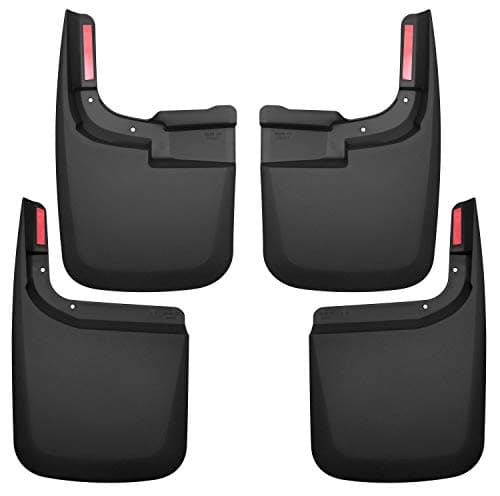
Custom-molded to the F-250/F-350 single-rear-wheel body with no OEM fender flares. Custom fit is the whole point with mud flaps: a universal flap either rubs at full lock or sits too high to catch anything.
Who should skip it. Fitment is specific to trucks without factory fender flares. On a truck with flares you need the other part number or they will not sit right.
Protection
8.8
Weather seal
8.0
Install
9.2
Durability
8.8
Value
8.0
What works
+Custom molding means no rubbing at lock
+Factory mounting points — no drilling
+Covers the full tire width rather than the inner half
What does not
−Fitment is narrow and easy to get wrong
−More expensive than universal flaps
−Will not fit flared trucks
Published specifications
Fitment
Ford F-250 / F-350 2017-2026, single rear wheel, without OEM fender flares
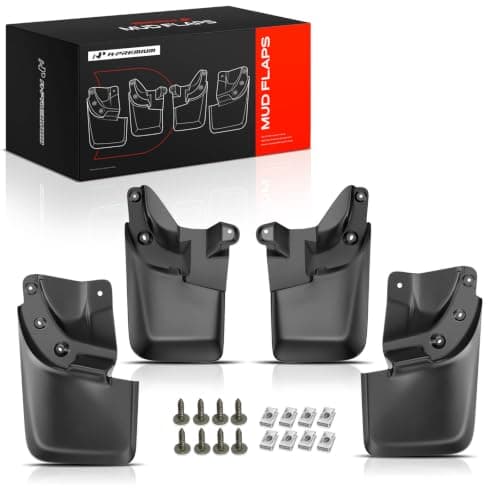
Vehicle-specific Tacoma flaps without the brand premium. For a mid-size truck that spends its life on gravel, this is a cheap fix for a problem that otherwise ends in paint work.
Who should skip it. Aftermarket hardware quality is the trade. Expect to replace a fastener or two over the life of the flaps.
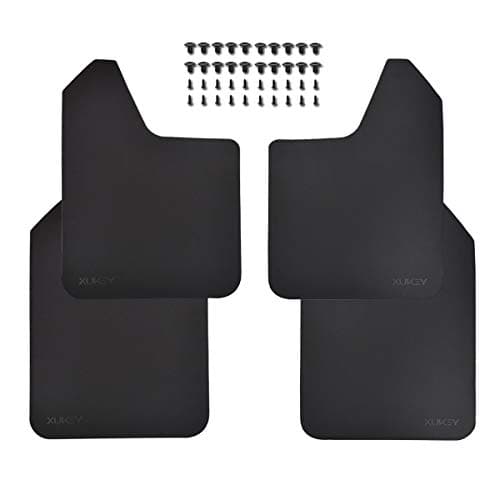
Four molded PP/TPO flaps with the hardware in the box, universal fitment. Molded plastic holds its shape where a flat rubber flap folds back at speed and stops working.
Who should skip it. Universal means you drill. If you want a bolt-in job with no holes, buy the vehicle-specific set for your truck.
Almost any truck or SUV with a willingness to drill
✗ Does not fit
Anyone wanting a no-drill install
Trucks where exact fit matters cosmetically
The fitment exclusions that catch people
Mud flap listings are unusually specific and the exclusions are easy to miss. Four that cause most of the returns:
With or without factory fender flares. This is a different part, not an adjustment. A flap for a non-flared truck will not sit right on a flared one.
Single rear wheel versus dually. Obvious when stated, and frequently buried.
Trim exclusions. Off-road and performance trims — Raptor and similar — have different bodywork and are usually excluded by name.
Model-year splits mid-generation. A 2021-2024 flap may not fit a 2025 truck even though the truck looks identical.
Install: the one job where factory holes are everything
Custom flaps use the truck's existing fender-liner fasteners, which means no drilling, no sealed holes, and nothing to rust. Universal flaps need holes, and holes in a wheel arch lip are in one of the wettest, saltiest places on the vehicle.
If you must drill: use stainless hardware, seal the hole, and use a backing plate or a wide washer. A flap pulls on its mount every time it flexes.
Check at full lock, loaded. Turn the wheel both ways with the truck on the ground and look at the clearance. Jacked up, everything clears.
Torque modestly. Over-tightening into plastic fender liner cracks it, and a cracked liner mount is how a flap ends up on the highway.
What we would actually buy
Custom-molded front and rear flaps for your exact truck, from a brand that publishes fitment properly. The price difference over universal flaps is small in absolute terms and buys you no drilling, no rubbing and correct coverage.
The only case for universal flaps is a truck not covered by anyone's custom range, or a trailer. Then buy molded rather than flat sheet, use stainless hardware, and seal the holes.
Questions people actually ask
Are mud flaps worth it?
On any truck that sees gravel, yes, and they are the cheapest preventative item on this site. A set of custom flaps costs a fraction of repainting a sandblasted rocker panel. Front flaps matter more than rear ones and are the set most people skip.
Do mud flaps fit trucks with fender flares?
Only the flare-specific part number. A flap designed for a non-flared truck will not sit correctly on a flared one — it is a different part rather than an adjustment, and it is the single most common reason a set goes back.
Do I have to drill for mud flaps?
Not for custom-molded flaps, which use the truck's existing fender-liner fasteners. Universal flaps need holes, and a hole in a wheel arch lip is in one of the saltiest places on the vehicle — use stainless hardware and seal it properly if you go that route.
Will mud flaps rub my tires?
Custom flaps should not, because they are shaped to the body. Universal flaps often do at full lock under load. Check the clearance with the truck on the ground and the wheel turned both ways — jacked up, everything clears and tells you nothing.
Should I remove front mud flaps in winter?
Some owners in deep-snow climates do, because front flaps pack with snow and a block of ice behind a tire is heavy enough to damage the mount. It is a legitimate trade, with the obvious catch that salt spray is worst in exactly that season.
Last reviewed October 5, 2026. Think a figure here is wrong? Tell us at contact@toolboxandtruck.com and we will check it, fix it and date the correction — see our editorial policy.