Work truck gear, ranked for the people who load it every morning.
Guides
Will a tool box damage my truck bed rails?
Not if it is clamped properly. The damage people blame on the box almost always starts in one of four places, and three of them are preventable in ten minutes at install.
Featured here: the Weather Guard 121-5-04 Aluminum Saddle Box, Low Profile, 11.0 cu ft.
Heads up: we earn an Amazon commission when you buy through our links, at no extra cost to you. Prices are pulled live from Amazon and were last checked November 13, 2026; when we cannot verify a price we say so rather than print an old one. How this site is funded.
How we know:Spec-verifiedOwner-report-verifiedWhat these mean
Top pick9.6/10★★★★★
Weather Guard
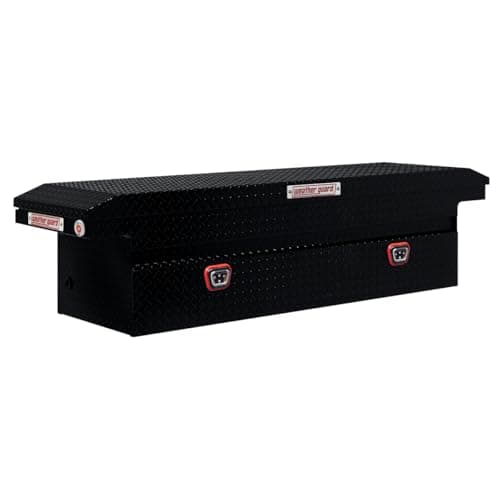
Weather Guard 121-5-04 Aluminum Saddle Box, Low Profile, 11.0 cu ft
11.0 cu ft of aluminum in the low-profile saddle format that fleets have standardized on for decades.
Tap any row for the full write-up. Prices come straight from Amazon and are never typed in by hand.
A properly clamped crossover box will not dent or deform your bed rails. The rails are a box section designed to carry a loaded bed, and a tool box spreads its weight across four mounting feet sitting on top of them. What a box genuinely does cause, over years, is paint wear at the contact points and corrosion where grit and water sit under the feet.
Four places account for nearly all of it: the contact patch under each foot, the clamp jaw on the underside of the rail, any hole somebody drilled, and the seam where water now sits instead of draining. The first three are install decisions.
Clamp, do not drill. Put something between the feet and the paint, tighten to snug rather than to maximum, and lift the box once a year to clean out what has collected underneath. Do that and the rails will outlast the box.
The four places damage starts
1. The contact patch under each foot
Most boxes ship with rubber or foam pads on the feet. They are thin, they compress, and once they are gone it is aluminum or steel bearing directly on painted steel with a thin film of grit in between. That is an abrasive joint that moves slightly every time you load the bed, and it polishes through the paint first and then starts rust.
The fix is cheap: a strip of self-adhesive rubber matting, truck bed mat offcut or even heavy rubber sheet under each foot, replaced when it flattens. A bed mat already covers the floor; this is the same idea for the rails. Bed liners and mats covers the floor side of the same problem.
2. The clamp jaw under the rail
A J-bolt clamp hooks the inner lip of the bed rail and pulls the box down. Tightened sensibly, that is a clamp. Tightened as hard as a long wrench allows, it is a press, and on an aluminum-bodied truck it can deform a thin inner lip. Snug plus a quarter turn is the whole specification, then re-check after a week of driving.
3. Holes somebody drilled
A drilled hole in a bed rail is an unpainted edge in the one part of the truck that collects water. It is also the one kind of damage on this page that is permanent. A crossover box does not need holes — it clamps, as described on installing a truck tool box with no drilling. Side-mount and underbody boxes sometimes do need them, and then the edge needs primer and sealant before the bolt goes in.
4. The water that no longer drains
This is the one nobody expects. A box sitting across the rails changes where water runs and where grit collects, and under the box is now a sheltered damp place that never gets washed or dried. Beds rust in exactly these conditions — in seams and under things, not on the open floor, which is the pattern explained on how to keep a truck bed from rusting.
Four boxes whose mounting is published
Boxes from makers that state how the box mounts and what the feet sit on, with live prices. A maker that will not tell you how the box attaches is telling you something.
Weather GuardSpec-verified
Weather Guard 121-5-04 Aluminum Saddle Box, Low Profile, 11.0 cu ft
11.0 cu ft of aluminum in the low-profile saddle format that fleets have standardized on for decades. It is the box every other box gets compared with, and the reason is parts availability and a lid that stays sealed.
Build
9.7
Weather seal
9.7
Security
9.5
Bed usability
9.3
Value
8.8
Why we picked it
+11.0 cu ft published — not an estimate
+Weather Guard latch and seal hardware is available decades out
+Low profile keeps rear glass visible
+Resale value that no budget box holds
Good to know. It is the most expensive way to store tools in a pickup bed short of a drawer system. If this is a personal truck that sees a job every other weekend, the money is better spent elsewhere.
Heavy-wall aluminum, a foam-filled RigidCore lid that does not flex when you sit on it, and a low profile that still clears most rear glass. This is the crossover to buy if you intend to keep the truck.
Build
9.7
Weather seal
9.5
Security
9.4
Bed usability
9.2
Value
9.0
Why we picked it
+Foam-filled lid does not oil-can under body weight
+Low profile clears rear glass on most full-size crew cabs
+Heavy-wall extrusion survives being used as a step
+Gas struts are serviceable rather than sealed units
Good to know. Skip it on a 5'5" short bed. At 69 inches it will sit on the rails, but you lose a disproportionate share of a short bed and the money is better spent on a side-mount pair.
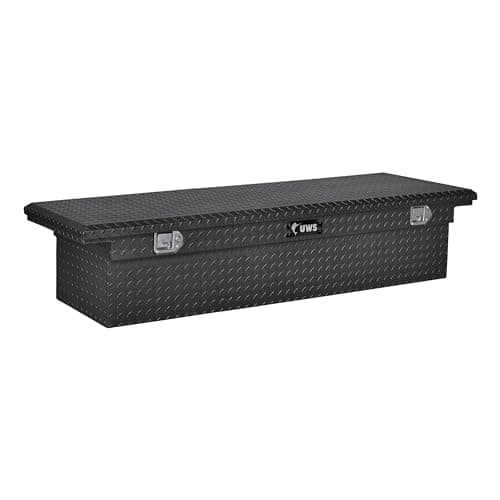
A 70 x 19 x 14 in gloss black aluminum single-lid box at a price the premium brands do not touch. You give up some lid rigidity; you keep most of the useful volume.
Build
9.2
Weather seal
9.2
Security
9.1
Bed usability
9.3
Value
9.6
Why we picked it
+Full 19 in of depth — a framing square lies flat
+Gloss finish wipes clean; dust does not show the way matte does
+Priced well below the premium aluminum boxes
Good to know. Not the one if you plan to stand on the lid daily — the panel is thinner than UWS's foam-filled RigidCore and will flex. Buy the UWS or a saddle box instead.
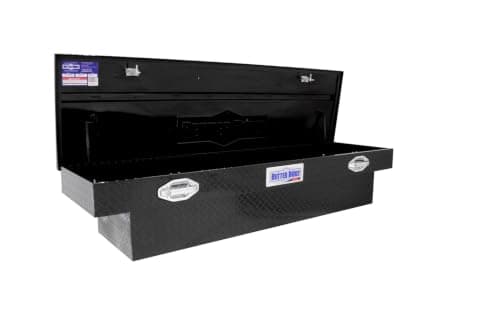
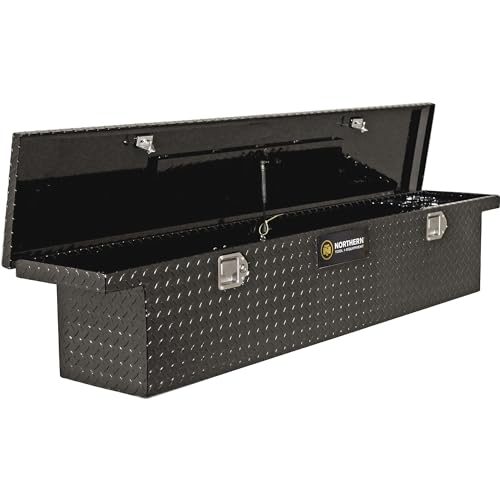
A 69 in low-profile aluminum crossover that is only 12 in wide and 13 in tall, and — unusually for this category — states all three figures on the listing. If you are working out whether a box will clear a cover or a rear window, a published height is worth more than any amount of marketing copy about a low crown.
Build
9.2
Weather seal
9.0
Security
9.1
Bed usability
9.6
Value
9.4
Why we picked it
+Publishes length, width and height, which most of this category does not
+12 in wide leaves more usable bed floor than a standard crossover
+Paddle latches rather than a single stamped center catch
+Gloss black aluminum does not rust at the mount holes
Good to know. Twelve inches of width and thirteen of height is a genuinely shallow box. Cased power tools do not go in it, and if nothing is competing for the space above the rails you are paying for a constraint you do not have.
Aluminum box on a steel rail, and the other way round
Two different metals in contact with moisture between them corrode faster than either would alone, and an aluminum box clamped to a painted steel rail is that arrangement. In practice the paint and the foot pads are the insulating layer that stops it, which is exactly why the pads matter more than they look like they should.
It matters more on an aluminum-bodied truck, where the rail itself is aluminum and the clamp hardware is usually steel. Keep the hardware dry, keep a pad between the parts, and check it when you check the torque. The material trade-off for the box itself is on aluminum against steel tool boxes.
A ten-minute install routine that prevents all of it
Clean both surfaces. Wash and dry the rails where the feet will sit. Installing a box over road grit is installing an abrasive.
Add a pad. Rubber matting under every foot, slightly larger than the foot's footprint so water runs off the edge rather than under it.
Clamp to snug, then a quarter turn. Both sides, alternating, so the box sits square. Then load the box and leave it.
Re-check after a week. Clamps settle. This is the step everybody skips and the reason boxes work loose.
Lift it once a year. Four clamps, ten minutes. Clean, dry, inspect the paint, replace the pads if they are flat.
And keep the box's weight honest. A box is not a structural member and the rails have limits — the figures and where to find yours are on truck tool box weight capacity.
Questions people actually ask
Does a truck tool box damage the bed rails?
Not structurally — a clamped crossover spreads its weight across four feet on a rail built to carry a loaded bed. What it does cause over years is paint wear at the contact points and corrosion where grit and water collect under the feet. Both are prevented with a rubber pad under each foot and an annual clean.
Should I drill holes to mount a tool box?
No, not for a crossover box. It clamps to the inner bed rail with J-bolts and needs no holes. A drilled hole is an unpainted edge in the wettest part of the truck and is the only permanent damage on this list. Where a side-mount bracket genuinely requires a hole, prime and seal the edge before the bolt goes in.
How tight should tool box clamps be?
Snug, plus about a quarter turn, working both sides alternately so the box sits square — then re-check after a week of driving, because clamps settle. Tightening as hard as a long wrench allows can deform a thin inner rail lip, especially on an aluminum-bodied truck.
Will a tool box cause rust in my truck bed?
Indirectly, yes, if you never look under it. The box shelters a patch of bed rail from washing and drying while grit and moisture collect there, which is the condition beds actually rust in. Lift the box once a year, clean and dry the contact area, and replace flattened foot pads.
Do I need pads under a tool box?
Yes, and the ones in the box are usually too thin to last. Use self-adhesive rubber matting or a bed mat offcut cut slightly larger than each foot, so water runs off the pad rather than sitting under it. This is the cheapest thing on this page and it prevents most of the damage described.
Last reviewed November 10, 2026. Think a figure here is wrong? Tell us at contact@toolboxandtruck.com and we will check it, fix it and date the correction — see our editorial policy.