Work truck gear, ranked for the people who load it every morning.
Guides
How much weight can a truck tool box hold?
Most manufacturers publish a lid rating and nothing else, and plenty publish nothing at all. Here is what the available numbers mean — and why your payload is the real limit.
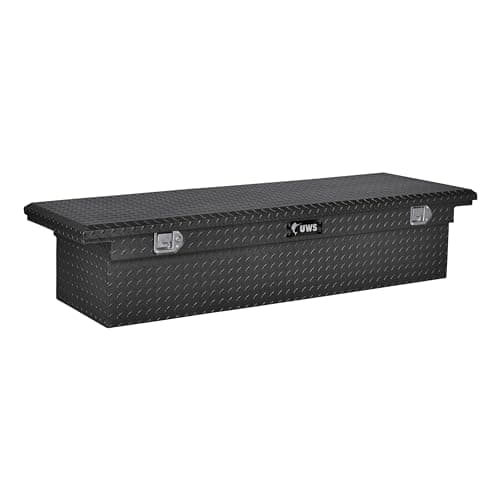
Featured here: the UWS UWS EC10473 69-inch Heavy-Wall Aluminum Crossover.
Heads up: we earn an Amazon commission when you buy through our links, at no extra cost to you. Prices are pulled live from Amazon and were last checked October 5, 2026; when we cannot verify a price we say so rather than print an old one. How this site is funded.
The honest answer to this question is uncomfortable: most truck tool box manufacturers do not publish a contents capacity, a lot do not publish a lid rating either, and the ones that do publish figures that are not directly comparable with each other.
What we will not do is invent numbers to fill the gap. Where a manufacturer publishes a figure, we print it and cite the listing. Where they do not, our spec rows say “not published”.
In practice the limit is almost never the box. It is your truck's payload, and the figure that governs it is on the door-jamb sticker rather than in any brochure.
The three different numbers people mean
Figure
What it describes
How often published
Lid load rating
Static weight the lid will take
Sometimes, on premium boxes
Contents capacity
Weight the box body will hold
Rarely
Box weight empty
What it costs you in payload before loading
Usually, as shipping weight
Mounting load
What the clamps or bolts will take
Almost never
Notice what is missing: an overall rating that combines them. There is no standard test in this category the way there is for, say, a tow hitch, which is why cross-brand comparison is genuinely hard rather than just inconvenient.
Why payload is the real limit
Work a half-ton example through with real figures. A full-size aluminum crossover box weighs a meaningful amount empty. Fill it with hand tools, a cordless kit and fasteners and the loaded box is a substantial fraction of what a half-ton has to give.
Now add a drawer system, a ladder rack, a tonneau cover, two people, a full tank and a day's material. On most half-tons you reach the door-jamb figure before you reach any box's structural limit.
Find the door-jamb sticker. Driver's door frame. It gives the payload for your specific truck as built, not the model maximum.
Subtract everything already bolted on. Box, rack, cover, liner, boards.
Subtract people and fuel. Both count.
What is left is your cargo. It is usually less than people expect, and it is the number that actually constrains the day.
Heavy-wall aluminum, a foam-filled RigidCore lid that does not flex when you sit on it, and a low profile that still clears most rear glass. This is the crossover to buy if you intend to keep the truck.
Who should skip it. Skip it on a 5'5" short bed. At 69 inches it will sit on the rails, but you lose a disproportionate share of a short bed and the money is better spent on a side-mount pair.
Build
9.4
Weather seal
8.8
Security
8.6
Bed usability
8.0
Value
7.4
What works
+Foam-filled lid does not oil-can under body weight
+Low profile clears rear glass on most full-size crew cabs
+Heavy-wall extrusion survives being used as a step
+Gas struts are serviceable rather than sealed units
What does not
−Among the most expensive aluminum crossovers on the shelf
−69 in is a full-size length — not a mid-size answer
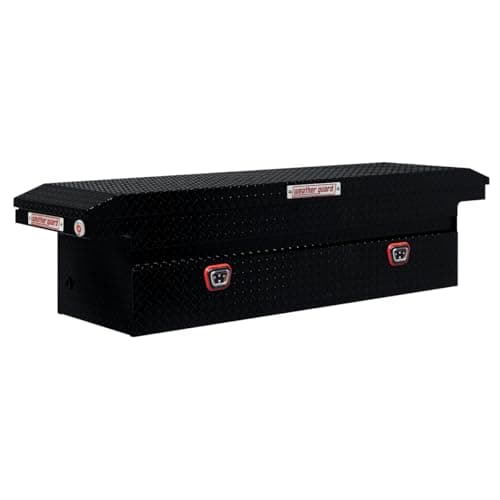
11.0 cu ft of aluminum in the low-profile saddle format that fleets have standardized on for decades. It is the box every other box gets compared with, and the reason is parts availability and a lid that stays sealed.
Who should skip it. It is the most expensive way to store tools in a pickup bed short of a drawer system. If this is a personal truck that sees a job every other weekend, the money is better spent elsewhere.
Build
9.6
Weather seal
9.4
Security
8.8
Bed usability
8.2
Value
6.8
What works
+11.0 cu ft published — not an estimate
+Weather Guard latch and seal hardware is available decades out
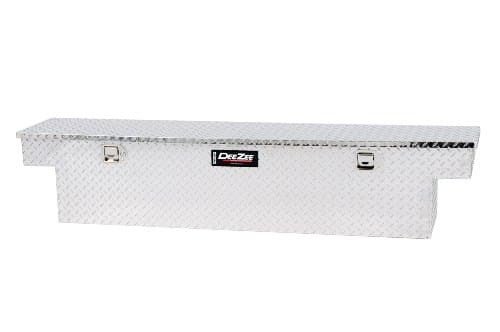
The narrow-body crossover. It eats noticeably less fore-aft bed length than a standard 19-20 in box, which is the whole point on a 5'5" or 5'7" bed where every inch in front of the wheel wells matters.
Who should skip it. If you carry long power tools in cases, the narrow body will fight you. A 19 in box swallows a circular saw case flat; this one does not.
Build
7.6
Weather seal
7.4
Security
7.2
Bed usability
9.2
Value
8.8
What works
+Gives back several inches of bed floor versus a standard-width box
+Light enough for a one-person install
+Cheapest route into a real aluminum crossover
What does not
−Narrow interior will not take large tool cases flat
−Thinner material than the heavy-wall boxes
−Published dimensions vary by listing — measure before you order
Full-size short beds where fore-aft space is tight
Trucks pairing a box with a bed slide or drawer unit
✗ Does not fit
Mid-size beds — narrow body, still full-size length
Anyone needing to lay a saw case flat inside the box
Standing on the lid
The question behind the question, usually. A cored or foam-filled lid is designed to take body weight routinely — that is part of why the construction exists. A single-skin lid will take it and will lose flatness over years, which is how a dry box starts leaking. The mechanism.
Where a manufacturer publishes a lid load rating we print it. Where they do not, treat the absence as a reason to be careful rather than as permission.
How much does a truck tool box weigh?
This one is usually published, as shipping weight, and it varies enormously by format and material:
Thin-wall aluminum crossover. Lightest of the full-size boxes. A one-person lift at a push.
Heavy-wall aluminum crossover. Noticeably heavier. A genuine two-person lift.
Fleet-grade aluminum saddle box. Heavier again, and the published figures are on the listings.
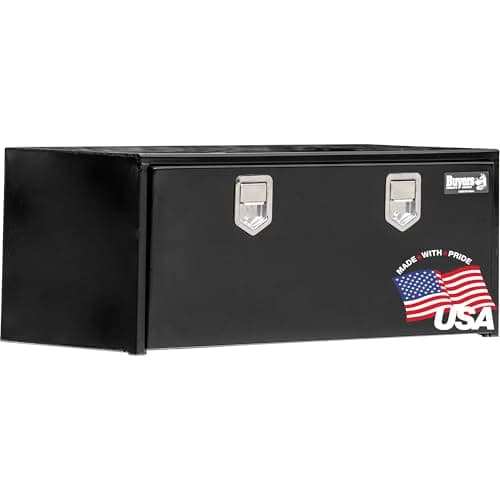
Steel underbody or triangle box. The heaviest here by a wide margin, which is why they are a two-person install with a jack.
On a payload-constrained truck, aluminum's weight advantage over steel is not a detail — it is money, and it is the practical argument for aluminum that survives even when corrosion is not a concern. Aluminum vs steel.
What to do with all this
Check your door-jamb payload before the third accessory. Not after.
Prefer aluminum on a half-ton that also tows. The weight saving is real capacity.
Buy a cored lid if you stand on it. And if the rating is unpublished, assume it is not designed for it.
Do not load a box to its volume. A full-size box filled with dense hand tools is heavier than most people expect, and it is all behind the rear axle line of the cab.
Questions people actually ask
How much weight can a truck tool box hold?
Most manufacturers do not publish a contents capacity, and we will not estimate one. Where a figure exists — usually a lid load rating on premium boxes — we print it and cite the listing. In practice your truck's payload is the limit long before the box's structure is.
How much does a truck tool box weigh?
It varies enormously: a thin-wall aluminum crossover is the lightest full-size box and a steel underbody or triangle box is several times that. Shipping weight is usually published on the listing, and on a payload-constrained truck it matters.
Can I stand on my tool box lid?
On a cored or foam-filled lid, routinely — that is part of why the construction exists. On a single-skin lid you can, and each time takes a little flatness out of the panel, which is the mechanism behind a box that starts leaking in year three.
Does a tool box count against payload?
Yes, empty and loaded. The figure that governs is on your driver's door-jamb sticker for your specific truck, not the model maximum. Add a drawer system, a rack, a cover, two people and fuel, and most half-tons run out before any box's structural limit.
Why do so few tool boxes publish a capacity?
There is no standard test in this category the way there is for a tow hitch, so there is nothing to publish against and no way to compare figures across brands. That is a genuine shortcoming of the category rather than something we can resolve by estimating.
Last reviewed October 5, 2026. Think a figure here is wrong? Tell us at contact@toolboxandtruck.com and we will check it, fix it and date the correction — see our editorial policy.