Work truck gear, ranked for the people who load it every morning.
Guides
Are truck tool boxes waterproof?
Almost none are, in any tested sense, and very few manufacturers claim it. Here is what the specifications actually say and what the honest expectation is.
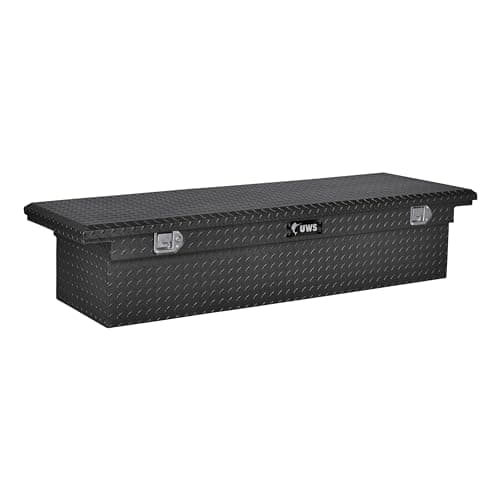
Featured here: the UWS UWS EC10473 69-inch Heavy-Wall Aluminum Crossover.
Heads up: we earn an Amazon commission when you buy through our links, at no extra cost to you. Prices are pulled live from Amazon and were last checked October 5, 2026; when we cannot verify a price we say so rather than print an old one. How this site is funded.
How we know:Spec-verifiedOwner-report-verifiedWhat these mean
Short answer: no, not in the sense you mean. Very few truck tool boxes publish any kind of water-ingress rating, and “weatherproof” in a product title is marketing rather than a specification. What a good box is, is weather-resistant: rain, a wash and a wet drive will not get inside it.
A well-built box with a rigid lid keeps tools dry through weather. It is not a dry box for electronics, it is not submersible, and if a manufacturer has not published a rating you should not assume one.
What the specifications actually say
Go and read the listings. Across the category you will find “weather-resistant”, “weather-sealed”, “waterproof lid” and occasionally “waterproof” used loosely. What you will almost never find is an ingress-protection rating or a described test.
On this site, where a manufacturer publishes a seal specification we print it and cite the listing; where they do not, the spec row says “not published”. In a category this full of adjectives, that absence is informative rather than neutral.
Why a box that was dry starts leaking
This is the useful part, because it is predictable and it is mostly preventable.
The lid loses flatness. A single-skin lid is a large flat panel. Sitting on it, standing on it and loading it take the flatness out over years.
The seal stops being met along its length. A lid that is slightly bowed contacts the seal at the latch and not at the ends.
Water runs in at the ends. Usually the rear corners, usually in a driving rain rather than a vertical one.
The seal compresses and takes a set. Rubber under constant load for five years does not spring back the way it did.
Which is why lid construction matters more than any claim about waterproofing. A foam-filled or cored lid resists step one, and if step one does not happen the rest does not either. The full lid argument.
Heavy-wall aluminum, a foam-filled RigidCore lid that does not flex when you sit on it, and a low profile that still clears most rear glass. This is the crossover to buy if you intend to keep the truck.
Who should skip it. Skip it on a 5'5" short bed. At 69 inches it will sit on the rails, but you lose a disproportionate share of a short bed and the money is better spent on a side-mount pair.
Build
9.4
Weather seal
8.8
Security
8.6
Bed usability
8.0
Value
7.4
What works
+Foam-filled lid does not oil-can under body weight
+Low profile clears rear glass on most full-size crew cabs
+Heavy-wall extrusion survives being used as a step
+Gas struts are serviceable rather than sealed units
What does not
−Among the most expensive aluminum crossovers on the shelf
−69 in is a full-size length — not a mid-size answer
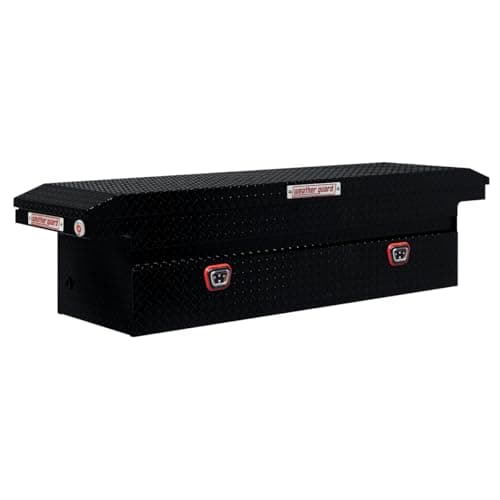
11.0 cu ft of aluminum in the low-profile saddle format that fleets have standardized on for decades. It is the box every other box gets compared with, and the reason is parts availability and a lid that stays sealed.
Who should skip it. It is the most expensive way to store tools in a pickup bed short of a drawer system. If this is a personal truck that sees a job every other weekend, the money is better spent elsewhere.
Build
9.6
Weather seal
9.4
Security
8.8
Bed usability
8.2
Value
6.8
What works
+11.0 cu ft published — not an estimate
+Weather Guard latch and seal hardware is available decades out
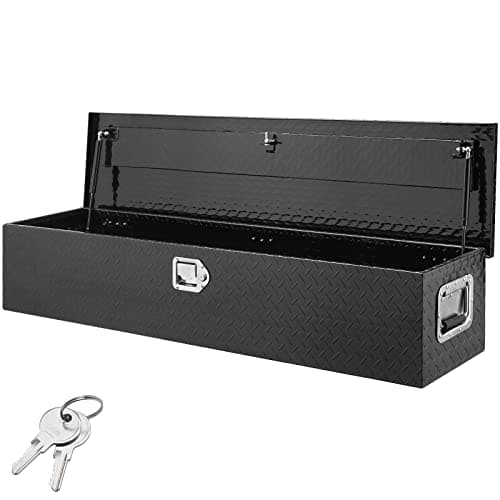
48 x 15 x 15 in of diamond-plate aluminum with side handles and a keyed latch. It is a box for straps, chains, salt and the things you do not want loose in the bed, and it costs a fraction of a branded chest.
Who should skip it. The latch is a budget latch. Do not treat this as secure storage, and do not expect it to stay dry in a sustained downpour.
Build
6.6
Weather seal
6.4
Security
5.8
Bed usability
8.0
Value
9.4
What works
+Very cheap for the volume
+Aluminum will not rust in the bed
+Side handles make it a two-man carry rather than a wrestle
Do not stand on a single-skin lid. The cheapest preventative measure available, and the hardest to stick to.
Clean the seal and the lip twice a year. Grit on a seal is both an abrasive and a spacer.
Treat the seal. A silicone or rubber conditioner keeps it pliable. A seal that has gone hard does not seal.
Check the drain holes if the box has them. Many boxes have small drains. Blocked drains turn a little ingress into standing water.
Keep electronics in their own sealed case inside the box. Belt and braces, and the only thing that actually protects a laser level.
When a box is genuinely not sealed
Budget chest boxes are the honest example. A thin-wall aluminum box with a cam latch and a foam strip is weather-resistant in the sense that it keeps rain off, and it will admit water in a sustained downpour. That is what you are paying a fraction of the price for.
Those boxes are still useful — straps, chain, salt, recovery gear — and the mistake is putting anything that minds being wet in one. Chest boxes, honestly assessed.
The alternatives if dry is non-negotiable
A sealed drawer system. The main systems publish weather-sealed drawers, which is the strongest claim in this whole space. Drawer systems.
A tonneau cover over the box. Two layers. A cover plus a slimline box is genuinely dry. Combinations.
Keep it in the cab. For anything genuinely water-sensitive, the under-seat void is dry, hidden and free. Cab organizers.
Questions people actually ask
Are truck tool boxes waterproof?
Almost none are in any tested sense, and very few publish an ingress rating. Weather-resistant is the honest description: a good box with a rigid lid keeps tools dry through rain, a wash and a wet drive. In a category this full of adjectives, an unpublished rating is informative.
Why did my tool box start leaking?
Almost always because the lid lost its flatness. A single-skin lid that has been sat on and loaded for years bows slightly, contacts the seal at the latch and not at the ends, and admits water at the rear corners in driving rain. Nothing broke; the geometry changed.
Are Husky truck tool boxes waterproof?
No box in that mid-market bracket is waterproof in a tested sense, and the same answer applies to Better Built, Dee Zee and the rest. Weather-resistant is the honest description. Full context on Husky specifically.
How do I keep my tool box dry?
Do not stand on a single-skin lid, clean the seal and the lip twice a year, treat the seal with a rubber conditioner, and keep the drain holes clear. For anything genuinely water-sensitive, use a sealed case inside the box.
What is the most waterproof truck storage?
A drawer system with weather-sealed drawers makes the strongest published claim in this space, and a tonneau cover over a slimline box gives you two layers. For anything truly water-sensitive, the under-seat void in the cab is dry, hidden and free.
Last reviewed October 5, 2026. Think a figure here is wrong? Tell us at contact@toolboxandtruck.com and we will check it, fix it and date the correction — see our editorial policy.