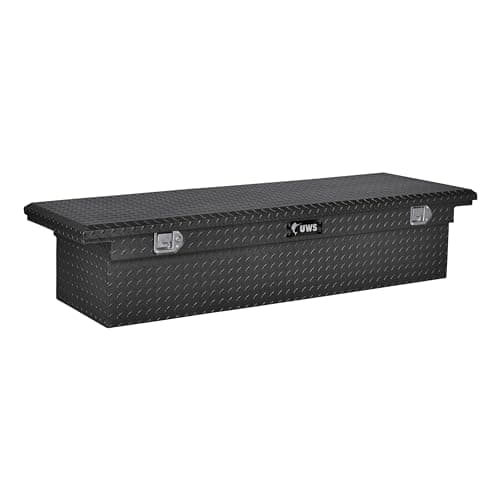
Featured here: the UWS UWS EC10473 69-inch Heavy-Wall Aluminum Crossover.
Heads up: we earn an Amazon commission when you buy through our links, at no extra cost to you. Prices are pulled live from Amazon and were last checked October 5, 2026; when we cannot verify a price we say so rather than print an old one. How this site is funded.
How we know:Spec-verifiedOwner-report-verifiedWhat these mean
A tool box locks tools up and keeps them dry. A drawer system does that and also fixes the fact that the front of your bed is four feet past your arms. The second thing costs several times as much as the first, which is why this comparison is worth doing properly.
A tool box if the problem is security. A drawer system if the problem is reach and organization. If both, start with the box — you can add drawers later; you cannot easily un-raise a bed floor.
Side by side
Tool box
Drawer system
Solves
Security, weather, a place for things
Reach, organization, security, weather
Costs you
18-21 in of bed floor, usually a cover
Vertical bed height, payload, tall cargo
Takes cased power tools
Yes
Yes, in the drawers
Reach from the tailgate
No — the box is at the bulkhead
Yes, that is the point
Install
Clamp on, under an hour
Two people, factory cleats, no drilling
Price
One unit
Several times that
Reversible
Completely
Completely, but it is a lift
The question that actually decides it
Not budget. This: how many times a day do you go into the bed, and when you get there, are you looking for something or lifting something?
Looking for something, many times a day. Drawers. The time saved is real and it compounds within a week.
Lifting something heavy, occasionally. Neither — you want a bed slide.
Putting something away securely, once or twice a day. A tool box. It is the right tool and it costs a fifth as much.
All three. A box plus a cheap slide-out tray gets you most of the way for a fraction of a drawer system. Cheaper alternatives.
What a drawer system costs that nobody mentions
Vertical bed capacity, permanently. The deck sits above the original floor by the module height, which means loads that used to sit below the rails now stand above them.
The tailgate is no longer level with the deck. You lift over a step.
Payload. Heavy before you load it, and it comes out of the same budget as a rack and a cover.
Cover clearance. A flush-mounted tonneau cover often leaves no usable space above the raised deck.
If the truck carries material more than tools, those four points add up to a clear answer, and it is not the drawer system. The full argument.
What a tool box costs that nobody mentions
The cover. A standard crossover box and an ordinary tonneau cover do not coexist, and plenty of people buy a box first and then discover that the cover they wanted needs to be a notched one at a premium.
It also costs you 18 to 21 inches of bed floor, which on a 5.5 ft bed is a third of your length. The short-bed calculation.
Heavy-wall aluminum, a foam-filled RigidCore lid that does not flex when you sit on it, and a low profile that still clears most rear glass. This is the crossover to buy if you intend to keep the truck.
Who should skip it. Skip it on a 5'5" short bed. At 69 inches it will sit on the rails, but you lose a disproportionate share of a short bed and the money is better spent on a side-mount pair.
Build
9.4
Weather seal
8.8
Security
8.6
Bed usability
8.0
Value
7.4
What works
+Foam-filled lid does not oil-can under body weight
+Low profile clears rear glass on most full-size crew cabs
+Heavy-wall extrusion survives being used as a step
+Gas struts are serviceable rather than sealed units
What does not
−Among the most expensive aluminum crossovers on the shelf
−69 in is a full-size length — not a mid-size answer
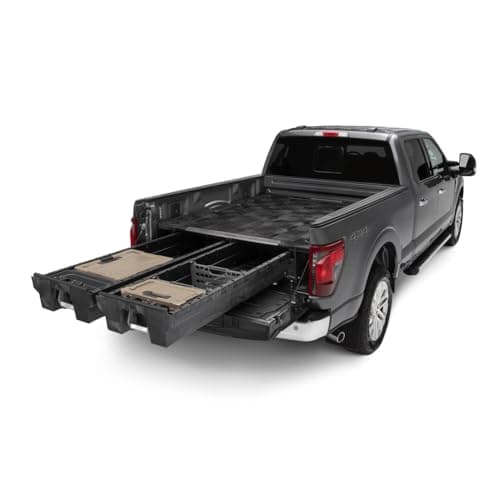
Two full-length weather-sealed drawers under a load-bearing deck. You keep the whole bed floor on top and gain two drawers you can reach from the tailgate without climbing in, which is the single biggest day-to-day change you can make to a work truck.
Who should skip it. It raises your bed floor by the height of the drawer module, so you lose vertical space and the ability to carry a full-height pallet. If you haul bulk more than tools, this is the wrong buy.
Build
9.4
Capacity
8.2
Install
8.8
Day-to-day access
9.8
Value
7.0
What works
+Drawers are reachable from the tailgate — no climbing into the bed
+Deck surface stays usable for cargo on top
+Weather-sealed drawers keep tools dry in an open bed
+No-drill installation on the factory cleat system
What does not
−The most expensive item in this category by a wide margin
−Raises the bed floor and costs you vertical capacity
−Very heavy — payload matters if you also tow
−Sold per bed length; ordering the wrong one means a return freight bill
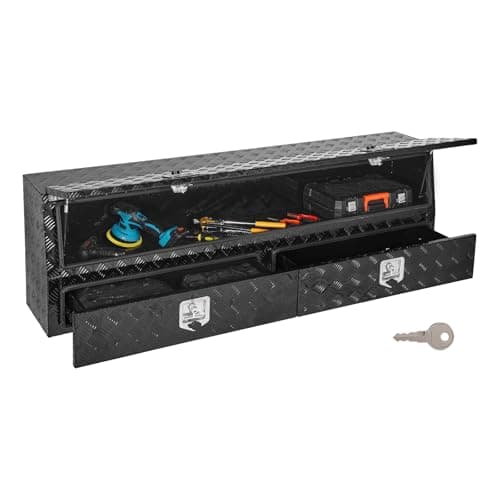
A 72 x 21 x 13 in tread aluminum topsider with two lower drawers and a flip-up door. It is the cheapest way to get drawers into a work bed without committing to a thousand-dollar drawer system.
Who should skip it. The drawer slides are the compromise. If the truck is loaded and unloaded every day, a proper drawer system's hardware will outlast this by years.
Build
7.6
Capacity
9.0
Install
7.0
Day-to-day access
9.0
Value
8.6
What works
+Real drawers at a fraction of drawer-system money
+Flip-up door means you are not reaching down into a well
+Full 72 in of length used
What does not
−Drawer slides are the first wear point
−21 in of width is a lot of bed to give up
−Heavy once loaded — the drawers encourage overfilling
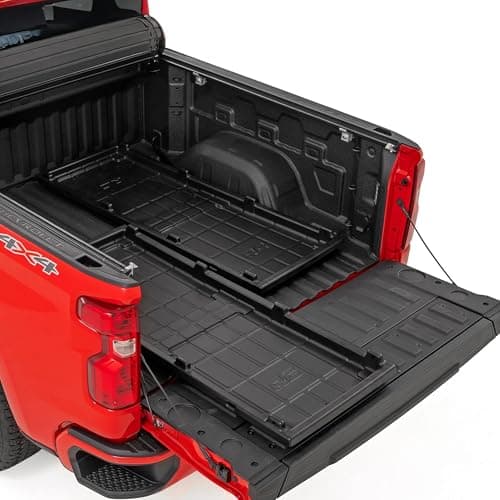
A UV-protected polyethylene slide-out tray for 5'7" and longer beds. It solves the actual daily problem — reaching the bulkhead — for a tenth of what a steel slide costs.
Who should skip it. Polyethylene is not steel. Drop a loaded box on the corner and you will crack it. Treat it as a tray for bags, totes and lighter gear.
Beds shorter than 5'7" — there is a separate mid-size version
Heavy equipment or point loads
Why both is a legitimate answer
The most common setup on a well-sorted trade truck is a drawer system and a crossover box. The drawers take hand tools, fasteners and consumables; the box takes cased power tools and anything that must lock properly.
That works, and the thing to check before committing to it is payload. A drawer system plus a box plus a rack on a half-ton consumes a meaningful fraction of the door-jamb figure before a single tool goes in. Bed storage for contractors sets out the whole build.
The order we would buy in
A box first, if you need security now. It is cheaper, faster and reversible.
A cheap slide-out tray second, to find out whether reach is genuinely your problem. It costs little and it answers the question.
A drawer system third, once you know. By then you also know your bed length exactly and which bed options you have.
Questions people actually ask
Should I buy a tool box or a drawer system?
A tool box if the problem is security and weather. A drawer system if the problem is reaching the front of the bed and finding the right tool. If both, buy the box first — it is cheaper, faster and reversible, and you can add drawers later.
Can you have a tool box and a drawer system?
Yes, and it is the most common setup on a well-sorted trade truck — drawers for hand tools and consumables, the box for cased power tools. Check your payload first: together with a rack they consume a meaningful fraction of a half-ton's door-jamb figure.
Is a drawer system worth five times a tool box?
If you go into the bed many times a day looking for things, yes — the time saved compounds and the organization is a different experience. If you go in twice a day to put something away securely, no, and a tool box is the right product.
What is the cheapest way to get drawer access?
A wheel-well drawer cabinet or a topsider with lower drawers — real drawers for a fraction of a drawer system's price, without raising the bed floor. The slides are not as good, and for fasteners and consumables specifically it is often the right answer anyway.
Does a drawer system affect what I can carry?
Yes, permanently while it is fitted. The raised deck means loads that used to sit below the bed rails now stand above them — appliance boxes, full-height pallets and plywood on edge are the usual casualties.
Last reviewed October 5, 2026. Think a figure here is wrong? Tell us at contact@toolboxandtruck.com and we will check it, fix it and date the correction — see our editorial policy.