Work truck gear, ranked for the people who load it every morning.
Guides
Are truck seat covers worth it?
On a work truck, usually yes, and the reason is resale rather than comfort. But the custom-versus-universal question has a clearer answer than people expect.
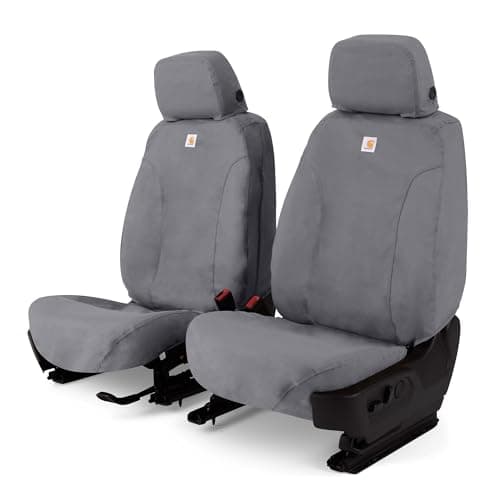
Featured here: the Covercraft Covercraft Carhartt SeatSaver Custom Seat Covers.
Heads up: we earn an Amazon commission when you buy through our links, at no extra cost to you. Prices are pulled live from Amazon and were last checked October 5, 2026; when we cannot verify a price we say so rather than print an old one. How this site is funded.
How we know:Spec-verifiedOwner-report-verifiedWhat these mean
A work truck's interior loses value faster than almost any other part of it, and the seats lose it fastest. Not through one dramatic event — through a tool belt, a wet jacket every day through winter, grit off boots, and a dog at some point.
On a truck that does real work: yes, and buy the custom pattern if the seats are bolstered. On a truck that mostly commutes: a cheap universal cover for the days it does work, and spend the money on floor liners instead.
What a cover actually protects against
Worth being specific, because people buy covers for reasons that are not the main ones.
Threat
Does a cover help?
Note
Abrasion from tool belts and boots
Yes, substantially
The main reason to buy one
Water from wet clothing
Yes, with a water-resistant fabric
Duck canvas alone is not very water resistant
Dirt and grit
Yes — if you take the cover off and wash it
A cover never removed traps grit against the seat
Sun fade
Yes on the seat; the cover fades instead
Which is a cheaper thing to replace
Spills and liquids
Partly — depends on the fabric
Neoprene and Cordura are the water-resistant options
Tears and punctures
Somewhat
A screwdriver through a cover goes through the seat too
The one on that list people miss is grit. A cover that lives permanently on the seat accumulates grit underneath it, and then the cover grinds that grit against the seat fabric — the exact problem a drop-in bed liner has. The cover has to come off occasionally for it to be a protective layer rather than a trap.
The money, honestly
A custom pattern costs two to four times a universal cover. Whether that is worth it depends on one physical fact about your seats.
Bolstered bucket seats: custom is the only version that works. A universal cover bunches at the bolsters within a month, and a bunched cover abrades the seat it was bought to protect. The extra money buys a cover that does its job rather than a nicer-looking one.
Flat bench seats: universal is genuinely fine. There is nothing for it to bunch over, and the money is better spent elsewhere.
Against reupholstery or against the resale difference on a tatty interior, either option is cheap. The question is not whether to protect the seats; it is which cover actually will.
Carhartt's duck canvas on Covercraft's custom patterns. The custom fit is the entire argument: a universal cover bunches at the bolsters within a month, and a bunched cover is how a seat gets worn under the cover you bought to protect it.
Who should skip it. Duck canvas is stiff and it is hot in summer until it breaks in. If the truck is mostly a commuter, a mesh cover is more comfortable for less money.
Material
9.2
Fit
9.4
Cleanability
8.8
Comfort
7.2
Value
7.6
What works
+Custom pattern stays put instead of bunching
+Duck canvas shrugs off tool abrasion and dog claws
+Comes off and washes rather than needing valeting
+Covercraft publishes airbag compatibility per pattern
What does not
−Expensive for a seat cover
−Stiff and hot until broken in
−Pattern must match your exact seat configuration — a bench and buckets are different parts
Published specifications
Material
Carhartt duck canvas
Fit
Custom, vehicle-specific pattern
Airbag
Side-airbag compatible patterns available — verify your part number
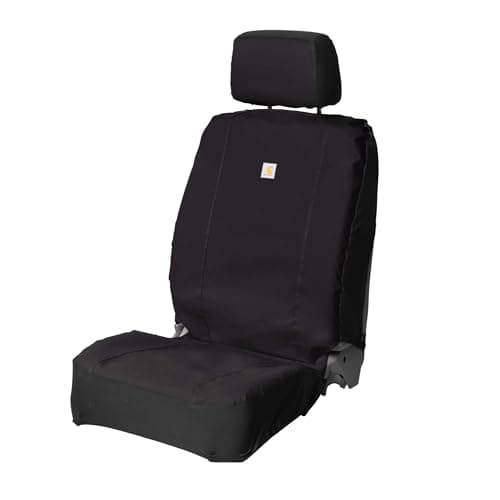
700 denier nylon duck in a universal front cover. The denier number is the specification that matters and 700 is a genuinely heavy fabric — higher than most work covers in this price bracket.
Who should skip it. It is universal fit. On a contoured truck seat it will never sit as cleanly as a custom pattern, and on a seat with side airbags you must verify compatibility.
Material
9.0
Fit
7.0
Cleanability
8.6
Comfort
7.0
Value
9.0
What works
+700 denier is a heavy, published figure
+Carhartt fabric with the brand's wear record
+Far cheaper than a custom set
What does not
−Universal fit will not sit flat on contoured seats
−Airbag compatibility not stated — verify before fitting over a side-airbag seat
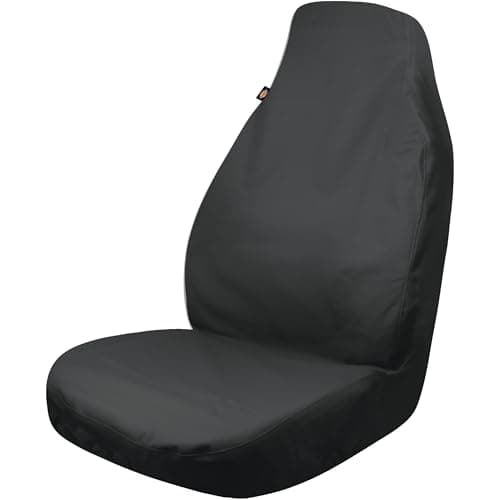
A water-resistant universal cover for less than the cost of a tank of diesel. It will not last like a Carhartt and it will not fit like a Covercraft, but it will stop one muddy week ruining a cloth seat.
Who should skip it. Treat it as consumable. At this price it is a one or two season cover, not a long-term solution.
Leather or vinyl seats that you wipe down. A cover adds little and makes the seat hotter. Wipe-clean surfaces are already the solution.
A truck being sold within months. The cover will not have paid for itself and the buyer may not want it.
Seats that are already beyond saving. A cover over a torn seat hides it rather than protecting it; if you are covering damage for resale, that is a disclosure question rather than a protection one.
A hot climate with a cab that bakes. Duck canvas is genuinely uncomfortable in high heat, and a mesh cover protects against dirt rather than abrasion. Be honest about whether you will keep it fitted.
The comfort cost, stated plainly
Duck canvas is stiff and hot for the first few weeks and then it breaks in and is excellent. In a hot climate the hot part does not entirely go away.
Duck canvas: toughest, hottest, stiffest when new.
Cordura: similar abrasion, water resistant, slightly less stiff.
Neoprene: comfortable and waterproof; traps heat and holds smell over years.
Mesh: coolest by a wide margin; protects against dirt, not abrasion.
If the truck is a daily driver in a hot climate and occasionally a work truck, a mesh cover that stays on beats a duck canvas cover that lives in the garage.
The answer in one line
Worth it on a working truck, worth the custom premium on bolstered seats, second in line behind floor liners, and only worth anything at all if you take it off and wash it twice a year.
Questions people actually ask
Are truck seat covers worth the money?
On a truck that does real work, yes — abrasion from tool belts and boots is what destroys a work seat, and a cover costs a fraction of reupholstery or of the resale difference. On a commuter that occasionally works, a cheap cover is enough and floor liners are the better spend.
Are custom seat covers worth four times a universal cover?
On bolstered bucket seats, yes — a universal cover bunches within a month and a bunched cover abrades the seat it was bought to protect. On a flat bench seat, no: there is nothing for it to bunch over and universal is genuinely fine.
Are Carhartt seat covers worth it?
The custom Covercraft-made patterns are, on a bolstered seat, and the fit is the reason rather than the fabric. The universal Carhartt-branded covers use the same good fabric with an approximate fit. Full review.
Do seat covers damage seats?
A cover that never comes off does, because grit accumulates underneath and then gets ground against the seat fabric. Take them off and wash them twice a year and they protect; leave them on permanently and they are a trap.
Should I buy seat covers or floor liners first?
Floor liners. Water in the carpet reaches the floor pan and a floor pan is structural in a way a seat is not. Seat covers are the second interior purchase, not the first.
Last reviewed October 5, 2026. Think a figure here is wrong? Tell us at contact@toolboxandtruck.com and we will check it, fix it and date the correction — see our editorial policy.