Work truck gear, ranked for the people who load it every morning.
Guides
Gull wing or single lid crossover tool box?
Both layouts hold the same gear. The difference is how you get at it, how many seals can fail, and what happens when you are standing on the wrong side of the truck.
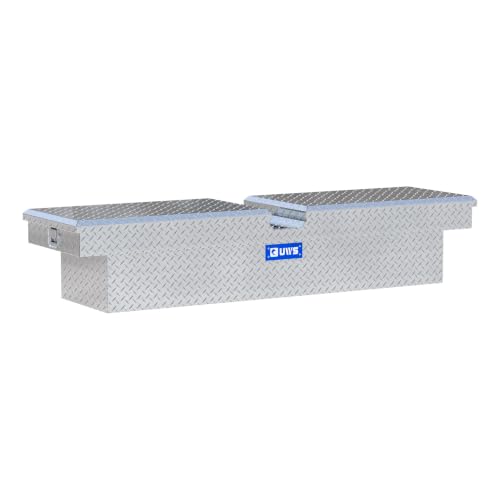
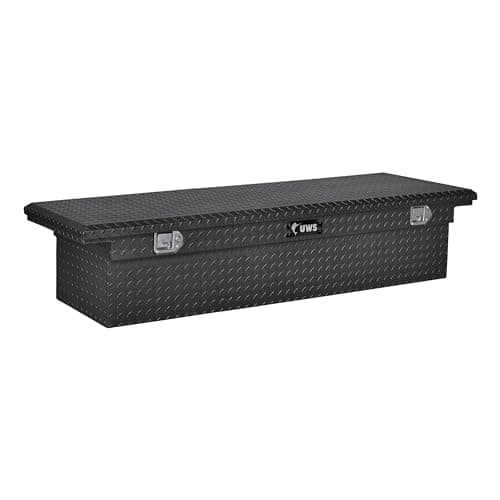
Our top pick: the UWS EC10473 69-inch Heavy-Wall Aluminum Crossover.
Heads up: we earn an Amazon commission when you buy through our links, at no extra cost to you. Prices are pulled live from Amazon and were last checked November 12, 2026; when we cannot verify a price we say so rather than print an old one. How this site is funded.
How we know:Spec-verifiedOwner-report-verifiedWhat these mean
Top pickBest of each layout9.5/10★★★★★
UWS
UWS EC10473 69-inch Heavy-Wall Aluminum Crossover
Heavy-wall aluminum, a foam-filled RigidCore lid that does not flex when you sit on it, and a low profile that still clears most rear glass.
Tap any row for the full write-up. Prices come straight from Amazon and are never typed in by hand.
Buy a gull wing box — two lids, hinged at the centre, opening to either side — if you work from both sides of the truck and want half the box open at a time. Buy a single lid if you want one stiff panel, one gasket and one lock to look after, which is the simpler and usually cheaper box for the same volume.
Neither layout holds more than the other at equal length. What changes is access, maintenance count and, in a small way, how the box resists prying.
Single lid for most trucks: fewer failure points, a stiffer panel, less money. Gull wing on a long bed where you genuinely work from both sides, or where opening half the box in the rain is worth two seals.
Four differences, and nothing else
Published layouts. Interior volume at equal length is effectively the same.
Gull wing (two lids)
Single lid
Access
Half the box, from either side
Whole box, from whichever side you stand on
Lid stiffness
Two shorter panels, each stiffer for its span
One long panel — construction matters more
Seals to maintain
Two
One
Locks to maintain
Two
One
Weather exposure when open
Half the box stays shut
Whole interior is open
Price at equal length
Higher
Lower
One gull wing, four single lids, ranked
Ranked on our published rubric with live prices. The gull-wing box here is the long one: on a mid-size bed the layout rarely makes sense, because there is not enough length for two halves that are both worth opening.
Heavy-wall aluminum, a foam-filled RigidCore lid that does not flex when you sit on it, and a low profile that still clears most rear glass. This is the crossover to buy if you intend to keep the truck.
Build
9.7
Weather seal
9.5
Security
9.4
Bed usability
9.2
Value
9.0
Why we picked it
+Foam-filled lid does not oil-can under body weight
+Low profile clears rear glass on most full-size crew cabs
+Heavy-wall extrusion survives being used as a step
+Gas struts are serviceable rather than sealed units
Good to know. Skip it on a 5'5" short bed. At 69 inches it will sit on the rails, but you lose a disproportionate share of a short bed and the money is better spent on a side-mount pair.
Two lids instead of one, on the same heavy-wall aluminum body and RigidCore lid construction UWS uses on its single-lid crossovers. On a full-size bed the gull-wing layout is the one that lets you reach what you need from whichever side of the truck you are standing on, without walking round.
Build
9.6
Weather seal
9.5
Security
9.4
Bed usability
9.4
Value
9.1
Why we picked it
+Access from either side of the truck without walking round
+Heavy-wall body rather than a stamped shell
+Foam-cored lids resist the flex that breaks a seal
+72 in spans a full-size bed properly
Good to know. Two lids mean two seals, two gas-strut sets and two locks, and every one of those is a future maintenance item. If the box is opened from one side ninety percent of the time, a single lid is simpler and cheaper for the same volume.
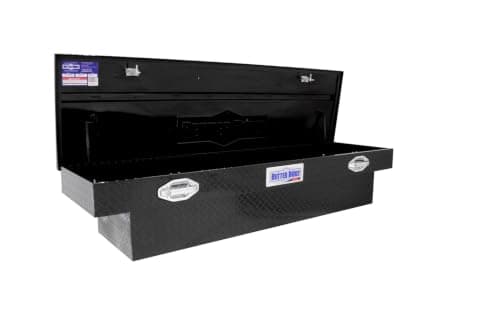
A 70 x 19 x 14 in gloss black aluminum single-lid box at a price the premium brands do not touch. You give up some lid rigidity; you keep most of the useful volume.
Build
9.2
Weather seal
9.2
Security
9.1
Bed usability
9.3
Value
9.6
Why we picked it
+Full 19 in of depth — a framing square lies flat
+Gloss finish wipes clean; dust does not show the way matte does
+Priced well below the premium aluminum boxes
Good to know. Not the one if you plan to stand on the lid daily — the panel is thinner than UWS's foam-filled RigidCore and will flex. Buy the UWS or a saddle box instead.
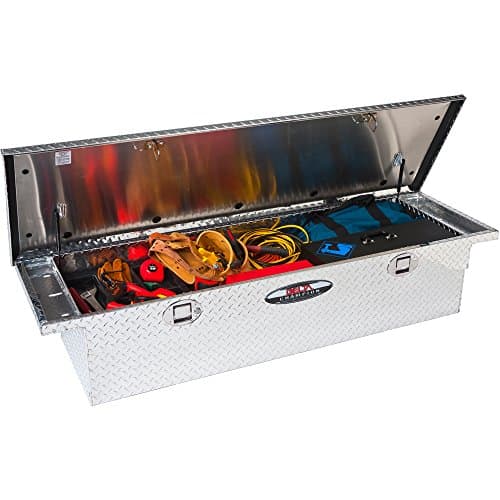
JOBOX's Gear-Lock drives multiple lock points from one key turn, which is the single biggest difference between a box a thief opens with a screwdriver and one he walks away from. The rest of the box is honest fleet-grade aluminum.
Build
9.5
Weather seal
9.4
Security
9.7
Bed usability
9.2
Value
8.9
Why we picked it
+Multi-point locking is genuinely harder to defeat than a single center latch
+Fleet-grade build with parts availability years out
+Low profile preserves rear visibility
Good to know. It costs premium money and spends it on the latch rather than the lid. If your box lives behind a locked gate every night, you are paying for security you do not need.
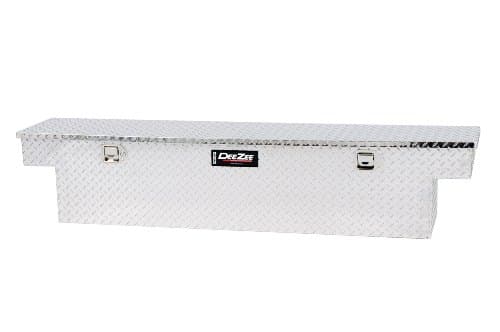
The narrow-body crossover. It eats noticeably less fore-aft bed length than a standard 19-20 in box, which is the whole point on a 5'5" or 5'7" bed where every inch in front of the wheel wells matters.
Build
9.1
Weather seal
9.0
Security
9.0
Bed usability
9.6
Value
9.5
Why we picked it
+Gives back several inches of bed floor versus a standard-width box
+Light enough for a one-person install
+Cheapest route into a real aluminum crossover
Good to know. If you carry long power tools in cases, the narrow body will fight you. A 19 in box swallows a circular saw case flat; this one does not.
Full-size short beds where fore-aft space is tight
Trucks pairing a box with a bed slide or drawer unit
✗ Does not fit
Mid-size beds — narrow body, still full-size length
Anyone needing to lay a saw case flat inside the box
Where the gull wing earns its money
You work from both sides. On a jobsite where the truck is parked against a kerb or a trench, being able to open the near half from wherever you are standing saves a walk every time.
It is raining. Half the interior stays shut and dry while you reach into the other half. With a single lid the whole box is open to the sky.
Two kinds of gear, kept apart. Hand tools one side, consumables and fasteners the other, with the centre divider doing the sorting for you.
The lids are shorter. A 36-inch lid on a 72-inch box is stiffer for its span than a 72-inch single panel, which matters most on budget boxes where the panel is thin.
Where the single lid wins
Fewer things to fail. Two gaskets and two locks is twice the maintenance, and the gasket is the component that fails first on any truck box — see are truck tool boxes waterproof.
Full-length items. A single lid opens the entire box at once, so a long level or a pry bar goes in and out without angling it past a centre divider.
Security. Two lids mean two lock points and two seams, and a seam is where a pry bar starts. A good single-lid box with a protected lock is the simpler thing to defend — the argument is on truck tool box security.
Price. At equal length and equal construction, the single lid is the cheaper box.
Lid construction beats lid count
This matters more than the layout: a foam-cored or ribbed lid resists the flex that breaks a seal, and a single-skin lid does not. A well-built single lid outperforms a cheap gull wing on weather sealing every time, and the giveaway is whether the maker names the lid construction at all. The boxes on this page that publish a lid type are the ones to shortlist.
If the box also has to live under a tonneau cover, the layout question is secondary to height — that is the low-profile format, and the full combination is covered on tonneau covers that work with a tool box.
What we would buy
On a full-size bed, working alone, with tools you use all day: a single-lid heavy-wall box with a named lid construction. One seal, one lock, one panel that does not flex. The detailed case for the one we rate highest is on the UWS crossover tool box review.
On a long bed, working with a crew, with the truck parked anywhere: the gull wing. Two people reaching into one box from opposite sides at the same time is a real advantage, and on a 72-inch box each lid is still a useful size.
On a mid-size truck: single lid, every time. There is not enough length in a Tacoma-width box for two halves that are both worth opening.
Questions people actually ask
What is a gull wing truck tool box?
A crossover box with two lids hinged at the centre, each opening upward to one side of the truck — so you can open the near half from whichever side you are standing on and leave the other half shut. The alternative layout is a single full-width lid.
Is a gull wing tool box better than a single lid?
Better at access and at keeping half the box dry in the rain; worse at maintenance count, at full-length items and at price. At equal length the two hold the same gear. Most single-truck owners are better served by a well-built single lid.
Do gull wing boxes leak more?
They have two gaskets instead of one, so there is twice as much seal to fail over time, and the centre is an extra junction. In practice lid construction matters more than lid count — a foam-cored lid that does not flex seals better than a thin single panel, whichever layout it is in.
Are two lids less secure than one?
Slightly, because there are two lock points and two seams, and a seam is where a pry attempt begins. The bigger security variables are wall thickness and whether the lock is protected behind a plate — a commercial gull wing is much harder to open than a budget single-lid box.
Does a gull wing box work on a mid-size truck?
Rarely worth it. A box sized for a Tacoma, Colorado, Ranger or Frontier does not have the length for two halves that are each usefully sized, so you pay for a second seal and lock and gain very little. Single lid is the sensible choice on a mid-size bed.
Last reviewed November 10, 2026. Think a figure here is wrong? Tell us at contact@toolboxandtruck.com and we will check it, fix it and date the correction — see our editorial policy.