Work truck gear, ranked for the people who load it every morning.
Guides
Running boards vs power steps
One is a fixed board you will kick and scuff for ten years. The other folds out of the way and has a motor. On a work truck the choice comes down to ground clearance and what you are willing to have fail.
Featured here: the AMP Research PowerStep Plug-N-Play — Silverado / Sierra 1500 (2019-2021).
Heads up: we earn an Amazon commission when you buy through our links, at no extra cost to you. Prices are pulled live from Amazon and were last checked November 13, 2026; when we cannot verify a price we say so rather than print an old one. How this site is funded.
How we know:Spec-verifiedOwner-report-verifiedWhat these mean
Top pick8.6/10★★★★★
AMP Research
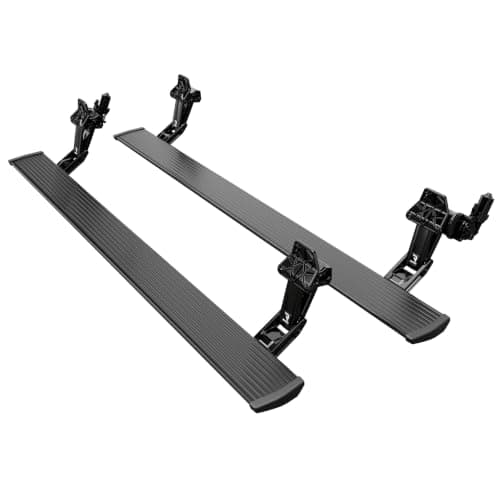
AMP Research PowerStep Plug-N-Play — Silverado / Sierra 1500 (2019-2021)
Electric retractable steps that deploy when a door opens and tuck away when it shuts.
Tap any row for the full write-up. Prices come straight from Amazon and are never typed in by hand.
Buy fixed running boards if the truck works off pavement, carries weight, or needs a step that cannot fail — a 4-inch oval nerf bar or a 6-inch flat board costs a fraction of a powered step and nothing on it can stop working. Buy electric power steps, like the AMP Research PowerStep, if the truck is lifted or high enough that climbing in is a daily effort and you want the step to disappear when you are working around the truck. That is the whole decision, and the rest of this page is why.
The arguments you will read elsewhere are about looks and fuel economy. Neither matters much here. What matters on a work truck is ground clearance at the rocker panel, whether the step survives being stood on with a toolbag in each hand, and what happens in year six when a motor and a controller have lived through six winters of salt.
Fixed boards for a truck that works: cheaper, nothing to fail, and a wide flat board is a better step than people expect. Power steps for a tall or lifted truck where the step is genuinely needed and the clearance of a fixed board is a problem — the convenience is real, and so is the eventual repair bill.
The powered step named on this page gets the long treatment in AMP Research PowerStep review — the part number trap, the step load nobody publishes, and what a failed deployment actually costs to diagnose.
Worth saying before the detail: this whole comparison is about cab access. If the climb you want to stop making is the one into the bed, neither answer here helps and the right page is bed steps and tailgate ladders, where a rated retractable step or a folding ladder does that job for a fraction of a set of boards.
The four differences that matter
Ground clearance. A fixed board hangs below the rocker permanently, which is the thing you notice on a rutted site access, a steep driveway or a curb. A retracting step tucks up under the body when the doors close and gives that clearance back. On a lifted truck a fixed board is also further from the ground and therefore less useful as a step.
What fails. A fixed board does not fail; it scuffs, bends if abused, and keeps working. A powered step has a motor, a linkage and a controller, all mounted in the dirtiest part of the vehicle. When one stops deploying it is a repair, not an inconvenience.
The step itself. A 6-inch flat board is a better step for somebody in work boots with both hands full than a round tube. Powered steps deploy a single step pad — excellent where it is, but there is less of it than a full-length board, and only where the motor puts it.
Cost, including installation. A set of fixed boards is a bolt-on afternoon. A powered step is a multiple of that price before anybody plugs in a harness, which is why plug-and-play wiring is a selling point worth having.
Side by side
Mounting and type details are the makers' published figures; the durability rows are our assessment.
Fixed running boards
Electric power steps
Clearance when driving
Hangs below the rocker
Retracts under the body
Step surface
Full length of the cab, flat or oval tube
One step pad per door
Moving parts
None
Motor, linkage, controller
Failure mode
Cosmetic — scuffs and dents
Stops deploying; needs repair
Install
Bolt-on, factory mounting points
Bolt-on plus a wiring harness
Winter behaviour
Collects slush, keeps working
Ice and salt are the enemy of any linkage
Relative cost
Low
Several times higher
Best on
Work trucks, off-pavement, heavy daily use
Tall or lifted trucks, frequent short trips
Both kinds, ranked
AMP ResearchSpec-verified
AMP Research PowerStep Plug-N-Play — Silverado / Sierra 1500 (2019-2021)
Best for: Steps that disappear when you are working
Electric retractable steps that deploy when a door opens and tuck away when it shuts. On a working truck the ground clearance matters — a fixed board is the thing that grounds out on a rutted site entrance.
Protection
8.9
Weather seal
9.0
Install
9.2
Durability
9.1
Value
8.7
Why we picked it
+No permanent clearance loss
+Plug-N-Play harness means no splicing
+LED lighting on the step itself
+Far easier entry than a fixed board at full extension
Good to know. It is a motor, a harness and a controller on the underside of a truck that lives in salt and mud. Fixed boards cannot fail; these can.
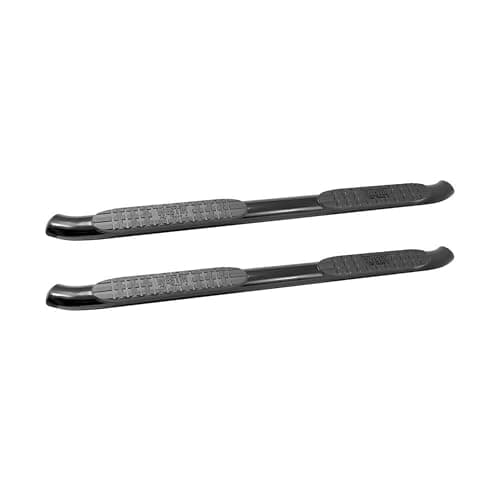
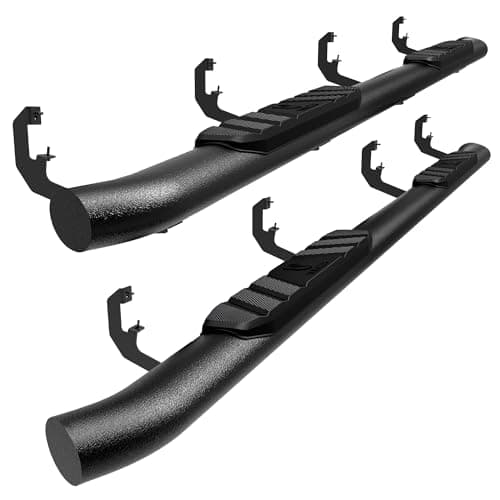
Four-inch oval tube nerf bars from a brand that has been making them for decades. Nothing to fail, a step pad you can hit with a boot, and hardware that does not seize into the mount after three winters.
Protection
9.1
Weather seal
9.4
Install
9.4
Durability
9.5
Value
9.4
Why we picked it
+Nothing electrical to fail
+Step pads are replaceable wear items
+Westin mounting hardware resists seizing
Good to know. A fixed bar costs you clearance permanently and it is the first thing to catch on a rock or a curb. Know your access roads.
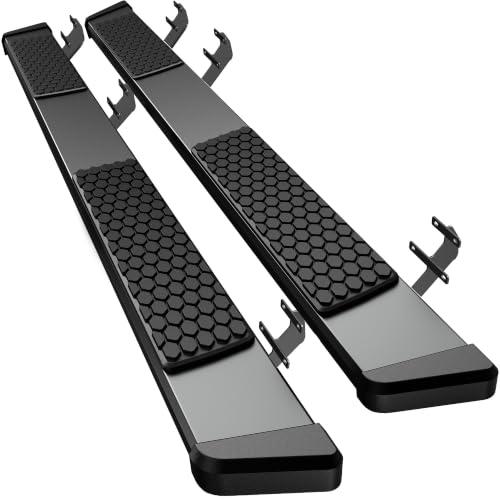
A 3.5 in flat-top board rather than a round bar, which is the right shape if you actually step on it with a work boot. Budget pricing, and the flat profile is the functional upgrade over a nerf bar.
Protection
9.0
Weather seal
8.9
Install
9.4
Durability
9.0
Value
9.6
Why we picked it
+Flat step surface, not a round tube
+Covers 1500 and HD trucks
+Half the price of brand-name boards
Good to know. Budget coating. In a salt climate expect the hardware to show rust before the board does.
Published specifications
Width
3.5 in
Fitment
Chevy Silverado / GMC Sierra 1500 2019-2026; 2500/3500 2020-2026
Six inches of step width on the F-150 SuperCrew. Width is what makes a board usable with a tool bag in each hand, and six inches is genuinely wide rather than nominally wide.
Protection
9.0
Weather seal
8.9
Install
9.4
Durability
9.0
Value
9.6
Why we picked it
+Six inches is genuinely wide underfoot
+Covers a long model-year range
+Inexpensive
Good to know. SuperCrew only. On a SuperCab the rear door geometry is different and these will look and work wrong.
A lifted or HD truck. The taller the sill, the more the step matters and the more a fixed board's own height works against it.
Anyone getting in and out dozens of times a day. A step placed where your foot wants it, at a height that is not a climb, is worth real money to a knee.
Tight sites and steep approaches. Nothing fixed under the rocker means nothing to catch on a curb, a ramp or a rock.
Where fixed boards win, which is most work trucks
Boots, gloves and both hands full. A wide flat board takes a work boot at any angle. It also takes a knee when you are reaching into the bed.
Salt, slush and a decade. No linkage means no linkage to seize. A board that looks tired at year eight is still a step.
Budget that has other jobs. The gap between a set of boards and a powered step buys a bed mat, a set of mud flaps and floor liners — all of which protect the truck's value. Contractor truck setup sets out that spending order.
Flat board or nerf bar?
If you land on fixed, there is a second decision. Oval nerf bars are tube with a step pad, usually cheaper and lighter, and they look right under a lifted truck. Flat boards — 5 to 6 inches wide — are the better step, and they also shield the rocker panel from stone chips thrown off the front wheel, which is a real benefit on a gravel site.
For a work truck we would take the flat board nearly every time, and the full ranking of both styles is on running boards and step bars. If rocker protection is why you are reading this, the other half of that job is mud flaps, which stop the debris before it reaches the panel at all.
The one-sentence answer
Unless the truck is lifted or your knees have already made the decision, buy wide fixed boards — they are the cheaper, tougher step, and on a work truck the thing you want from a step is that it never needs thinking about.
Questions people actually ask
Are power steps better than running boards?
Better at two things — ground clearance and step placement — and worse at two: cost and reliability. On a lifted or HD truck the powered step earns its money. On a working half-ton that lives on sites and in salt, fixed boards are the sounder buy because nothing on them can stop working.
Do power steps break?
They have a motor, a linkage and a controller mounted in the dirtiest part of the vehicle, so yes, eventually something needs attention — and when a step stops deploying it is a repair rather than an annoyance. Buy a brand with available parts, and expect salt to be the deciding factor on lifespan.
Do running boards reduce ground clearance?
At the rocker panel, yes — a fixed board hangs below the body and it is the first thing to meet a curb, a ramp edge or a rut. That is the single best argument for a retracting step on a truck that works off pavement.
Are wide running boards better than nerf bars?
As a step, yes. A 5 to 6 inch flat board takes a work boot at any angle and doubles as rocker protection against stone chips. Oval nerf bars are lighter, usually cheaper and suit a lifted truck's look. Both styles ranked.
Can you fit running boards yourself?
Fixed boards are generally a bolt-on job at factory mounting points with hand tools and an hour or two. Powered steps add a wiring harness — plug-and-play versions exist specifically to keep that simple, and they are worth looking for if you are fitting them yourself.
Last reviewed October 11, 2026. Think a figure here is wrong? Tell us at contact@toolboxandtruck.com and we will check it, fix it and date the correction — see our editorial policy.