Work truck gear, ranked for the people who load it every morning.
Guides
Are running boards worth it?
On a lifted crew cab with passengers who are not you, yes. On a truck that works in ruts, the clearance they cost is a real price — and nobody mentions it before you buy.
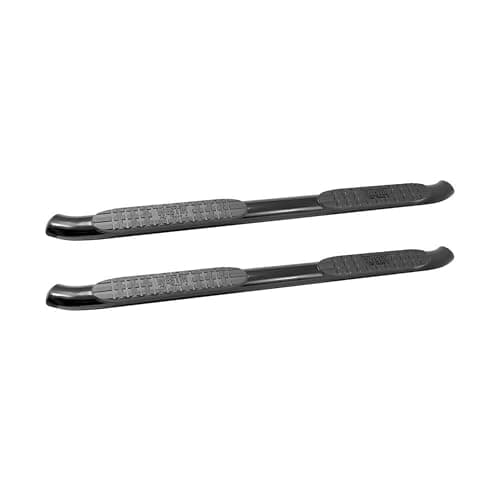
Featured here: the Westin PRO TRAXX 4 Oval Nerf Bars, Black, Pair.
Heads up: we earn an Amazon commission when you buy through our links, at no extra cost to you. Prices are pulled live from Amazon and were last checked November 13, 2026; when we cannot verify a price we say so rather than print an old one. How this site is funded.
How we know:Spec-verifiedOwner-report-verifiedWhat these mean
Top pick9.3/10★★★★★
Westin
Westin PRO TRAXX 4 Oval Nerf Bars, Black, Pair
Four-inch oval tube nerf bars from a brand that has been making them for decades.
Running boards are worth it if anybody other than you regularly gets into the truck, and especially if the truck is a crew cab, is lifted, or carries passengers who are short, older or wearing something they would rather not drag up a door sill. For a single driver who vaults into a stock-height truck ten times a day, they are the accessory most likely to be fitted and then resented, because the price they charge is paid in exactly the situations a work truck finds itself in.
That price is ground clearance at the rocker panel, and it is a real one. A 6 in wide board hangs below the rocker along the whole length of the cab, which is the part of the truck that meets ruts, curbs, snow banks and the edges of unmade sites. A fixed board is the first thing to touch when the truck leans into a rut, and the first thing to catch when you park against a curb at an angle.
Fit boards if the truck carries passengers, a lift or both. Fit nerf bars if it is mostly you and you want a step without a full-length board. Fit power steps if you want the step and the clearance, and you are willing to pay several times the price and accept a motor in the mix. Fit nothing if the truck works in ruts and the only occupant is you.
If the power-step option is the one you are circling, AMP Research PowerStep review is the page that argues both sides of it properly, including what living with a motor underneath actually involves.
Who they are worth it for
The six situations buyers arrive with, and the honest answer for each.
Your truck
Worth it?
Why
Crew cab, passengers daily
Yes
Rear-door access is the whole case, and it is a strong one
Lifted truck
Yes
The step height has gone past what most people can manage
Stock height, driver only
Marginal
You are buying a step you do not need and clearance you do
Works in ruts and on unmade ground
No, or nerf bars
Full-length boards are the first thing to strike
Snow country
Boards with grip, maintained
They collect ice and become the slipperiest part of the truck
Regular cab, one door each side
Nerf bars
A board along a short cab is mostly for looks
What they cost you
Four costs, in the order that owners actually notice them.
Ground clearance at the rocker. A board hangs below the rocker for the length of the cab. On a working truck that is the dimension that meets the world.
Winter maintenance. Boards collect packed snow and then ice. An iced board is a slip hazard in exactly the moment you are stepping onto it, which is why grip surface matters more than width.
A washing job you did not have. Mud, salt and grit collect on top of a board and against the rocker behind it. Left there, that is a corrosion site on the part of the body that rots first.
Payload, modestly. A pair of steel boards and brackets is a real weight, though it is small next to a rack or a drawer system. How much weight can a truck bed hold sets out the budget.
Boards, bars or power steps
Three products are sold against this problem and they are genuinely different, which is why a straight yes or no to worth it is the wrong shape of answer.
Running boards are a flat surface along the cab. Best step, worst clearance, and the one to fit if passengers are the reason.
Nerf bars or oval tube bars are a round tube with a step pad. Less step area, noticeably better clearance, and they shed snow rather than collecting it. The Westin PRO TRAXX 4 is this type.
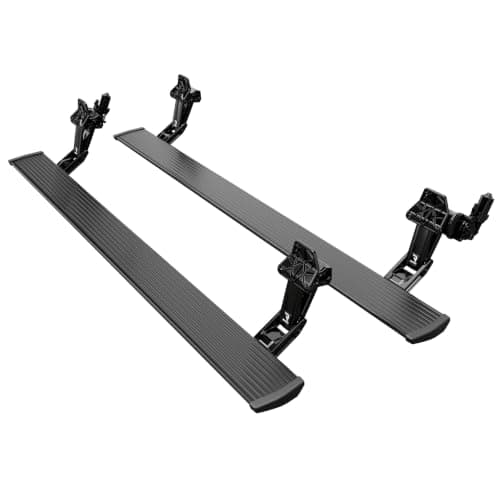
Power steps retract flush under the rocker when the door shuts, which means the step exists only when you need it. They cost several times a fixed board and they add a motor and a harness. The AMP Research PowerStep is this type.
Bed steps solve a different problem entirely — getting into the bed rather than the cab. Bed steps and tailgate ladders covers those.
A tube bar if clearance matters, a wide board if passengers matter, a budget board if price matters, and a power step if you want both. Live Amazon prices where available.
Four-inch oval tube nerf bars from a brand that has been making them for decades. Nothing to fail, a step pad you can hit with a boot, and hardware that does not seize into the mount after three winters.
Protection
9.1
Weather seal
9.4
Install
9.4
Durability
9.5
Value
9.4
Why we picked it
+Nothing electrical to fail
+Step pads are replaceable wear items
+Westin mounting hardware resists seizing
Good to know. A fixed bar costs you clearance permanently and it is the first thing to catch on a rock or a curb. Know your access roads.
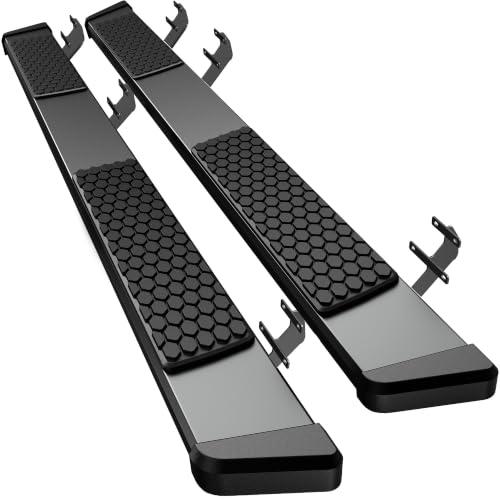
Six inches of step width on the F-150 SuperCrew. Width is what makes a board usable with a tool bag in each hand, and six inches is genuinely wide rather than nominally wide.
Protection
9.0
Weather seal
8.9
Install
9.4
Durability
9.0
Value
9.6
Why we picked it
+Six inches is genuinely wide underfoot
+Covers a long model-year range
+Inexpensive
Good to know. SuperCrew only. On a SuperCab the rear door geometry is different and these will look and work wrong.
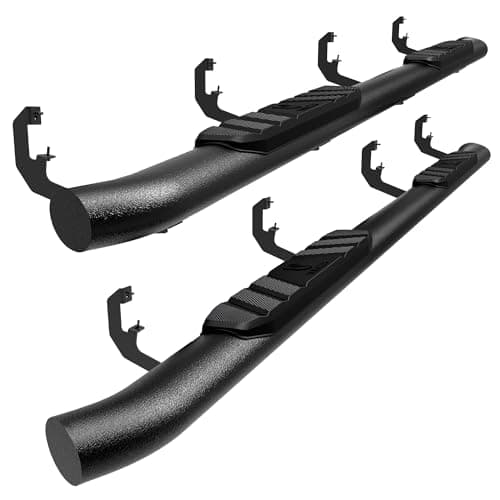
A 3.5 in flat-top board rather than a round bar, which is the right shape if you actually step on it with a work boot. Budget pricing, and the flat profile is the functional upgrade over a nerf bar.
Protection
9.0
Weather seal
8.9
Install
9.4
Durability
9.0
Value
9.6
Why we picked it
+Flat step surface, not a round tube
+Covers 1500 and HD trucks
+Half the price of brand-name boards
Good to know. Budget coating. In a salt climate expect the hardware to show rust before the board does.
Published specifications
Width
3.5 in
Fitment
Chevy Silverado / GMC Sierra 1500 2019-2026; 2500/3500 2020-2026
Electric retractable steps that deploy when a door opens and tuck away when it shuts. On a working truck the ground clearance matters — a fixed board is the thing that grounds out on a rutted site entrance.
Protection
8.9
Weather seal
9.0
Install
9.2
Durability
9.1
Value
8.7
Why we picked it
+No permanent clearance loss
+Plug-N-Play harness means no splicing
+LED lighting on the step itself
+Far easier entry than a fixed board at full extension
Good to know. It is a motor, a harness and a controller on the underside of a truck that lives in salt and mud. Fixed boards cannot fail; these can.
Chevrolet Silverado and GMC Sierra 1500, 2019-2021
✗ Does not fit
2022+ Silverado / Sierra — separate part number
Other trucks — fitment is model specific
Anyone who wants zero electronics underneath
What to check before you order
Cab style, exactly. SuperCrew, SuperCab, Crew Cab, Double Cab — the board length changes with every one and the brackets are cab-specific.
Factory bed steps or a corner step. Some trucks have them; some brackets interfere.
Whether the listing names your years. The Tyger boards here publish 2019-2026 for the Silverado 1500 and separate years for the HD trucks. Those splits are real.
Grip surface, not just width. A wide smooth board is worse in winter than a narrow textured one.
Bracket material and finish. Brackets are what rust on a running board installation, not the board.
The one argument against them nobody makes
A running board changes how you get out of the truck, and not entirely for the better. Stepping down onto a board and then down to the ground is two movements where there was one, and in mud it is a movement onto a surface with mud on it. Owners who vault out of a truck twenty times a day often find the board is in the way rather than helpful. That is a genuine reason to fit nerf bars instead, and it is not a reason you will read on a product listing.
Where we would start, in one sentence
Decide whether this is about passengers or about you; passengers means boards, you means nerf bars, and both means saving up for power steps.
Questions people actually ask
Are running boards worth it on a truck?
Worth it if the truck carries passengers, is lifted, or both — rear-door access on a crew cab is the strongest case for them. Marginal on a stock-height truck with one driver, and a poor idea on a truck that works in ruts, where the board is the first thing to strike.
Do running boards reduce ground clearance?
Yes, at the rocker panel, along the whole length of the cab. That is the dimension that meets ruts, curbs and snow banks on a working truck, and it is the main reason to consider nerf bars instead.
Are nerf bars better than running boards?
Better clearance, better in snow because they shed it rather than collecting it, and less step area. If the step is mainly for you, bars are usually the better buy. If it is for passengers in the back doors, a full board is worth the clearance.
Are power running boards worth the extra money?
They are the only option that gives you a full step and keeps the clearance, because they retract under the rocker when the door shuts. You pay several times a fixed board and you add a motor and a harness to the truck. The comparison.
Do running boards cause rust?
Not directly, but they create a place for mud, salt and grit to sit against the rocker panel — which is the part of a truck body that rots first. Washing on top of and behind the board in salt season is the whole mitigation.
Are running boards dangerous in winter?
They collect packed snow and then ice, and an iced board is slippery at exactly the moment you step onto it. Grip surface matters more than board width for this reason, and clearing them is part of owning them.
Last reviewed October 17, 2026. Think a figure here is wrong? Tell us at contact@toolboxandtruck.com and we will check it, fix it and date the correction — see our editorial policy.