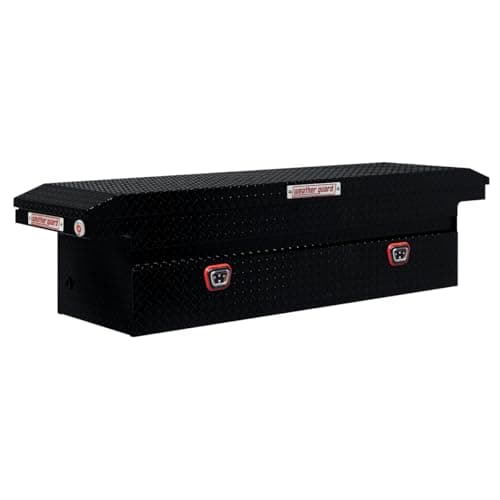
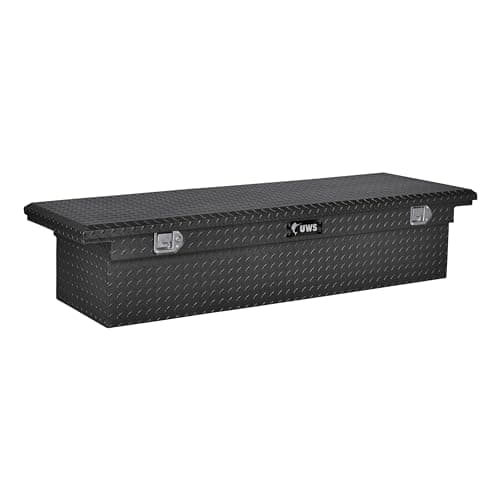
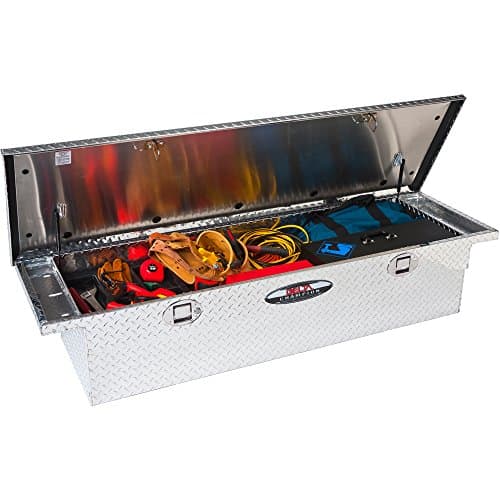
Featured here: the Weather Guard Weather Guard 121-5-04 Aluminum Saddle Box, Low Profile, 11.0 cu ft.
Heads up: we earn an Amazon commission when you buy through our links, at no extra cost to you. Prices are pulled live from Amazon and were last checked October 5, 2026; when we cannot verify a price we say so rather than print an old one. How this site is funded.
Weather Guard's aluminum saddle box in the low-profile configuration publishes 11.0 cubic feet of capacity and has been the default fleet choice for long enough that it is the reference point for the whole category. If somebody says a box is “built like a Weather Guard”, this is the box they mean.
Worth it if the truck earns its living or if you intend to keep it a decade. The premium buys parts availability and a lid that stays sealed, not extra volume.
What fleets actually buy it for
Not the metal, and not the looks. Fleet purchasing optimizes for one thing above all others: the cost of keeping the thing working for ten years with the same hardware.
Parts availability. Latches, lock cylinders, gas struts, seals. A fleet with forty of these boxes needs to be able to buy one latch in 2036, and Weather Guard's supply chain is the reason they can.
A lid that stays sealed. The failure mode that ends most tool boxes is a lid that stops meeting its own seal after years of being sat on. The construction here resists that.
Predictable fitment. Published dimensions and published fitment charts, so a purchasing department can order forty boxes for forty trucks without anyone measuring.
Resale value. A used Weather Guard box has a market. A used budget box does not.
This box and the two it competes with
Weather GuardSpec-verified
Weather Guard 121-5-04 Aluminum Saddle Box, Low Profile, 11.0 cu ft
11.0 cu ft of aluminum in the low-profile saddle format that fleets have standardized on for decades. It is the box every other box gets compared with, and the reason is parts availability and a lid that stays sealed.
Who should skip it. It is the most expensive way to store tools in a pickup bed short of a drawer system. If this is a personal truck that sees a job every other weekend, the money is better spent elsewhere.
Build
9.6
Weather seal
9.4
Security
8.8
Bed usability
8.2
Value
6.8
What works
+11.0 cu ft published — not an estimate
+Weather Guard latch and seal hardware is available decades out
Heavy-wall aluminum, a foam-filled RigidCore lid that does not flex when you sit on it, and a low profile that still clears most rear glass. This is the crossover to buy if you intend to keep the truck.
Who should skip it. Skip it on a 5'5" short bed. At 69 inches it will sit on the rails, but you lose a disproportionate share of a short bed and the money is better spent on a side-mount pair.
Build
9.4
Weather seal
8.8
Security
8.6
Bed usability
8.0
Value
7.4
What works
+Foam-filled lid does not oil-can under body weight
+Low profile clears rear glass on most full-size crew cabs
+Heavy-wall extrusion survives being used as a step
+Gas struts are serviceable rather than sealed units
What does not
−Among the most expensive aluminum crossovers on the shelf
−69 in is a full-size length — not a mid-size answer
JOBOX's Gear-Lock drives multiple lock points from one key turn, which is the single biggest difference between a box a thief opens with a screwdriver and one he walks away from. The rest of the box is honest fleet-grade aluminum.
Who should skip it. It costs premium money and spends it on the latch rather than the lid. If your box lives behind a locked gate every night, you are paying for security you do not need.
Build
9.0
Weather seal
8.6
Security
9.6
Bed usability
8.0
Value
7.0
What works
+Multi-point locking is genuinely harder to defeat than a single center latch
+Fleet-grade build with parts availability years out
+Low profile preserves rear visibility
What does not
−Expensive
−Heavier than a comparable thin-wall box — two people to lift it on
−Gear-Lock hardware is the part to keep lubricated through winter
It is the most expensive way to store tools in a pickup bed short of a drawer system, and three of the four reasons fleets buy it do not apply to one truck.
Parts availability in 2036 matters enormously to a fleet and somewhat less to someone who will have sold the truck by then.
Predictable fitment for forty trucks is irrelevant when you are measuring one.
Resale value is real but it is a fraction of the premium.
The sealed lid is the one that genuinely transfers. That is the reason a private buyer should consider it.
Which is why our general recommendation on the crossover roundup is a heavy-wall UWS for a private truck and the Weather Guard for a fleet one. Both have good lids; one of them also has a decade of parts behind it that you may not need.
Low profile versus full standard
Weather Guard sells this box in several profiles and the choice is worth understanding, because the capacity figures differ and so does your rear visibility.
Weather Guard saddle box profiles. Published capacities vary by model — check the specific part.
Profile
Published capacity
Trade
Low profile
11.0 cu ft
Best rear visibility; shallowest interior
Full standard
Higher
More volume; more of the rear window
Full extra wide
Higher still
Most volume; widest footprint on the rails
On a crew cab with a reversing camera, the deeper profiles are reasonable. Without a camera, the low profile is the one that keeps the truck pleasant to reverse, and 11.0 cubic feet is a lot of tool box.
Fitment
This is a full-size box. The exterior bed rail widths that suit it are the full-size figures — UWS publishes roughly 65 in for an F-150, 64 in for a Silverado 1500 and 66 in for a Ram 1500. A Tacoma at about 57 in is out of scope entirely.
Measure the exterior bed rail width. Outside to outside across the rail tops nearest the cab.
Check Weather Guard's fitment chart for your truck and year. The chart is the authority.
Confirm rear glass clearance. Hold a tape at the box's stated height above the rail line.
Plan the cover now if you want one. This is not a slimline box; it will not close under an ordinary cover.
Installation
It is a genuine two-person lift. Clamp kits will hold it on most full-size trucks without drilling, which is the route we would take — see installing a tool box without drilling.
The verdict in one paragraph
If you are running a trade truck that earns money and will still be working in eight years, buy it and stop thinking about tool boxes. If you are outfitting a personal truck that sees a job every other weekend, buy a heavy-wall UWS and spend the difference on floor liners, a cargo bar and straps — which together will change your week more than the better latch will.
Questions people actually ask
Are Weather Guard tool boxes worth the money?
For a fleet or a trade truck kept a decade, yes — the premium buys parts availability and a lid that stays sealed. For a personal truck sold within a few years, three of the four reasons fleets buy them do not apply, and a heavy-wall box from a cheaper brand plus the money saved is the better outcome.
How big is a Weather Guard saddle box?
The low-profile aluminum full-size box publishes 11.0 cubic feet. Weather Guard sells deeper and wider profiles with higher published capacities — check the specific part number, because the figure varies by model.
What is a saddle box?
It is Weather Guard's name for a crossover box: it sits across both bed rails behind the cab with the lid opening upward, straddling the bed like a saddle. Functionally the same format as any crossover box.
Low profile or full standard Weather Guard box?
Low profile if the truck has no reversing camera, because the deeper profiles take more of the rear window. Full standard if you have a camera and want the volume. Eleven cubic feet in the low profile is already a lot of tool box.
Will a Weather Guard box fit under a tonneau cover?
No — this is not a slimline box and it will not close under an ordinary cover. If you want both a box and a cover, you need a slimline cross-bed box or a cover specifically notched for a tool box. Clearances.
Last reviewed October 5, 2026. Think a figure here is wrong? Tell us at contact@toolboxandtruck.com and we will check it, fix it and date the correction — see our editorial policy.