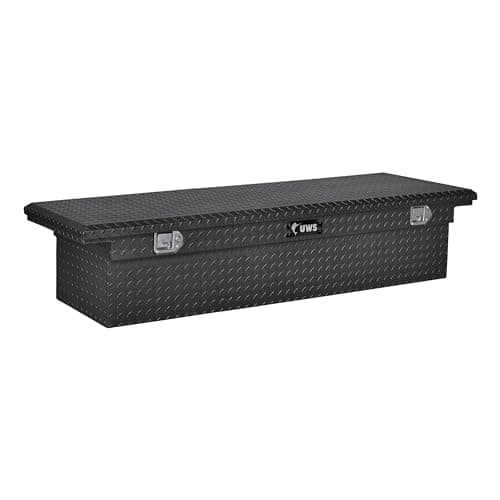
Our top pick: the UWS EC10473 69-inch Heavy-Wall Aluminum Crossover.
Heads up: we earn an Amazon commission when you buy through our links, at no extra cost to you. Prices are pulled live from Amazon and were last checked November 12, 2026; when we cannot verify a price we say so rather than print an old one. How this site is funded.
How we know:Spec-verifiedOwner-report-verifiedWhat these mean
Top pickBest value per dollar9.5/10★★★★★
UWS
UWS EC10473 69-inch Heavy-Wall Aluminum Crossover
Heavy-wall aluminum, a foam-filled RigidCore lid that does not flex when you sit on it, and a low profile that still clears most rear glass.
Tap any row for the full write-up. Prices come straight from Amazon and are never typed in by hand.
The best truck tool box for the money is the UWS EC10473 crossover: a 69-inch heavy-wall aluminum box whose lid is foam-filled rather than single-skin, at a price under the fleet brands. That one specification is where the value sits in this whole category — but “for the money” means something different at each tier, so below it we name the box we would buy at four other price points and exactly what the next dollar stops buying.
This is deliberately not the cheap-box page. If your budget is firm and low, budget tool boxes ranks the bottom shelf honestly, compromises and all. This page answers a different question: across the whole category, where does the value curve flatten? Because above a certain point you are buying brand, warranty and paint finish, and those are worth something — just not what the price gap implies.
Spend up to a foam-filled lid, a full-length hinge and a latch that pulls the lid down at more than one point. Those three things separate a box that lasts a truck's life from one that does not. Past them, the money goes into brand, warranty length and finish — real, but not what makes a box work.
What the next dollar buys, in order
Four features account for nearly all of the honest quality difference in this category. They are listed in the order we would buy them, which is also the order in which they stop mattering.
The latch. A multi-point or gear-driven latch pulls the lid down along its whole length and ties into a reinforced strike. A single center latch on a stamped plate lets the lid corners flex. This is the one feature that is simultaneously the security story and the dryness story.
The lid. Foam-filled lids do not flex, which means they keep meeting their gasket evenly and they survive being stood on. A single-skin lid that has been stood on once is a box that is damp inside afterwards — the UWS review sets out that mechanism in full.
The hinge. A full-length hinge in a corrosion-resistant material is the difference between a lid that still closes square in year eight and one that has worked loose at the ends. It is also the part nobody inspects before buying.
The metal. Heavy-wall aluminum over thin-wall, every time. It is the difference between a box that dents and a box that deforms out of square, and it costs you nothing in payload.
The picks, by tier
Prices come straight from Amazon when you load the page, so the tiers below are described in words rather than numbers — the ranking is by value, and the live price is on each card.
Heavy-wall aluminum, a foam-filled RigidCore lid that does not flex when you sit on it, and a low profile that still clears most rear glass. This is the crossover to buy if you intend to keep the truck.
Build
9.7
Weather seal
9.5
Security
9.4
Bed usability
9.2
Value
9.0
Why we picked it
+Foam-filled lid does not oil-can under body weight
+Low profile clears rear glass on most full-size crew cabs
+Heavy-wall extrusion survives being used as a step
+Gas struts are serviceable rather than sealed units
Good to know. Skip it on a 5'5" short bed. At 69 inches it will sit on the rails, but you lose a disproportionate share of a short bed and the money is better spent on a side-mount pair.
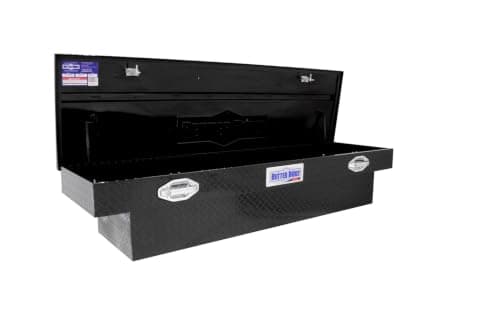
A 70 x 19 x 14 in gloss black aluminum single-lid box at a price the premium brands do not touch. You give up some lid rigidity; you keep most of the useful volume.
Build
9.2
Weather seal
9.2
Security
9.1
Bed usability
9.3
Value
9.6
Why we picked it
+Full 19 in of depth — a framing square lies flat
+Gloss finish wipes clean; dust does not show the way matte does
+Priced well below the premium aluminum boxes
Good to know. Not the one if you plan to stand on the lid daily — the panel is thinner than UWS's foam-filled RigidCore and will flex. Buy the UWS or a saddle box instead.
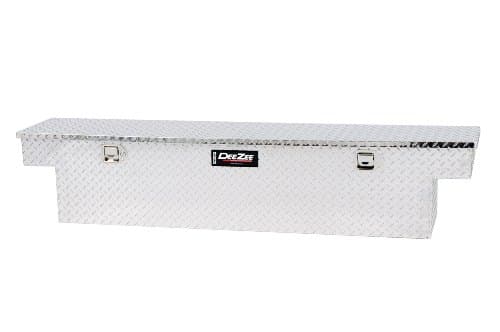
The narrow-body crossover. It eats noticeably less fore-aft bed length than a standard 19-20 in box, which is the whole point on a 5'5" or 5'7" bed where every inch in front of the wheel wells matters.
Build
9.1
Weather seal
9.0
Security
9.0
Bed usability
9.6
Value
9.5
Why we picked it
+Gives back several inches of bed floor versus a standard-width box
+Light enough for a one-person install
+Cheapest route into a real aluminum crossover
Good to know. If you carry long power tools in cases, the narrow body will fight you. A 19 in box swallows a circular saw case flat; this one does not.
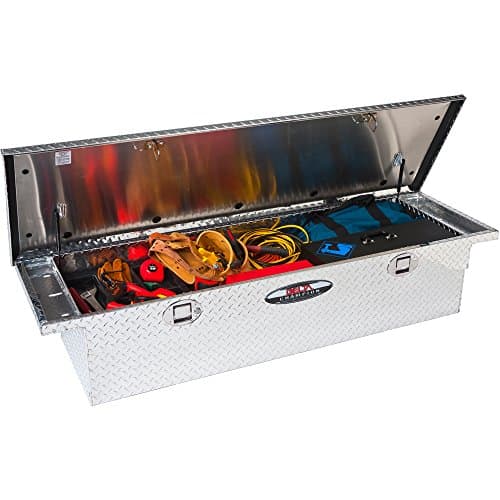
JOBOX's Gear-Lock drives multiple lock points from one key turn, which is the single biggest difference between a box a thief opens with a screwdriver and one he walks away from. The rest of the box is honest fleet-grade aluminum.
Build
9.5
Weather seal
9.4
Security
9.7
Bed usability
9.2
Value
8.9
Why we picked it
+Multi-point locking is genuinely harder to defeat than a single center latch
+Fleet-grade build with parts availability years out
+Low profile preserves rear visibility
Good to know. It costs premium money and spends it on the latch rather than the lid. If your box lives behind a locked gate every night, you are paying for security you do not need.
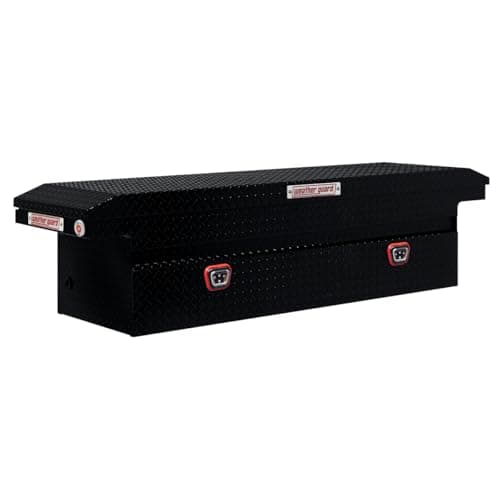
11.0 cu ft of aluminum in the low-profile saddle format that fleets have standardized on for decades. It is the box every other box gets compared with, and the reason is parts availability and a lid that stays sealed.
Build
9.7
Weather seal
9.7
Security
9.5
Bed usability
9.3
Value
8.8
Why we picked it
+11.0 cu ft published — not an estimate
+Weather Guard latch and seal hardware is available decades out
+Low profile keeps rear glass visible
+Resale value that no budget box holds
Good to know. It is the most expensive way to store tools in a pickup bed short of a drawer system. If this is a personal truck that sees a job every other weekend, the money is better spent elsewhere.
Full-size trucks with a standard exterior rail width
Fleet applications where parts matter
✗ Does not fit
Mid-size trucks
Anyone shopping on price
Tier by tier
Our tier picks. Published construction details come from each maker's listing, cited on the cards.
Tier
The box we would buy
What it has
What it still lacks
Value sweet spot
UWS EC10473, 69 in
Foam-filled lid, heavy-wall aluminum, low profile
A gear-driven multi-point lock
Full-size value
Better Built Crown Series, 70 x 19 x 14 in
Aluminum, full-size single lid, published dimensions
A foam-filled lid
Short-bed value
Dee Zee DZ6163N narrow crossover
Narrow body — gives back bed floor length
Volume, and a foam-filled lid
Security-first
Crescent JOBOX Gear-Lock
Gear-Lock multi-point latch, low profile
The lowest price in its size class
Fleet grade
Weather Guard 121-5-04, 11.0 cu ft
Published volume, fleet hardware, low profile
Nothing that matters — you are paying for it
The point of that table is the first row. Everything below it trades away a feature you would notice; the last row adds brand, warranty and finish. If you read one row, read the first — and if the box is going on a truck that parks outside overnight with tools in it, read the security-first row instead, because a gear-driven latch is the one upgrade that genuinely changes what the box resists.
Aluminum or steel for the money?
At every tier, aluminum unless you have a specific reason. Aluminum does not rust out from a chipped mount hole, it does not add meaningful weight to your payload, and it dents rather than cracks. Steel earns its place where impact resistance matters more than corrosion — underbody boxes, which take stone strikes, are steel for exactly that reason.
The full argument, including what happens to each metal at a dropped-load dent, is in aluminum versus steel tool boxes. The short version for a value shopper: a mid-priced aluminum box outlives a similarly priced steel one on a truck that sees salt.
The two costs that are not the box
A wrong-size return. Freight on a 70-inch box can approach what you paid for it, and fitment is the commonest reason a box goes back. Two measurements settle it: exterior bed rail width and clear floor length. Both are in the bed dimensions chart for all four trucks this site covers, and the method is in how to measure a truck bed.
The bed you lose. A standard crossover takes a slice of floor behind the cab permanently. On a 5'5" bed that is a real fraction of your cargo space, and it is why narrow-body and low-profile boxes exist. Crossover boxes ranks the shapes against each other.
When paying more is the right call
Three situations where we would ignore the value curve and buy up. A fleet of trucks that share keys and need identical replaceable hardware. A box carrying tools worth more than the truck's deductible, which makes the latch the whole product. And a truck you intend to keep for a decade, where serviceable hardware means the box is still working when the paint is not.
If security is the driver rather than longevity, read tool box security before you spend anything — there are cheaper interventions than a better box, and some of them work better.
Where we would start, in one sentence
Measure your bed, then buy the cheapest heavy-wall aluminum box with a foam-filled lid and a latch that pulls down at more than one point — that combination is the value floor in this category and the point where paying more stops changing your day.
Questions people actually ask
What is the best truck tool box for the money?
A heavy-wall aluminum crossover with a foam-filled lid — the UWS EC10473 is our pick, because it has both at a price under the fleet brands. The lid is the specification that decides whether a box is still dry in year five, and it is the one most boxes at this price skip.
How much should I spend on a truck tool box?
Enough to get a foam-filled lid, a full-length hinge and a latch that pulls down at more than one point. Below that you are buying a lockable bin with an expiry date; above it you are buying brand, warranty length and finish. The exception is security: a gear-driven multi-point latch is worth paying for if the truck sleeps outside loaded.
Is an expensive truck tool box worth it?
On a truck you are keeping for a decade, or one carrying tools worth more than your deductible, yes — serviceable hardware and a real latch are what you are buying. On a truck you will replace in three years, the mid-tier box does the same job and the difference buys tools.
Aluminum or steel for the best value?
Aluminum at nearly every price point, because it does not rust out from a chipped mount hole and it costs you less payload. Steel's case is impact resistance, which is why underbody boxes are steel. The full comparison.
What is the difference between a cheap box and a mid-range one?
The latch, the lid and the hinge. A cheap box has a single center latch on a stamped plate, a single-skin lid that flexes off its gasket, and a light-gauge piano hinge. A mid-range box fixes all three, which is why it is still square years later. The cheap shelf, ranked honestly.
Does a more expensive tool box mean better security?
Usually, but not because of the lock — because of what the lock is bolted to. A multi-point latch pulling into a reinforced strike resists a pry bar; a keyed cylinder on a thin plate does not, whatever it cost. What actually works.
Last reviewed October 11, 2026. Think a figure here is wrong? Tell us at contact@toolboxandtruck.com and we will check it, fix it and date the correction — see our editorial policy.