Work truck gear, ranked for the people who load it every morning.
Tool boxes
The best tool boxes for a flatbed truck
A flatbed has no bed sides to bolt to and no rails to straddle, so the whole bed-mount market is irrelevant. What is left hangs under the deck, and the decision is clearance, material and how you reach the back of the box.
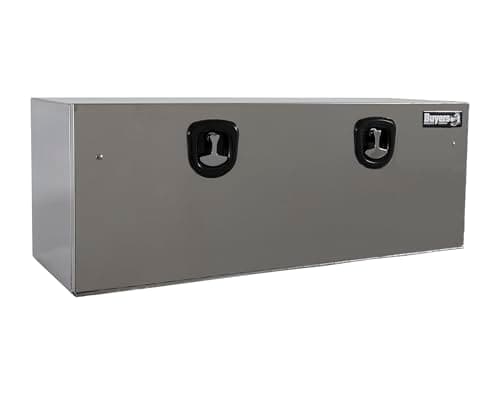
Our top pick: the Buyers Products 1702660 Stainless Underbody Box, 18 x 18 x 48 in.
Heads up: we earn an Amazon commission when you buy through our links, at no extra cost to you. Prices are pulled live from Amazon and were last checked November 13, 2026; when we cannot verify a price we say so rather than print an old one. How this site is funded.
How we know:Spec-verifiedOwner-report-verifiedWhat these mean
Top pickBest flatbed boxes9.5/10★★★★★
Buyers Products
Buyers Products 1702660 Stainless Underbody Box, 18 x 18 x 48 in
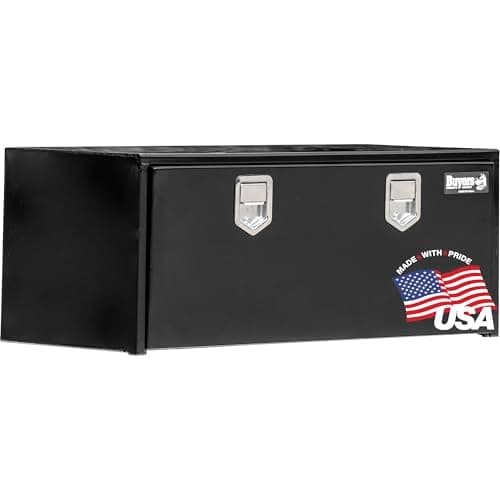
16 gauge polished stainless with a locking T-handle compression latch, and the only box here whose listing publishes both mounting orientations — underbed or flat mount.
Tap any row for the full write-up. Prices come straight from Amazon and are never typed in by hand.
If your truck has a flatbed, the box to buy first is a Buyers Products 1702660: 18 x 18 x 48 in of 16 gauge polished stainless with a locking T-handle compression latch, and the only listing in this group that publishes both mounting orientations — underbed or flat mount. If the truck does not live in salt, the painted-steel 1702110 is the same box in the cheaper material. And if you spend your day reaching into a deep box, the 1763142 with double barn doors is worth the money on its own.
This page exists because a flatbed changes the question. On a pickup, a tool box straddles the bed rails or bolts to the bed floor, and almost everything sold as a truck tool box assumes exactly that. A flatbed has neither: no rails to straddle, no sides to bolt through, and a deck you do not want to give up to a box. So the box goes underneath, hanging from the deck frame or the truck frame, in the space between the deck and the ground. That is a completely different set of constraints, and it is why a flatbed owner reading a crossover box roundup gets nothing useful from it.
Before you look at a single box, measure three things: the clear length of rail between your existing brackets, the vertical clearance from the underside of the deck to the point where you stop being willing to lose ground clearance, and the width you can hang without the box sitting outside the deck edge. Those three numbers eliminate most of the market before price ever comes up.
If you are on a standard pickup frame rail rather than a flatbed, the sibling page is underbody truck tool boxes — same mounting principle, different bracketing problem. If you want a box on the deck rather than under it, side mount boxes is the closer category.
The three measurements, in order
Clear rail length. Not the length of the truck. The distance between the brackets, fuel tank, exhaust, spare tire carrier and air system that are already using that rail. A 60 in box needs 60 inches of nothing else, and on a short-wheelbase truck that run does not exist.
Under-deck clearance. The vertical gap from the deck underside down. A 24 in tall box is a different proposition from an 18 in one, and the 24 in box on this page needs a genuinely high deck to avoid becoming a speed bump detector. Measure to the lowest point you are willing to accept, then subtract bracket depth.
Hang width. The box must not stand out past the deck edge, or it becomes the first thing that touches a loading dock. Most under-deck boxes here are 18 in deep; the barn-door box is 24 in.
Then the door swing, if you choose barn doors. Double doors need room to open outward. Behind a dual wheel or close to a fender, that room may not be there.
How we ranked these
Five boxes, five criteria, scored out of ten and published on every card. The weighting on a flatbed page is different from the pickup pages: install is harder and matters more, and corrosion resistance matters a great deal more, because an under-deck box lives permanently in the spray zone.
Build and material. Stainless, aluminum or painted steel, and the gauge where it is published. On a flatbed this is the longevity decision, not a finish preference.
Capacity against clearance. Volume is only useful if the box physically goes on. We score the balance, which is why a 24 in box does not automatically beat an 18 in one.
Access. Lift lid or barn doors. A deep box with a lid means lying on the ground; a box with doors means standing and looking in. This is the most underrated spec in the category.
Latch and seal. A compression latch pulls the lid onto the seal; a plain T-handle only holds it shut. Under a deck, in road spray, that difference shows up inside the box.
Value. Cost per usable cubic inch, weighted by whether the hardware is a counter part you can replace or a one-off you cannot.
The picks, ranked
Prices come from Amazon when you load this page. Where no live price is available the button says check price rather than showing a number we cannot stand behind.
No. 1Buyers ProductsSpec-verified
Buyers Products 1702660 Stainless Underbody Box, 18 x 18 x 48 in
16 gauge polished stainless with a locking T-handle compression latch, and the only box here whose listing publishes both mounting orientations — underbed or flat mount. On a flatbed in a salt state the material is the whole decision, because a painted steel box in the spray zone is on a clock.
Build
9.7
Capacity
9.5
Install
8.5
Day-to-day access
9.2
Value
9.0
Why we picked it
+Stainless body does not rely on a paint film for corrosion defense
+Compression latch pulls the lid onto the seal rather than just holding it shut
+Listing publishes flat-mount as well as underbed mounting
+Buyers latch and hinge parts are available off the shelf
Good to know. It is the most expensive box on this page and stainless is heavy. If the truck works in a dry climate, painted steel does the same job for a lot less money.
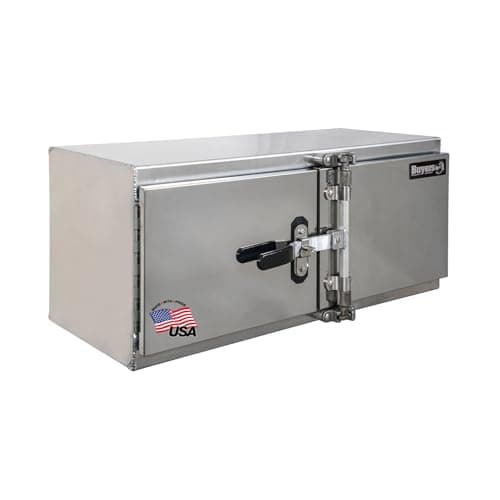
24 x 24 x 48 in of aluminum with stainless double barn doors on a cam lock rod, published for flatbed trailers and dump trucks. Barn doors are the reason to buy it: a lift-lid box this deep means lying on the ground to reach the back, and doors mean you just open them and look in.
Build
9.6
Capacity
9.7
Install
8.4
Day-to-day access
9.7
Value
8.9
Why we picked it
+Barn doors make the back of the box reachable standing up
+Aluminum body with stainless doors — no paint film to fail
+Cam lock rod pulls both doors tight along their length
+Published as made in USA with Buyers' own hardware
Good to know. It is the largest and most expensive box on this page, it needs 24 in of vertical clearance under the deck, and double doors give you two seals and two hinge sets to look after instead of one.
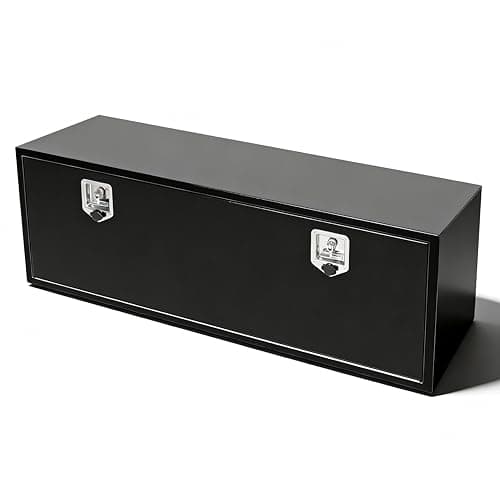
60 inches of black steel with a stainless T-latch and four keys, published for flatbed trailers and service trucks. It is a foot longer than the fleet-brand 48 in boxes and costs less than any of them, which on a long trailer rail is a straightforward trade.
Build
9.0
Capacity
9.7
Install
8.5
Day-to-day access
9.1
Value
9.6
Why we picked it
+60 in swallows shovels, bars and long levels whole
+Stainless latch on a budget box, which is unusual
+Four keys supplied rather than two
+Cheapest cost per inch of length here
Good to know. The brand is not Buyers or Weather Guard and the hardware is not going to be stocked at a truck equipment counter. Buy it knowing that the latch is the part you will eventually want to replace, and that you will be sourcing it yourself.
$319.9513% off · Price as of November 13, 2026. #ad
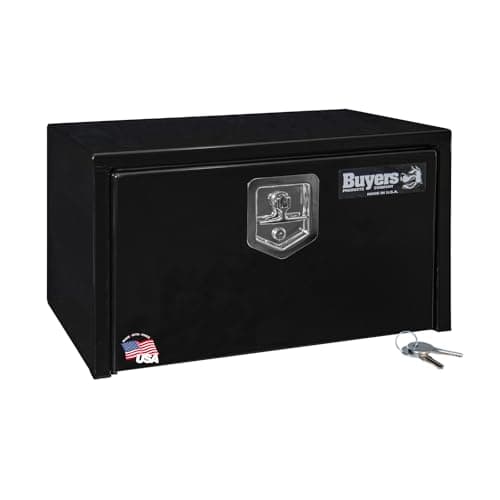
14 x 16 x 24 in — the one that fits where the bigger boxes do not. On a short-wheelbase truck or alongside an auxiliary tank this is often the only underbody box that will physically go on.
Build
9.5
Capacity
8.7
Install
8.9
Day-to-day access
9.2
Value
9.4
Why we picked it
+Fits tight frame-rail runs
+Full Buyers build quality in a small format
+Cheapest route into underbody storage
Good to know. It is small. If you have the rail length for a 36 or 48 in box, take it; the cost difference is not proportional to the volume difference.
Reproduced from each listing. Note that only one box here publishes a gauge figure, and only one publishes a compression latch rather than a plain T-handle.
Dimensions
Material
Access and latch
Buyers 1702660
18 x 18 x 48 in
16 ga polished stainless
Lift lid, locking T-handle compression latch
Buyers 1763142
24 x 24 x 48 in
Aluminum, stainless doors
Double barn doors, cam lock rod
Buyers 1702110
18 x 18 x 48 in
Steel
Lift lid, locking T-latch
Vigorighter 60 in
60 x 18 x 18 in
Black steel
Lift lid, stainless T-latch, 4 keys
Buyers 1703300
14 x 16 x 24 in
Steel
Lift lid, locking T-latch
The gauge column is the honest story of this category. Buyers publishes 16 gauge on the stainless box and nothing on the painted steel ones; the budget boxes publish no wall thickness at all. That is not a reason to avoid them, but it does mean that comparing two 48 in boxes by price alone compares two things you cannot actually see. Where thickness is unpublished, weight is the best available proxy — a heavier box of the same dimensions has more steel in it.
Barn doors against a lift lid
This is the decision most flatbed owners get wrong, because the lift lid is the default and nobody tells you what it costs. A box 24 inches deep with a lid on top is a box you reach into blind, from above, with your arm at full extension. In practice the back third becomes long-term storage and you keep the things you actually use near the front.
Both formats are correct. Which one is correct for you depends on how deep the box is and how often you open it.
Lift lid
Barn doors
Reaching the back
Blind, arm at full stretch
Open, step back, look in
Seals to maintain
One
Two, plus a center meeting edge
Room needed
Vertical, above the box
Horizontal, outside the doors
Price
The standard
A clear step up
Water intrusion risk
Lower — gravity helps
Higher — the meeting edge is the weak point
Rule of thumb: under about 18 inches deep, a lid is fine and simpler. At 24 inches deep, doors stop being a luxury. The Buyers 1763142 on this page is the 24 in box, and it is the one with the doors, which is not a coincidence.
Stainless, aluminum or painted steel
An under-deck box sits in the worst environment on the truck: constant road spray, grit, and in winter a salt solution that gets everywhere and dries nowhere. The material choice is a straight bet on how long the truck will be yours.
Painted steel. Cheapest, strongest against impact, and the paint film is the entire corrosion defense. One good stone chip in a wheel-spray position starts the clock. Touch it up the week it happens, not the season after.
Stainless. No paint film to fail, so a scratch is a scratch rather than the start of rust. Heavier and considerably more expensive. In a salt state this is the box that is still serviceable in year ten.
Aluminum. No rust and the lightest of the three, which matters when you are hanging 48 inches of box off a bracket. It dents where steel would scratch, and a dented lip is a lid that no longer seals.
Hanging an under-deck box is the hardest install on this site, and it is worth being honest about why. The box is heavy and empty. It has to end up square, level and tight, because a box that can move will eventually wear its own brackets. And the fasteners are carrying a load in shear, in a place that gets hit with water and grit every day.
Use the maker's bracket kit where one exists. Buyers sells mounting hardware designed around their boxes, and improvised angle iron is the commonest reason a box ends up crooked.
Check what is behind the hole before you drill. Brake lines, fuel lines and wiring harnesses all run along frame rails. On a flatbed there is also the deck structure itself, which you should not be putting holes through without knowing what carries the load.
Two people, or a jack. A 48 in steel box held at arm's length while you line up a bolt is how installs go wrong.
Then come back in a week and re-torque it. Everything settles.
What we would not buy for a flatbed
A crossover box. It needs bed rails to straddle. There are none. This is the single most common wasted purchase a new flatbed owner makes.
A 60 in box for a short-wheelbase truck. Measure the clear run first. The longest box here is excellent and completely useless on a crew cab with a short frame.
Painted steel in a salt state, if the truck is a keeper. The price difference against stainless looks large today and small in year six.
A deep box with a lift lid if you open it ten times a day. You will be lying on the ground, and you will stop using the back of it.
Where we would start, in one sentence
Measure the clear rail run and the under-deck clearance, then buy the stainless 1702660 if the truck sees salt and the painted 1702110 if it does not — and if the box is going to be deep, pay for doors.
Questions people actually ask
What kind of tool box fits a flatbed truck?
An under-deck box — also sold as an underbody or underbed box — that hangs from the deck or frame rail beneath the deck. Crossover and side-mount boxes both need pickup bed rails to mount to, so neither works on a flatbed without fabrication.
What size underbody tool box should I buy for a flatbed?
Whatever fits your clear rail run and under-deck clearance. The common sizes here are 18 x 18 x 48 in, 24 x 24 x 48 in and 60 x 18 x 18 in, plus a 14 x 16 x 24 in box for tight runs. Measure between your existing brackets, tank and exhaust before choosing.
Are stainless steel underbody tool boxes worth the extra money?
In a salt state, usually yes. A painted steel box relies entirely on its paint film, and an under-deck box takes constant stone and grit hits in the wheel spray. Stainless has no film to fail. In a dry climate the extra is much harder to justify.
Should I get barn doors or a lift lid?
Doors once the box is deep. On a box around 18 inches deep a lift lid is simpler and seals better. At 24 inches deep, a lid means reaching in blind at full stretch, and barn doors let you open the box and actually see what is in it.
Can you mount an underbody tool box on top of a flatbed deck?
Some are sold for it — the Buyers 1702660 listing publishes both underbed and flat mount as options. Most under-deck boxes do not publish a flat-mount option, and a box bolted to the deck is also a box using deck space you probably bought the flatbed to have.
How do you stop an underbody tool box from rusting?
Pick the material for the climate, then keep the paint intact — touch up stone chips the week they happen rather than the season after. Keep the latch and hinges lubricated, because road spray hits them first. Tools rusting inside a sound box is a condensation problem instead, covered in how to keep tools from rusting in a truck box.
Last reviewed October 29, 2026. Think a figure here is wrong? Tell us at contact@toolboxandtruck.com and we will check it, fix it and date the correction — see our editorial policy.