Work truck gear, ranked for the people who load it every morning.
Guides
How much does a truck tool box cost?
Three tiers, one of which is a trap. What separates a $200 box from a $700 one is not volume or looks — it is the lid, the gasket and the lock, in that order.
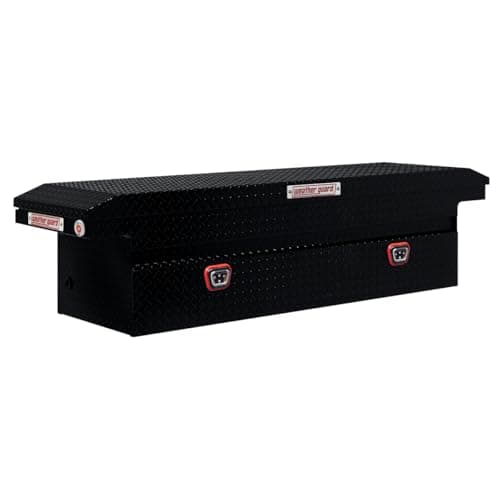
Our top pick: the Weather Guard 121-5-04 Aluminum Saddle Box, Low Profile, 11.0 cu ft.
Heads up: we earn an Amazon commission when you buy through our links, at no extra cost to you. Prices are pulled live from Amazon and were last checked November 12, 2026; when we cannot verify a price we say so rather than print an old one. How this site is funded.
How we know:Spec-verifiedOwner-report-verifiedWhat these mean
Top pickBest box per price tier9.6/10★★★★★
Weather Guard
Weather Guard 121-5-04 Aluminum Saddle Box, Low Profile, 11.0 cu ft
11.0 cu ft of aluminum in the low-profile saddle format that fleets have standardized on for decades.
Tap any row for the full write-up. Prices come straight from Amazon and are never typed in by hand.
A crossover truck tool box costs roughly $200 to $400 at the budget end, $400 to $700 for a box from a real manufacturer, and $700 upward for the heavy-wall aluminum and steel boxes built for daily commercial use. Every price on this page is read live from the Amazon catalog when you load it, so the numbers are current rather than remembered.
The more useful answer is where that money goes. It is not volume — a $250 box and a $750 box of the same length hold within a few percent of each other. It is the lid construction, the gasket, and the lock, and those three decide whether your tools are dry and still there in five years.
Spend in the middle tier if the box holds your working tools. The jump from budget to mid-tier buys a lid that does not flex and a gasket that still seals in year three; the jump from mid to commercial buys wall thickness and lock hardware that survives a pry bar attempt.
The three tiers, and what actually differs
Volume is roughly constant across the tiers. Construction is not.
Tier
Typical build
What the money buys
What is still missing
Budget
Thin stamped aluminum, single-skin lid
Lockable, weather-resistant storage that spans the bed
Lid stiffness, a gasket that lasts, a lock worth the name
Mid
Named manufacturer, stated gauge, bonded gasket
A lid that does not flex open at the corners, a real seal, published dimensions
Pry resistance, commercial-duty hinges
Commercial
Heavy-wall aluminum or steel, foam-cored lid, protected lock
Wall thickness, lock hardware, hinge and strut quality, warranty
Nothing — this is the tier the trades buy
One box per price step, ranked
Five boxes spanning budget to commercial, ranked on our published rubric with the live price on each. Check the length against your bed before buying — the fitment rules are on the measuring guide linked below.
No. 1Weather GuardSpec-verified
Weather Guard 121-5-04 Aluminum Saddle Box, Low Profile, 11.0 cu ft
11.0 cu ft of aluminum in the low-profile saddle format that fleets have standardized on for decades. It is the box every other box gets compared with, and the reason is parts availability and a lid that stays sealed.
Build
9.7
Weather seal
9.7
Security
9.5
Bed usability
9.3
Value
8.8
Why we picked it
+11.0 cu ft published — not an estimate
+Weather Guard latch and seal hardware is available decades out
+Low profile keeps rear glass visible
+Resale value that no budget box holds
Good to know. It is the most expensive way to store tools in a pickup bed short of a drawer system. If this is a personal truck that sees a job every other weekend, the money is better spent elsewhere.
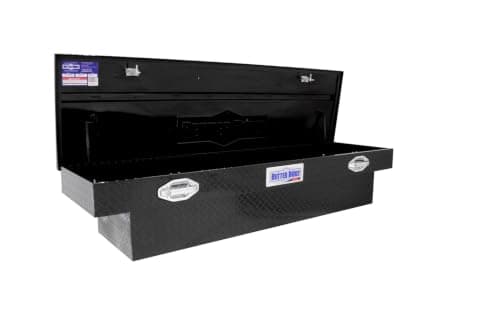
Heavy-wall aluminum, a foam-filled RigidCore lid that does not flex when you sit on it, and a low profile that still clears most rear glass. This is the crossover to buy if you intend to keep the truck.
Build
9.7
Weather seal
9.5
Security
9.4
Bed usability
9.2
Value
9.0
Why we picked it
+Foam-filled lid does not oil-can under body weight
+Low profile clears rear glass on most full-size crew cabs
+Heavy-wall extrusion survives being used as a step
+Gas struts are serviceable rather than sealed units
Good to know. Skip it on a 5'5" short bed. At 69 inches it will sit on the rails, but you lose a disproportionate share of a short bed and the money is better spent on a side-mount pair.
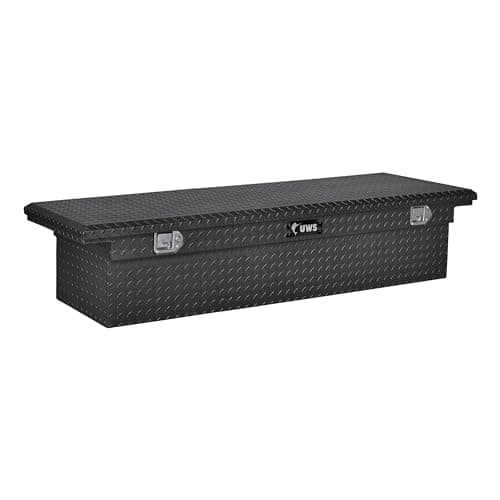
A 70 x 19 x 14 in gloss black aluminum single-lid box at a price the premium brands do not touch. You give up some lid rigidity; you keep most of the useful volume.
Build
9.2
Weather seal
9.2
Security
9.1
Bed usability
9.3
Value
9.6
Why we picked it
+Full 19 in of depth — a framing square lies flat
+Gloss finish wipes clean; dust does not show the way matte does
+Priced well below the premium aluminum boxes
Good to know. Not the one if you plan to stand on the lid daily — the panel is thinner than UWS's foam-filled RigidCore and will flex. Buy the UWS or a saddle box instead.
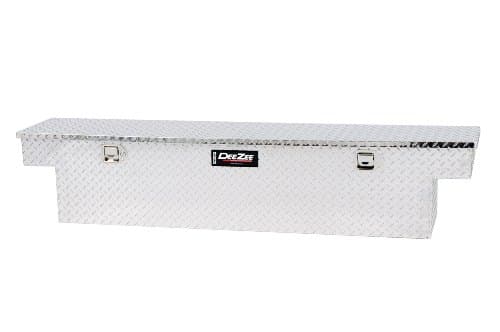
The narrow-body crossover. It eats noticeably less fore-aft bed length than a standard 19-20 in box, which is the whole point on a 5'5" or 5'7" bed where every inch in front of the wheel wells matters.
Build
9.1
Weather seal
9.0
Security
9.0
Bed usability
9.6
Value
9.5
Why we picked it
+Gives back several inches of bed floor versus a standard-width box
+Light enough for a one-person install
+Cheapest route into a real aluminum crossover
Good to know. If you carry long power tools in cases, the narrow body will fight you. A 19 in box swallows a circular saw case flat; this one does not.
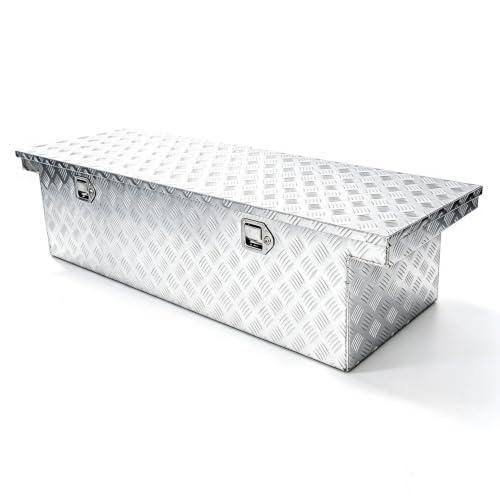
60 inches, which is the size class that matters: a mid-size truck's exterior rail width is around 57 in, and the 69 and 72 in boxes everyone else sells are built for the mid sixties. This one is not.
Build
8.8
Weather seal
8.8
Security
8.7
Bed usability
9.4
Value
9.5
Why we picked it
+60 in clears mid-size rails
+Light enough to fit single-handed
+Cheapest correct-length option
Good to know. Budget aluminum with a budget latch. It solves the fitment problem, not the security problem.
Tacoma, Colorado, Canyon, Ranger and Frontier — verify your exterior rail width first (a Tacoma is about 57 in)
✗ Does not fit
Full-size trucks (you are leaving volume on the table)
Secure storage of high-value tools
Where the price difference lives
The lid, first
A single-skin aluminum lid on a 69-inch box flexes in the middle when you lift one end, and that flex is what breaks the seal and lets water in at the corners. A foam-cored or ribbed lid does not. This is the single biggest construction difference between tiers, and it is visible in a photograph if you know to look at the lid's underside.
The gasket, second
Budget boxes use an adhesive foam strip that compresses permanently and stops sealing. Mid and commercial boxes use a bonded automotive-style gasket in a channel. Neither makes a box watertight — no truck box is — and the detail is on are truck tool boxes waterproof.
The lock, third
A cheap box has a cam lock in thin sheet metal, which gives up to a screwdriver in the seam. A commercial box protects the lock behind a steel plate or uses a paddle mechanism with a rotating bar. If the box holds tools overnight, this is the component worth the money — the full argument is on truck tool box security.
What makes a box cost more that should not
Finish upgrades. Tread plate, powder coat and polished finishes are cosmetic choices. They hide scratches; they do not add strength, and a maker that charges for finish while leaving the lid construction unpublished is selling you the wrong thing.
Length beyond your bed. A 72-inch box on a bed that needs 69 inches is money spent on a box that will not sit down on the rails.
Drawers you will not use. Drawers cost volume as well as money. Tool boxes with drawers is the place to decide whether they earn their keep.
Brand names on rebadged boxes. Three checks separate a manufacturer from a reseller: a stable model number, a named material, and all three dimensions published. They are set out on truck tool box brands.
What we would spend, by use
Tools you earn with, in the bed every day: commercial tier. The lid, the lock and the wall thickness are the three things that fail on everything cheaper, and all three fail in ways that cost you tools.
A box for recovery gear, straps and the things you would rather not carry in the cab: mid tier. It seals properly, it locks adequately, and nothing in it is worth a pry bar.
A second truck, a trailer, or a box that will be moved around: budget tier, with eyes open. Expect the gasket to be the first thing to go, and do not keep anything irreplaceable in it. The honest version of this tier is ranked on budget truck tool boxes.
Questions people actually ask
How much should I spend on a truck tool box?
If the box holds the tools you work with, the mid tier — roughly $400 to $700 — is the point where the lid stops flexing and the gasket stops failing. Below that you are buying lockable weather-resistant storage and should not keep anything irreplaceable in it. Above it you are buying wall thickness and lock hardware for daily commercial abuse.
Why are truck tool boxes so expensive?
Because the parts that cost money are the ones you cannot see: a foam-cored or ribbed lid that resists flex, a bonded gasket in a channel, protected lock hardware and heavy-wall material. Two boxes of the same length hold almost the same volume, so the price gap is construction, not capacity.
Are cheap truck tool boxes worth buying?
For recovery gear, straps and low-value items on a second truck or a trailer, yes. For tools you earn a living with, no — the gasket compresses out within a couple of seasons and a cam lock in thin sheet metal is a minute's work to defeat. Our cheap tool chest guide covers what the low price removes, in order.
Does a bigger tool box cost much more?
Length adds less to the price than construction does. Going from a 60-inch to a 69-inch box in the same range is usually a small step; going from a budget 69-inch box to a commercial one of the same length is often double. Buy the length your bed takes and spend the difference on build.
Do I need to pay for installation?
No. A crossover box sits on the bed rails and clamps to them with J-bolts, which is one person and twenty minutes on most trucks. Side-mount and underbody boxes need brackets and sometimes drilling, which is where a shop visit can make sense.
Last reviewed November 10, 2026. Think a figure here is wrong? Tell us at contact@toolboxandtruck.com and we will check it, fix it and date the correction — see our editorial policy.