Work truck gear, ranked for the people who load it every morning.
Guides
UWS vs Weather Guard
The two aluminum boxes a serious buyer ends up choosing between. One publishes its volume, the other publishes its lid. Here is what that difference actually means.
Featured here: the UWS EC10473 69-inch Heavy-Wall Aluminum Crossover.
Heads up: we earn an Amazon commission when you buy through our links, at no extra cost to you. Prices are pulled live from Amazon and were last checked November 12, 2026; when we cannot verify a price we say so rather than print an old one. How this site is funded.
How we know:Spec-verifiedOwner-report-verifiedWhat these mean
Top pick9.5/10★★★★★
UWS
UWS EC10473 69-inch Heavy-Wall Aluminum Crossover
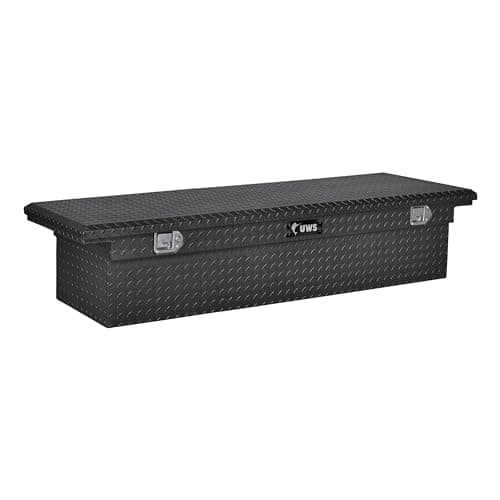
Heavy-wall aluminum, a foam-filled RigidCore lid that does not flex when you sit on it, and a low profile that still clears most rear glass.
Tap any row for the full write-up. Prices come straight from Amazon and are never typed in by hand.
Buy the UWS EC10473 if you want the most box for the money: 69 in of heavy-wall aluminum with a RigidCore foam-filled lid, which is the single best anti-drum, anti-bow lid design at this price. Buy the Weather Guard 121-5-04 if you want the fleet standard and a published volume figure — 11.0 cu ft, low profile, and the box that service managers specify without thinking about it. Both are aluminum crossover-class boxes from serious manufacturers, and either one will outlive the truck.
This comparison exists because these two brands occupy the same shelf and almost nobody explains the difference. They are not the same product at a different price. UWS sells construction: wall thickness and lid core. Weather Guard sells a specification: a known box, a known volume, a known replacement part, bought in quantity by people who do not want surprises. Which one is right depends on whether you are buying for yourself or for a fleet of six.
UWS for the owner-operator who wants maximum box per dollar and cares about the lid. Weather Guard for the business that wants the same box on every truck, with a published volume and a parts chain behind it. There is no wrong answer here, only a wrong reason.
What each maker publishes
Reproduced from each maker's own listing. Note that the two published size figures are not comparable — one is a length, one is a volume.
UWS EC10473
Weather Guard 121-5-04
Class
Crossover, single lid
Saddle box, single lid
Material
Heavy-wall aluminum
Aluminum
Profile
Low profile
Low profile
Published size
69 in long
11.0 cu ft
Lid
RigidCore foam-filled
Not published in detail
Finish
Matte black
Gloss black
Published capacity
Not published
Not published
Model
EC10473
121-5-04
That last point in the caption is the single most useful thing on this page. You cannot compare 69 in against 11.0 cu ft. A length tells you whether the box fits your rails; a volume tells you what goes in it. Each maker publishes the figure that flatters its own strength, and neither publishes the other, so the honest comparison has to be made on construction rather than on numbers.
The lid, which is the real difference
On a crossover box the lid is the component that fails, and it fails in two ways. It bows in the middle, after which the seal no longer meets all the way round and water gets in. Or it drums — resonates against the latch in the rain and at speed — which is an annoyance rather than a failure but an annoyance you hear every day.
UWS answers this directly. The RigidCore lid is foam-filled, which stiffens the panel against bowing and kills the drum. It is the headline feature and it is a real one.
Weather Guard answers it with the rest of the box. The construction is heavier throughout and the box is built to a fleet specification, so the lid is stiff because the whole box is.
Both beat a thin single-skin lid by a wide margin, which is the actual comparison most buyers should be making — against the cheap boxes, not against each other.
Live Amazon prices where available. The Better Built and JOBOX picks are here because the honest answer to this comparison is sometimes neither of the two in the title.
Heavy-wall aluminum, a foam-filled RigidCore lid that does not flex when you sit on it, and a low profile that still clears most rear glass. This is the crossover to buy if you intend to keep the truck.
Build
9.7
Weather seal
9.5
Security
9.4
Bed usability
9.2
Value
9.0
Why we picked it
+Foam-filled lid does not oil-can under body weight
+Low profile clears rear glass on most full-size crew cabs
+Heavy-wall extrusion survives being used as a step
+Gas struts are serviceable rather than sealed units
Good to know. Skip it on a 5'5" short bed. At 69 inches it will sit on the rails, but you lose a disproportionate share of a short bed and the money is better spent on a side-mount pair.
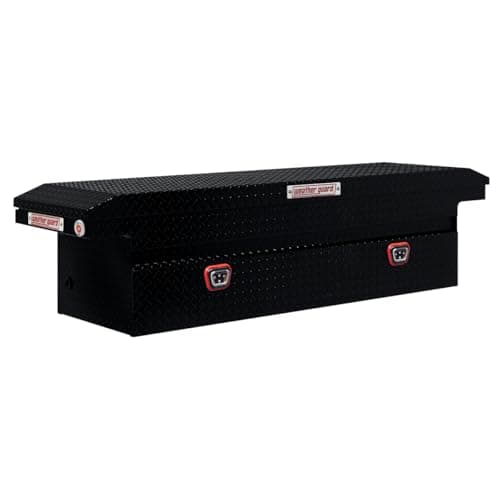
11.0 cu ft of aluminum in the low-profile saddle format that fleets have standardized on for decades. It is the box every other box gets compared with, and the reason is parts availability and a lid that stays sealed.
Build
9.7
Weather seal
9.7
Security
9.5
Bed usability
9.3
Value
8.8
Why we picked it
+11.0 cu ft published — not an estimate
+Weather Guard latch and seal hardware is available decades out
+Low profile keeps rear glass visible
+Resale value that no budget box holds
Good to know. It is the most expensive way to store tools in a pickup bed short of a drawer system. If this is a personal truck that sees a job every other weekend, the money is better spent elsewhere.
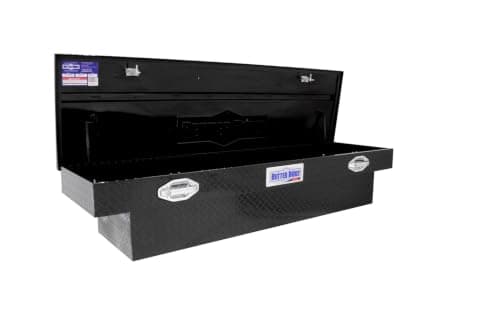
A 70 x 19 x 14 in gloss black aluminum single-lid box at a price the premium brands do not touch. You give up some lid rigidity; you keep most of the useful volume.
Build
9.2
Weather seal
9.2
Security
9.1
Bed usability
9.3
Value
9.6
Why we picked it
+Full 19 in of depth — a framing square lies flat
+Gloss finish wipes clean; dust does not show the way matte does
+Priced well below the premium aluminum boxes
Good to know. Not the one if you plan to stand on the lid daily — the panel is thinner than UWS's foam-filled RigidCore and will flex. Buy the UWS or a saddle box instead.
JOBOX's Gear-Lock drives multiple lock points from one key turn, which is the single biggest difference between a box a thief opens with a screwdriver and one he walks away from. The rest of the box is honest fleet-grade aluminum.
Build
9.5
Weather seal
9.4
Security
9.7
Bed usability
9.2
Value
8.9
Why we picked it
+Multi-point locking is genuinely harder to defeat than a single center latch
+Fleet-grade build with parts availability years out
+Low profile preserves rear visibility
Good to know. It costs premium money and spends it on the latch rather than the lid. If your box lives behind a locked gate every night, you are paying for security you do not need.
The five situations buyers actually arrive with, and the box that suits each.
Your situation
The answer
Why
One truck, your own money
UWS EC10473
Most box per dollar, and the best lid at the price
Several trucks, same spec
Weather Guard 121-5-04
Published volume, known part, repeatable purchase
Street-parked overnight
JOBOX Gear-Lock
Multi-point lock beats both on the pry-bar attack
Tightest budget that still lasts
Better Built Crown Series
70 x 19 x 14 in aluminum single lid for less
Mid-size truck
Neither
57 in of rail needs a 60 in box — see the Tacoma pages
That bottom row matters. Both boxes in this comparison are full-size parts. A Tacoma's exterior rail width is about 57 in against roughly 65 in on an F-150, so a 69 or 70 in box overhangs. Tacoma tool boxes has the mid-size options.
Price, and what it buys
Neither of these is a cheap box and that is the point of both of them. What the money buys, in order of how much difference it makes: the lid, the wall thickness, the latch, the finish. What it does not buy is a published load rating — nobody in this category publishes one, which is why neither box should be sold to you as a step.
If the price is the obstacle, the honest move is the Better Built Crown Series rather than a thin-wall box from an unknown brand. Best for the money ranks that tier properly.
If the budget is really tight, budget tool boxes is the page, and it says plainly what you give up.
If you need the lid lower still, low profile boxes is the page for that constraint.
Where we would start, in one sentence
Measure your exterior rail width, and then buy the UWS if this is your truck and your money, or the Weather Guard if it is the third truck in the business and you want the fourth one to have the same box.
Questions people actually ask
Is UWS or Weather Guard better?
UWS gives you more box per dollar and the better published lid design — a RigidCore foam-filled panel that resists bowing and drumming. Weather Guard gives you a published 11.0 cu ft volume, a fleet-standard specification and a parts chain. For one truck, UWS. For several trucks on the same spec, Weather Guard.
Why is Weather Guard so expensive?
It is priced as a fleet product rather than a consumer one: heavier construction throughout, a published volume figure, and a model number that service managers can reorder for years. Whether that is worth the premium depends on whether repeatability has value to you.
Is the UWS RigidCore lid worth it?
It addresses the two real crossover-lid failure modes — bowing, which breaks the seal, and drumming, which you hear every wet mile. Against a thin single-skin lid the difference is large. Against the Weather Guard box, which is stiff throughout, it is smaller.
What size UWS or Weather Guard box fits my truck?
Size to the exterior bed rail width, not the bed length. UWS publishes roughly 65 in on an F-150, 64 in on a Silverado 1500, 66 in on a Ram 1500 and 57 in on a Tacoma, which is why both boxes here are full-size only. The measuring method.
Can you stand on a UWS or Weather Guard tool box lid?
Neither maker publishes a load rating for the lid, so we will not tell you that you can. Both lids are stiff enough to take a knee or a tool bag. Treat standing on one as a way to find out what a lid costs to replace.
Last reviewed October 17, 2026. Think a figure here is wrong? Tell us at contact@toolboxandtruck.com and we will check it, fix it and date the correction — see our editorial policy.