Work truck gear, ranked for the people who load it every morning.
Tool boxes
The best small underbody tool boxes
Most underbody boxes are sold in 36 and 48 inch lengths, which is no use when the clear run on your frame rail is 26 inches. Six short boxes, ranked on what fits and what lasts down there.
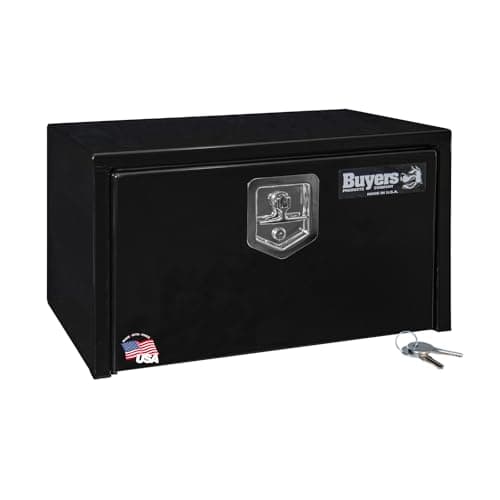
Our top pick: the Buyers Products 1703300 Steel Underbody Box, 14 x 16 x 24 in.
Heads up: we earn a commission when you buy through our links, at no extra cost to you — from Amazon Associates, and from brand partner programs we have joined directly through the Impact network. Amazon prices are pulled live and were last checked November 20, 2026; a brand list price carries the date we read it off the maker’s own page. When we cannot verify a price we say so rather than print an old one. How this site is funded.
Tap any row for the full write-up. Prices come straight from Amazon and are never typed in by hand.
If you have 24 inches of clear frame rail and need a box there, the one to buy is the Buyers Products 1703300: 14 x 16 x 24 in of steel with a locking T-latch, from the brand that supplies the fleet trade, and the only short box here whose maker publishes real documentation. If the truck lives where the roads get salted, the ARKSEN aluminum box at the same 24 inch length is the better material in the one mounting position where corrosion is genuinely the thing that kills a box. If the rail will take 30 inches, the VEVOR 30 x 17 x 18 in is the best volume per dollar on this page by a wide margin.
This page exists because the underbody category is sold in the wrong sizes for a lot of pickups. Walk the catalog and you find 36, 48 and 60 inch boxes, dimensioned for flatbeds and service bodies where the frame rail is clear from the cab to the rear axle. On a crew-cab pickup with a short bed, a spare tire winch, an exhaust hanger and often a DEF tank, the usable clear run between obstructions is frequently under 30 inches. The main underbody roundup is organized around the big boxes. This one is organized around the ones that go on.
Before you buy anything, get under the truck with a tape and find the longest uninterrupted run of frame rail, the vertical drop you have below it before the box hangs lower than the rocker, and the horizontal room before the box reaches the tire's swept path. Those three figures decide the purchase. Everything else on this page is secondary.
How to measure a frame-rail run
Four measurements, in this order. Do them with the truck on level ground and the tape held square, not angled along the rail.
Clear length. The longest run of rail with nothing bolted to it, nothing welded to it and no bracket in the way. Measure between obstructions rather than from the cab, and subtract an inch at each end for the mounting brackets. A 26 inch clear run is a 24 inch box, not a 30.
Vertical drop. From the underside of the rail down to the lowest point you are prepared for the box to reach. A box hanging below the rocker panel line is a box that will find a curb, a ramp or a rut. An 18 in tall box needs that much drop plus bracket height.
Tire swept path. With the wheels turned to full lock, the front tire sweeps further inboard than most people expect, and a rear tire moves on its suspension travel. Leave real clearance here, not a quarter inch.
Door and lid swing. A lift lid needs vertical clearance above it to open. Under a low bed or a flat deck there often is not any, which is the whole argument for the barn-door box further down this page.
How we ranked these
Five criteria, scored 0-10 and published on every card. The weighting is different from the big-box page, because at this size volume stops being the point and fit becomes it.
Published dimensions. Every box here publishes a length, width and height, which is the minimum for a purchase decided by a tape measure. None of these makers publishes a steel gauge, a wall thickness or a watertight rating, and every card says so rather than carrying a figure we cannot source.
Material in the spray zone. An underbody box lives below the rocker line in everything the wheels throw. Aluminum does not rust at a scratch and steel does, and at this price point no maker is offering a coating that changes that. Three of the six here are aluminum.
Latch and security. A T-handle with a lock and keys is the standard, and all six have one. None of these is a box to leave a cordless kit in overnight on a street — that is what a lockable crossover box is for.
Access. How the box opens and whether you can reach the back of it on your knees in a yard. A 12 in deep box is all reachable; an 18 in deep box has a back third you will need to empty to get to.
Value. Against the live Amazon price, which updates when you load this page.
The picks, ranked
Prices come from Amazon when you load this page. Where no live price is available the button says check price rather than showing you a number we cannot stand behind.
No. 1Buyers ProductsSpec-verified
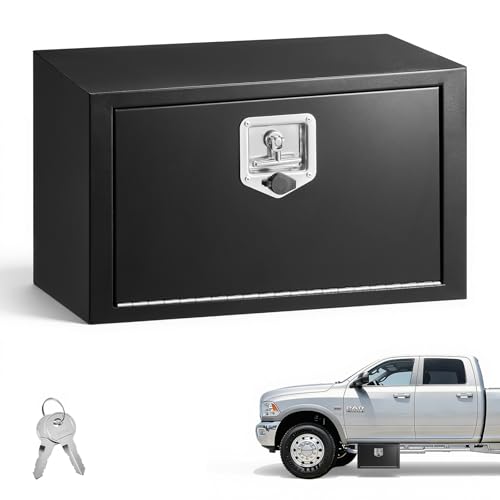
Buyers Products 1703300 Steel Underbody Box, 14 x 16 x 24 in
Best for: A small underbody box where clearance is tight
$319.9513% off · Price as of November 20, 2026. #ad
14 x 16 x 24 in — the one that fits where the bigger boxes do not. On a short-wheelbase truck or alongside an auxiliary tank this is often the only underbody box that will physically go on.
Build
9.5
Capacity
8.7
Install
8.9
Day-to-day access
9.2
Value
9.4
Why we picked it
+Fits tight frame-rail runs
+Full Buyers build quality in a small format
+Cheapest route into underbody storage
Good to know. It is small. If you have the rail length for a 36 or 48 in box, take it; the cost difference is not proportional to the volume difference.
$169.965% off · Price as of November 20, 2026. #ad
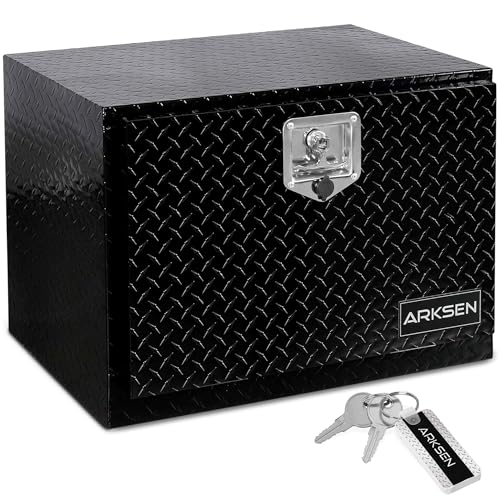
Diamond plate aluminum in a 24 in length, with a T-handle lock and keys. Aluminum is the material argument for an underbody box more than for any other mount on a truck: this is the box that lives in the road spray, below the rocker line, in whatever the wheels throw at it.
Build
9.3
Capacity
9.0
Install
9.0
Day-to-day access
9.2
Value
9.4
Why we picked it
+Aluminum in the one mounting position where corrosion is worst
+Lockable T-handle rather than a hasp
+Deep enough to stand a 5 gallon pail in
Good to know. At 17 in deep and 18 in tall it is a chunkier box than the 12 x 14 in options, so it needs more clear frame-rail depth than a tight crew-cab run may have. The listing publishes no wall thickness and no watertight rating.
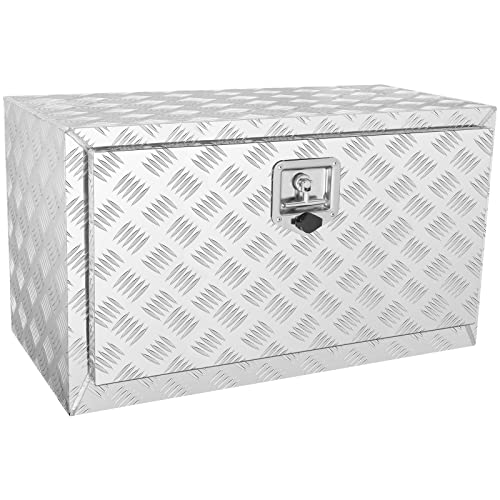
Six more inches of length than the 24 in boxes for a few dollars more, in the same diamond plate aluminum and with the same T-handle lock. If the frame rail will take 30 inches, this is the size to buy: it is the point where a box stops being a place for straps and starts being a place for tools.
Build
9.1
Capacity
9.4
Install
9.0
Day-to-day access
9.2
Value
9.6
Why we picked it
+Best volume per dollar of any box on this page
+Aluminum, so scratches do not start rust
+Takes long-handled hand tools a 24 in box will not
Good to know. Thirty inches is a real constraint on a short-wheelbase truck, and it is enough length to start interfering with a spare tire carrier or an exhaust hanger. Measure the rail run before ordering, not after.
$99.9015% off · Price as of November 20, 2026. #ad
The smallest box on this page and the cheapest, in powder-coated steel with a lock and two keys. Twenty-four by twelve by fourteen inches is the size that goes on where nothing else will — behind a rear wheel, ahead of a spare, alongside an auxiliary tank.
Build
8.8
Capacity
8.6
Install
9.4
Day-to-day access
9.0
Value
9.7
Why we picked it
+Lowest price of any underbody box we rate
+Small enough to fit rail runs nothing else will
+Steel takes a knock from a thrown stone better than thin aluminum
Good to know. Steel in the spray zone is the wrong material for a wet climate unless you are willing to touch up every chip. The volume is small enough that it is a strap-and-chain box rather than a tool box, and no gauge is published.
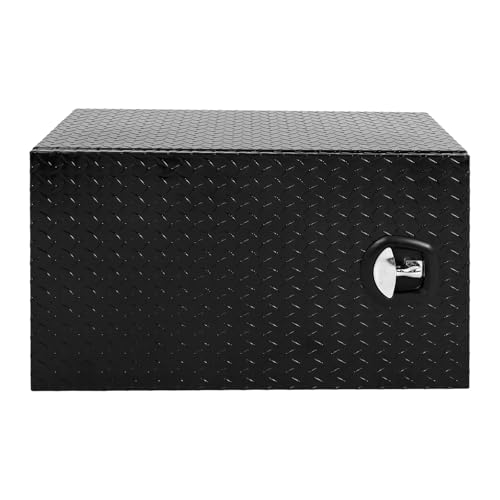
Barn doors instead of a lift lid, which is the reason to buy it: under a flat deck or a low bed there is often no vertical clearance to open a lid at all, and a door that swings outward works where a lid simply cannot. Thirty by eighteen by eighteen inches of diamond plate aluminum.
Build
9.2
Capacity
9.3
Install
8.9
Day-to-day access
9.5
Value
9.2
Why we picked it
+Opens where a lift lid has no clearance
+Aluminum, in the position where corrosion is worst
+Doors put the whole opening at hand height rather than overhead
Good to know. Barn doors are two hinge lines and two seal paths rather than one, so there is more to go wrong and more to keep clean. If you have the headroom for a lift lid, a lift lid is the simpler box.
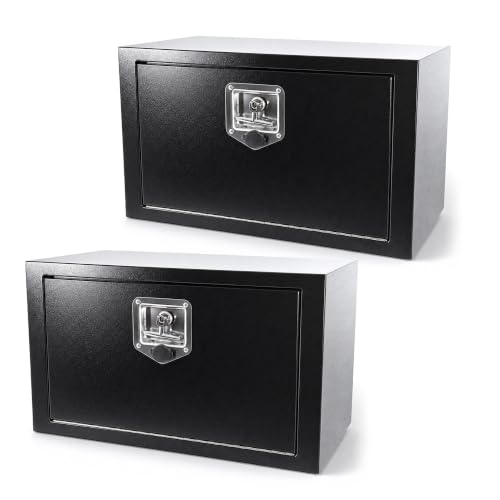
Two matching 24 x 12 x 14 in steel boxes in one order, with T-handle latches. Underbody storage is usually bought one side at a time and then regretted, because a second box six months later rarely matches the first — this is the cheaper and tidier way to do both rails.
Build
8.8
Capacity
9.0
Install
9.2
Day-to-day access
9.0
Value
9.5
Why we picked it
+Two matching boxes, so both rails end up the same
+Cheaper per box than buying twice
+Small footprint fits where larger boxes will not
Good to know. It is two of the small steel box, with the small steel box's limits doubled: no published gauge, a spray-zone material and a volume suited to straps and chains rather than tools. If you only have one clear rail run, buy one box.
Anyone needing one larger box instead of two small ones
What the makers actually publish
Published figures only. The Buyers box publishes its dimensions as height by width by length; the others publish length first. No maker here publishes a gauge, a wall thickness or a watertight rating.
Published dimensions
Material
Opening
Buyers 1703300
14 x 16 x 24 in
Steel
Lift lid, T-latch
ARKSEN 24 in
24 x 17 x 18 in
Diamond plate aluminum
Lift lid, T-handle
VEVOR 30 in
30 x 17 x 18 in
Diamond plate aluminum
Lift lid, T-handle
VEVOR 24 in steel
24 x 12 x 14 in
Steel
Lift lid, T-handle
COOLBAG 30 in
30 x 18 x 18 in
Aluminum
Barn doors
Vigorighter pair
24 x 12 x 14 in each
Steel
Lift lid, T-handle
The dimension ordering in that table is worth a second look, because it is a genuine source of wrong purchases. Buyers lists the 1703300 as 14 x 16 x 24 in, meaning 14 in tall, 16 in wide and 24 in long. The VEVOR and ARKSEN boxes list length first. Two boxes described as 24 x 17 x 18 and 18 x 17 x 24 are the same box, and a buyer comparing numbers in the order they are printed will conclude they are not.
Steel or aluminum, at this size
The material argument matters more under the bed than anywhere else on the truck. A crossover box sits above the rail in the open air; an underbody box sits in the wheel spray, which in a salt-belt winter is a brine bath for five months of the year.
Aluminum does not rust. It corrodes, slowly and cosmetically, and a scratch stays a scratch. Steel at this price point is powder-coated, and a powder coat that has been hit by a stone is a rust site that spreads under the coating from the inside. None of the steel boxes here publishes a gauge, so you cannot even compare thickness between them. Aluminum against steel for a truck tool box works through the full trade, including the one place steel genuinely wins — impact resistance, which under the bed is not academic.
That is why the ARKSEN aluminum box ranks second behind a steel box rather than first. The Buyers box earns its place on build and documentation, not on material, and in a dry climate it is the better box. In Michigan or Minnesota, buy the aluminum.
What "waterproof" means on these listings
All six boxes describe themselves as waterproof or weather-resistant and none of them publishes a rating to back it. In practice a lift lid with a foam gasket keeps out rain and road spray and does not keep out a pressure washer or a river crossing. Assume the contents will get damp eventually and do not store anything in there you would mind being damp. Are truck tool boxes waterproof? covers what the seals actually do, and keeping tools from rusting in a truck box covers the condensation problem, which is the one that does the damage.
What we would actually buy
On a crew-cab pickup with a 26 inch clear run and no salt: the Buyers Products 1703300. It is the most expensive box on this page per cubic inch and it is the one with a maker behind it, a published model number and a locking T-latch rather than a generic handle. For a truck that is a tool rather than a hobby, that is worth the premium.
On the same truck in a salt-belt state: the ARKSEN 24 x 17 x 18 in, for the aluminum. It is a deeper box than the Buyers, so check the vertical drop before ordering, and the extra depth is genuinely useful — a 5 gallon pail stands up in it.
If the rail will take 30 inches: the VEVOR 30 x 17 x 18 in. It is the best value on the page and the size where an underbody box changes from somewhere to keep straps into somewhere to keep tools. Six extra inches costs very little and buys a lot.
The budget pick is the VEVOR 24 x 12 x 14 in steel box, which is the cheapest underbody box we rate anywhere on this site. It is small, it is steel and it has no published gauge, and for a trailer, a second truck or a place to keep chains and a breaker bar out of the bed, those things do not matter much. If both rails are clear, the Vigorighter pair is the same box twice for less than buying it twice.
One case overrides all of the above: if there is no vertical clearance to open a lid, none of the five lift-lid boxes works at all, and the COOLBAG barn-door box is the answer. Under a flat deck or a low bed that is a common situation, and it is why a more expensive box with two seal paths still earns a place here. The best tool boxes for a flatbed truck covers the larger boxes built for the same problem.
Questions people actually ask
What is the smallest underbody tool box you can buy?
Around 24 inches long by 12 inches wide by 14 inches tall is the practical floor, and two boxes on this page are that size. Shorter than that and there is not enough span for two mounting brackets to carry the load sensibly. If 24 inches will not fit your clear rail run, an underbody box is probably the wrong answer and an in-bed box is the right one.
How much clear frame rail do I need for a 24 inch underbody box?
At least 26 inches of uninterrupted rail, because you lose roughly an inch at each end to the mounting brackets. Measure between obstructions rather than from the cab, and check the vertical drop below the rail and the tire's swept path at full lock before you order. Those three figures decide the purchase more than anything on the product page does.
Do underbody tool boxes come with mounting brackets?
Almost never, including every box on this page. The box is sold as a box, and the brackets that carry it from your particular frame rail are a separate purchase that none of these six listings names for a specific truck. Budget for brackets and hardware on top of the box price, and plan on a second pair of hands for anything over about 50 lb.
Should a small underbody box be steel or aluminum?
Aluminum if the truck sees salt, steel if it does not. An underbody box lives below the rocker line in everything the wheels throw up, which makes it the one position on the truck where corrosion rather than wear decides how long the box lasts. Aluminum does not rust at a scratch; powder-coated steel does, and it spreads under the coating. Steel's advantage is impact resistance, which under the bed is not academic either.
Are small underbody tool boxes secure?
They lock, and all six here have a T-handle with a lock and keys, but a locked thin-wall box under a truck is a deterrent rather than a defense. None of these is where a cordless kit should spend the night on a street. Use them for chains, straps, recovery gear and tools you would be annoyed rather than ruined to lose, and keep the expensive things in a heavier in-bed box.
Why would I choose a barn-door underbody box?
Because a lift lid needs vertical clearance above it to open, and under a flat deck or a low bed there often is not any. Barn doors swing outward instead, which works in that space. The trade is two hinge lines and two seal paths rather than one, and a higher price for the same volume, so only buy one if the clearance problem is real.
Last reviewed November 20, 2026. Think a figure here is wrong? Tell us at contact@toolboxandtruck.com and we will check it, fix it and date the correction — see our editorial policy.