Work truck gear, ranked for the people who load it every morning.
Guides
Break strength against working load limit
Every strap on the shelf advertises a four-figure number. It is almost never the figure that governs what you are allowed to carry, and the gap between the two is where people get hurt.
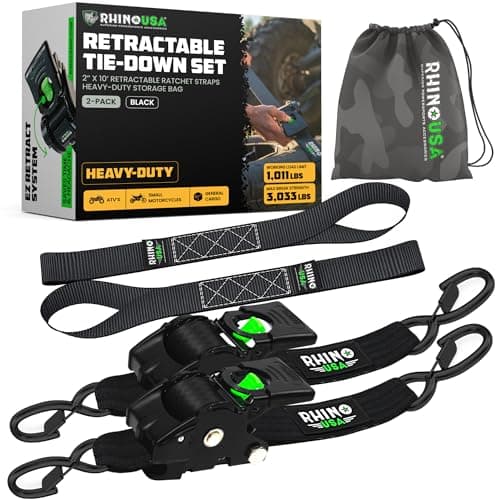
Featured here: the Rhino USA Retractable Ratchet Straps, 2 in x 10 ft, 3,033 lb, 2-pack.
Heads up: we earn an Amazon commission when you buy through our links, at no extra cost to you. Prices are pulled live from Amazon and were last checked November 13, 2026; when we cannot verify a price we say so rather than print an old one. How this site is funded.
How we know:Owner-report-verifiedSpec-verifiedWhat these mean
Top pick9.6/10★★★★★
Rhino USA
Rhino USA Retractable Ratchet Straps, 2 in x 10 ft, 3,033 lb, 2-pack
2 in webbing, 10 ft, published 3,033 lb break strength, and the strap retracts into the housing when you release it.
Pick up any ratchet strap in any store and the front of the package will carry one large number. On the straps in this site's registry that number runs from a few thousand pounds to five figures. It is the most prominent specification on the product and it is, for the purpose you are about to use the strap for, close to the least useful.
The reason is that there are three different numbers in play, they differ from each other by a factor of three or four, and the packaging frequently shows you the largest one.
Break strength is where the thing fails. Working load limit is what it is rated to carry. The assembly rating is the lowest of everything in the chain — strap, hook, ratchet and the anchor it is clipped to. That last number is the only one that describes your actual setup, and it is usually the smallest.
The three numbers
Break strength
Also sold as breaking strength, minimum breaking strength or ultimate strength. It is the load at which the component fails in a test. It is a destructive figure, it describes the end of the product's life, and it is not a working number — nothing should ever be loaded anywhere near it.
It is also the number most likely to be printed in the largest font, because it is the biggest one available. When a product page or a package states a four-figure or five-figure number without saying which basis it is on, assume break strength until the maker says otherwise.
Working load limit
The working load limit, or WLL, is the load the maker rates the component to carry in normal use. It is a fraction of break strength, and the size of that fraction varies by material and by manufacturer — which is precisely why you should read the marked figure rather than calculate one.
The federal rule is unambiguous about where the number comes from. Under 49 CFR 393.108(b), the working load limits of tiedowns may be determined using either the tiedown manufacturer's markings or the tables published in the section, and where a marking differs from the tables the marking controls. The tables exist for material that the maker has not marked — unmarked wire rope, for instance, is assigned one quarter of its nominal strength. The regulation is cited in full below.
The assembly rating
This is the one people skip, and it is the one that governs. 49 CFR 393.108(a) states that the working load limit of a tiedown, connector or attachment mechanism is the lowest working load limit of any of its components — including the tensioner — or the working load limit of the anchor point, whichever is less.
Read that twice, because it is the whole page in one sentence. A strap rated well is only worth what its hook is worth. A hook rated well is only worth what the ratchet is worth. And the entire assembly is only worth what the thing you clipped it to is worth, which on a pickup is a stake pocket, a factory cleat or a bolt-on D-ring that may have no published rating at all.
Why the chain matters more than the strap
The practical failure mode on a pickup almost never involves a strap parting in the middle. Webbing in good condition is strong. What fails is one of the three things at the ends.
The anchor. A factory bed cleat and an aftermarket bolt-on D-ring are not the same component. One has an engineered mounting into the bed structure; the other is as strong as the sheet metal it is bolted through and the hardware used. If the anchor is the weakest link, the assembly is rated at the anchor.
The hook. A hook can open up under load before the webbing is anywhere near its limit, particularly if it is loaded at an angle rather than along its spine.
The ratchet. The tensioner is a mechanism with pawls and a spool, and it is a component with its own rating like everything else in the chain.
This is why the useful question is never how strong is this strap. It is: what is the lowest rated thing between my cargo and my truck, and do I know what that number is?
Reading the products on this site
Three tie-down products from the registry are below, and together they make the point better than any worked example could.
The Rhino USA retractable straps publish a break strength explicitly, which is the honest way to label it — the figure is stated on the listing as break strength rather than presented as a capacity.
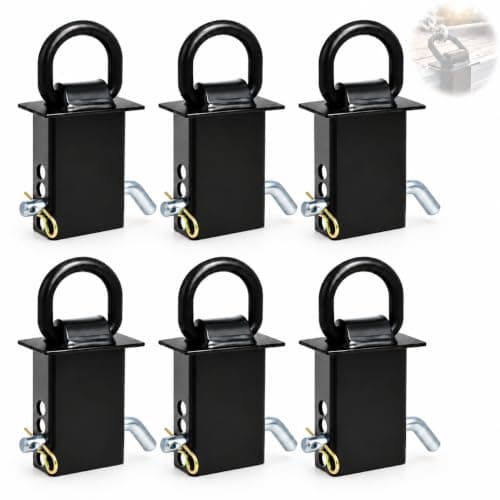
The removable stake pocket D-ring publishes a single large rating figure without stating which basis it is on, which is the ambiguity this page exists to flag. A number that does not say whether it is break strength or working load limit cannot be used in the 393.108(a) calculation at all.
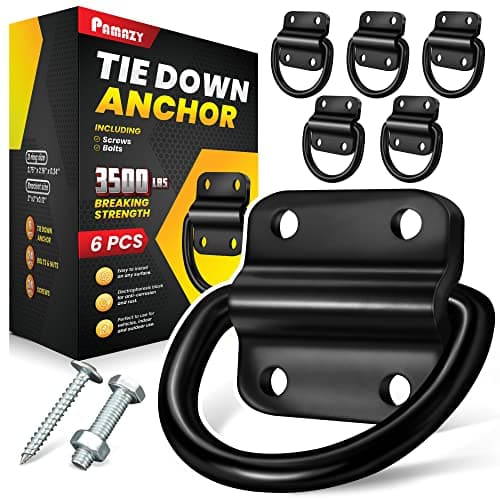
The PAMAZY bolt-on D-rings publish a per-anchor rating and a quantity, which is the shape of specification you want on an anchor — because under the federal rule the anchor's figure can cap the entire assembly.
The tie-down hardware on this site
Prices come live from Amazon when you load the page. The published figures on each card are the makers' own.
Rhino USAOwner-report-verified
Rhino USA Retractable Ratchet Straps, 2 in x 10 ft, 3,033 lb, 2-pack
2 in webbing, 10 ft, published 3,033 lb break strength, and the strap retracts into the housing when you release it. The retraction is the feature: loose webbing in a bed is how straps get lost, frayed and run over.
Build
9.5
Capacity
9.5
Install
9.8
Day-to-day access
9.7
Value
9.2
Why we picked it
+Published break strength rather than a vague claim
+Retraction keeps the tail out of the dirt
+2 in webbing is the right width for real loads
Good to know. Retractable housings are bulkier than a plain strap and the mechanism is another thing to fail. For strapping down a load once a year, plain ratchet straps are fine.
Drops into the factory stake pocket, published at 16,200 lb, and lifts straight out when you are done. No drilling, no sealed holes, and a rating that is in a completely different league from a bolt-on ring.
Build
9.4
Capacity
9.7
Install
9.7
Day-to-day access
9.5
Value
9.5
Why we picked it
+No drilling at all
+Very high published rating
+Removable, so the pocket is free again when you need it
Good to know. Your truck has to have usable stake pockets. Many newer trucks have them covered by bed rail caps, and some have none at all.
Six 3,500 lb steel D-rings. Most beds give you four factory points in the corners and nothing useful in the middle; these bolt in where you actually need them, which is usually mid-bed.
Build
9.2
Capacity
9.3
Install
8.9
Day-to-day access
9.5
Value
9.7
Why we picked it
+Six points for less than the cost of one strap
+Lets you anchor mid-bed where factory points do not exist
+Steel, so no plastic to crack in cold
Good to know. They are only as strong as what they bolt to. A D-ring rated to 3,500 lb through thin sheet metal is not a 3,500 lb anchor — back it up with a plate.
Mounting into unsupported thin sheet without a backing plate
Five rules that follow from all of this
Use the marked working load limit, not the headline number. If the only figure on the product is break strength, the product has not told you its rating.
Rate the assembly at its weakest component, including the anchor. This is the federal rule and it is also just true.
Treat an unstated basis as unusable. A number with no label is marketing, not a specification.
Count the anchor as part of the system. The best strap on the market clipped to a self-tapping screw in sheet metal is rated at the screw.
Inspect the webbing, not just the numbers. Cuts, abrasion, UV chalking and heat glazing all reduce a strap below its marked figure, and none of that shows up in a specification.
What this does not tell you
Two limits worth being explicit about. First, none of this says anything about how much your truck can carry — that is payload, it is set by the manufacturer, and it is a completely separate constraint covered on how much weight can a truck bed hold. You can be well inside every strap rating and still be over the truck's rating.
Second, securement is about restraining a load, not about bracing a settled one. A cargo bar stops things migrating around an empty-ish bed and is excellent at that; it is not a tiedown and no rating on this page applies to it.
Questions people actually ask
What is the difference between break strength and working load limit?
Break strength is the load at which the component fails in a destructive test. Working load limit is what the maker rates it to carry in normal use, and it is a fraction of break strength — the size of that fraction varies by material and by manufacturer, which is why you read the marked figure rather than calculate one. The big number on the packaging is usually break strength.
How do I find the working load limit of my tiedown?
Read the manufacturer's marking. Under 49 CFR 393.108(b) the working load limit may be determined from the maker's markings or from the tables published in that section, and where they differ the marking controls. The tables cover material the maker has not marked — unmarked wire rope, for example, is assigned one quarter of its nominal strength.
Does the anchor point affect the rating of a strap?
Yes, and this is the part most people miss. 49 CFR 393.108(a) sets the working load limit of a tiedown as the lowest working load limit of any of its components, including the tensioner, or the working load limit of the anchor point, whichever is less. A strong strap clipped to a weak anchor is rated at the anchor.
Is a cargo bar a tiedown?
No. A cargo bar braces across the bed and keeps a settled load from sliding; it is not rated as a tiedown and none of the bars on this site publishes a load rating at all. If the load genuinely has to be restrained, it needs straps and rated anchor points. Cargo bars covers what a bar is good for.
Do these rules apply to me if I am not a commercial driver?
49 CFR part 393 subpart I governs commercial motor vehicles, so whether it legally applies depends on how the truck is used. The physics does not change with the plate, and the regulation is the clearest published description of how these numbers relate — which is why this page uses it as the reference rather than inventing its own framework.
Last reviewed November 6, 2026. Think a figure here is wrong? Tell us at contact@toolboxandtruck.com and we will check it, fix it and date the correction — see our editorial policy.